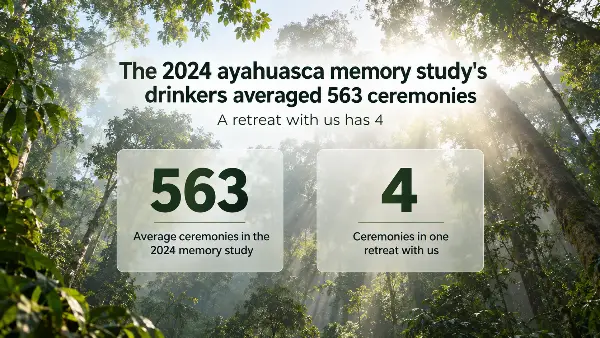
Ask “does ayahuasca improve memory” and you’ll find headlines that say it might. Most trace back to 1 study of 24 church members who had averaged 563 ceremonies, tested on objects in drawings they’d seen minutes earlier. A 2013 study found ayahuasca made working memory worse while it was active. I haven’t found a study that tested memory in a first-time drinker.
Since 2017, our maloca on the Momón has hosted more than 650 ceremonies. Most guests come to us once, for 4 ceremonies over 10 days. That’s a long way from 563.
Does ayahuasca improve memory?
It depends on which memory you mean, and on who’s drinking.
Ayahuasca’s effect on memory depends on the kind of memory and the drinker. In a 2024 study, 24 Santo Daime members who averaged 563 ceremonies recognized more objects after drinking than when sober. Their false memories didn’t rise. In a 2013 study, ayahuasca raised working memory errors during the brew. Studies of long-term drinkers found no lasting decline.
The 2024 result surprised the people who ran it. They had predicted, in writing before they started, that ayahuasca would hurt memory and add false memories. Earlier lab studies had found other psychedelics made this kind of memory worse.
What the 2024 study measured, cup by cup
It measured how well experienced drinkers recognized objects from drawings they’d seen minutes earlier, while the brew was active. It didn’t test memory days or weeks later, personal memories or first-timers.
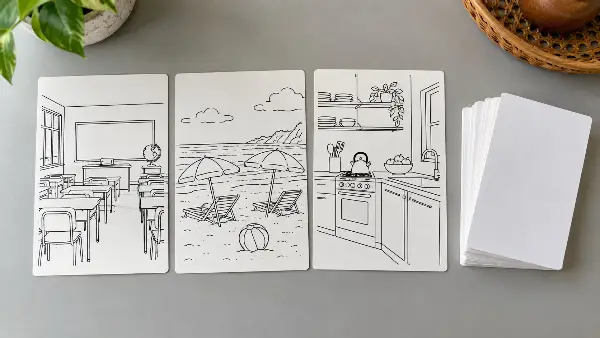
The study appeared in late 2024 in the Journal of Psychopharmacology. It tested 24 Santo Daime members twice: once sober, then again after drinking. Everyone did it in that order, and there was no placebo. Each time they looked at 3 black-and-white drawings of scenes, such as a classroom, a beach or a funeral, for 40 seconds each. Short descriptions of the scenes then slipped in objects that weren’t there. Minutes later, they said whether each object had been in a drawing, and how sure they were.
After drinking, they spotted more of the objects that had been in the drawings: about 72%, up from 66%. Their most confident answers got more accurate too. False memories didn’t move. The gain was in recollection, the kind of memory that brings back specific details. Familiarity, the vague sense you’ve seen something before, didn’t change. Because everyone took the sober test first, practice could account for some of the gain. The authors say that can’t be ruled out.
They started the test about 160 minutes after drinking. On the clock we publish, the brew peaks between 90 minutes and 2 hours, and it wears off after 4 to 6 hours. So they were tested after the peak, with the brew still working.
| The 2024 study tested | It didn’t test |
|---|---|
| 24 church members averaging 563 ceremonies | Anyone drinking for the first time |
| Objects from drawings, minutes later | Memory days or weeks later |
| Memory about 160 minutes after drinking | Childhood or personal memories |
| A sober session, then a brew session | A placebo, or the reverse order |
Their average cup was 24 ml, anywhere from 11 to 40 ml. It carried 3.36 mg of DMT and 170.64 mg of beta-carbolines, the alkaloids from the vine. On a first night, our lead healer typically pours 40 to 60 ml. That doesn’t make our cup twice as strong. Strength depends on the brew, and volume alone can’t compare 2 brews. We don’t send ours to a lab.
Does ayahuasca affect memory during the ceremony?
Yes. In a 2013 study that checked working memory during the brew, it got worse.
Working memory is the scratchpad you use to hold an instruction or a phone number for seconds at a time. A 2013 study in Psychopharmacology tested 24 drinkers, 11 long-term and 13 occasional. They took 3 thinking tests in their usual ceremony setting, before and after drinking. Working memory errors went up for the whole group. A planning task got harder only for the occasional drinkers. The more ayahuasca a person had drunk in their life, the smaller that drop.
So the brew can make it harder to hold a thought while it’s active, even in long-term drinkers. In the separate 2024 study, drinkers averaging 563 ceremonies recognized more objects. Those are 2 kinds of memory with 2 different results. We’ve asked the same during-or-after question about creative thinking.
Our facilitators give a short reminder of the house rules before every ceremony, and they keep moving through the room all night. You don’t need to remember much at midnight.
The 4 kinds of memory people mean, and what the research says
People asking about ayahuasca and memory usually mean 1 of 4 things. The evidence is different for each.
| What you’re asking | Example | Best human evidence | What it found | What we do |
|---|---|---|---|---|
| Can I hold a thought during ceremony? | Remembering an instruction | Psychopharmacology, 2013 | Worse while the brew is active | A short rules reminder before each ceremony; staff in the room all night |
| Will I remember the ceremony? | What you saw and heard | Journal of Psychopharmacology, 2024 (indirect) | Better recognition of objects from drawings, in experienced drinkers | Guided journaling prompts after each ceremony; an 11 AM circle |
| Will old memories come back? | A childhood scene | Scientific Reports, 2023 | Reliving painful past events is common; accuracy of new memories unknown | Integration circles led by a facilitator trained in clinical social work; at least 25 vetted therapists in guests’ home countries |
| Will it harm my memory over the years? | Long-term brain health | 3 studies, 1996 to 2025 | No decline found | Planned: a thinking check at intake, Day 10 and 3 months |
5 human studies that tested memory or thinking directly:
| Study | Who took part | Design | What happened |
|---|---|---|---|
| Journal of Nervous and Mental Disease, 1996 | 15 long-term members of a Brazilian ayahuasca church, 15 matched non-drinkers | Compared with non-drinkers | No sign of cognitive decline |
| PLoS ONE, 2012 | 127 regular drinkers, 115 non-drinkers | Tested twice, a year apart | Drinkers scored better on 3 tests, 1 of them working memory |
| Psychopharmacology, 2013 | 24 drinkers: 11 long-term, 13 occasional | Before and during the brew | Working memory errors up; planning down in occasional drinkers only |
| Journal of Psychopharmacology, 2024 | 24 Santo Daime members, average 563 ceremonies | Sober session first, then a brew session | Recognition up, about 66% to 72%; false memories unchanged |
| European Archives of Psychiatry and Clinical Neuroscience, 2025 | 48 people: 16 drinking 20+ years, 16 under 3 years, 16 non-drinkers | Compared 3 groups | Long-time drinkers beat beginners on 2 working memory tests; no decline |
All 5 studied people who’d drunk ayahuasca before, and 3 also tested non-drinkers for comparison. None studied someone drinking for the first time.
Will a first-timer get the same result?
No one knows, and I haven’t found a study that tested memory in first-time drinkers. The closest evidence says occasional drinkers fare worse on a planning task.
The 2024 authors write that their findings “cannot generalize to inexperienced populations.” In the 2013 study, the planning drop showed up only in the occasional drinkers.
Compare that with who drinks with us. 22% of our guests have come back for a second retreat, and our most frequent returning guest has done 6 retreats in 4 years. Our standard retreat has 4 ceremonies. Even that guest is nowhere near the 563 ceremonies the 2024 study’s drinkers averaged.
If it’s your first time, expect to hold thoughts less well during the ceremony, and write down what you want to keep.
The vine or the DMT: what the researchers think
They don’t know. The 2024 authors offer 2 explanations, and their own data adds a caution about the vine.
Their brew was heavy on the vine. By weight it carried about 51 times more beta-carboline than DMT. One explanation is that long-term drinkers may develop a “reverse tolerance,” so even a small dose of DMT works on them. The other is that the vine’s alkaloids drove the change by blocking an enzyme called MAO-A.
Then the complication. People with more harmine in their blood showed smaller gains in their most confident answers. The authors say higher doses of the vine’s alkaloids may help less, or even hurt memory. It’s 1 small study, so treat it as a hint.
Don’t take harmine or vine extracts as a memory supplement. The vine’s alkaloids block MAO-A, the same action behind the medication rules every guest must follow. And our microdosing post explains why a small, reliable dose of the brew can’t be measured out.
Does ayahuasca cause memory loss? The evidence in 2026
The studies so far haven’t found lasting memory loss from ayahuasca. In the 2013 study, working memory dipped while the brew was active.
Long-term drinkers in other studies tested the same as non-drinkers or better. In 2012, a team followed 127 regular drinkers and 115 non-drinkers for a year. The drinkers scored better on 3 tests, 1 of them a working memory task, and showed no impairment. A 2025 study of people who’d been drinking for more than 20 years found no decline. They scored on par with non-drinkers on most tests, and better than beginners on working memory. A 1996 study of 15 long-term church members found no cognitive decline either.
None of these can prove ayahuasca caused the better scores. People who stay in a church for 20 years may differ from people who leave.
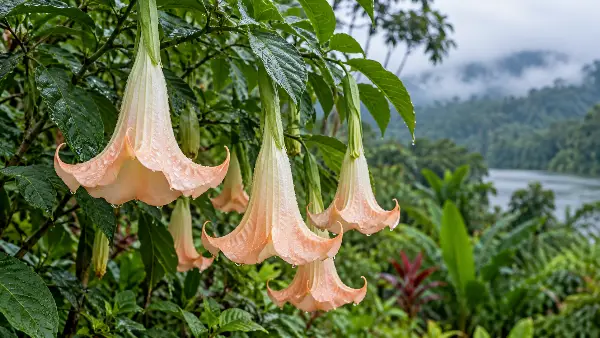
If you lose hours of a ceremony, the cause may not be the vine or the leaf. Toé, a Brugmansia plant that some centers mix in for stronger visions, is a source of scopolamine. A 1991 study in Brain and Cognition looked at 25 people treated for scopolamine poisoning in Colombia, where the drug comes from Datura or Brugmansia plants. Their standout symptom was severe amnesia for new events, with gaps that ran hours or even days.
Our brew has 2 ingredients, the caapi vine and the chacruna leaf, and toé isn’t one of them. Here’s what each plant has shown for memory so far:
| Plant | What it carries | What the memory research shows | In our brew? |
|---|---|---|---|
| Caapi vine | Harmine and other beta-carbolines | Unclear. It’s 1 of 2 explanations for the 2024 gain. More harmine in the blood went with smaller gains, and the authors say higher doses may help less or even hurt | Yes |
| Chacruna leaf | DMT | Unclear. The 2024 authors suggest long-term drinkers may respond to even a low DMT dose | Yes |
| Toé (Brugmansia) | Scopolamine | Severe amnesia for new events in 25 cases of scopolamine poisoning, 1991 | No |
If you can’t account for hours of a ceremony, see a doctor and ask the center for a full list of what went into the brew. If you think you were harmed, report it.
A memory that surfaces in ceremony can’t prove the event happened, or that it didn’t
A memory that comes back in ceremony is a real experience. On its own, it can’t tell you whether the event happened the way you saw it.
The American Psychological Association made the same point in guidance first published in 1995 and still on its site. Most experts, it says, agree that a forgotten memory of childhood abuse can come back later, though that’s rare. They also agree that people can build convincing memories of events that never happened. Without other evidence, it says, there’s no way to tell a true memory from a false one.
The brew itself may make this harder. The authors of the 2024 memory paper note that psychedelics boost mental imagery and suggestibility, 2 factors tied to false memories. Their own study found no rise in false memories, but it tested objects in drawings, minutes later, in people averaging 563 ceremonies. A childhood memory is a different test.
My advice: treat a memory that’s new to you as real for you and unconfirmed as history. It may be accurate. Before you act on it in a way you can’t undo, such as confronting a parent, talk it through with a trauma-informed therapist at home. The APA says a competent therapist is likely to tell you that, without other evidence, current knowledge can’t settle whether a memory is real.
You don’t need proof to get support. If what came back is abuse, it deserves care whether or not you can confirm it. If someone may be at risk now, report it.
Dementia and Alzheimer’s: no human evidence yet
There’s no human evidence that ayahuasca prevents or treats dementia, and I wouldn’t drink for that reason.
I couldn’t find a single study that gave ayahuasca or harmine to people with dementia. Claims that ayahuasca grows new brain cells come from cell and mouse studies, not people.
If memory worries are part of why you’re looking at a retreat, talk to your own doctor first, and list any diagnosis on your application. Our medical director, who is a licensed physician, reviews the medical history on every application.
What we do with what you remember
We help you keep what came up, and we check on you after you leave.
After every ceremony you get guided journaling prompts. At 11 AM the group meets for a circle of 90 to 120 minutes. Our head facilitator is a clinical social worker by training who practiced in California, with further training in somatic experiencing, IFS and EMDR. About 82% of guests join the video call we offer in their first week home. Our referral network has at least 25 therapists in North America, Europe and Australia who know psychedelic integration. Each has confirmed with our head facilitator that they won’t treat a ceremony experience as a sign of illness. If distress lasts after you’re home, contact one of them or your doctor.
We plan to add 1 more number. Every guest already answers depression and trauma questionnaires at intake, Day 10 and 3 months, and we publish those scores. We’ll add a standard 4-question check at the same 3 points. It’s called PROMIS Cognitive Function 4a, and it asks how well your thinking has worked over the past week. We plan to publish the first results in 2027.
The short answer to “does ayahuasca improve memory” is narrow. In experienced drinkers, on 1 lab task, about 160 minutes after drinking, it seemed to. If you’re weighing your first retreat, read how our retreats run and what each service includes. Then send us your questions before you apply.
FAQs
Does ayahuasca improve memory long term?
No study has shown that ayahuasca brings a lasting memory boost, and the studies we read found no lasting harm. In a 2012 study, 127 regular drinkers and 115 non-drinkers were tested twice, a year apart. The drinkers scored better on 3 tests, including 1 working memory task. Neither design can prove the brew caused the difference.
Does ayahuasca improve memory for first-time drinkers?
We haven’t found a study that tested it. The 2024 study that found better recognition used 24 church members who averaged 563 ceremonies. Its authors say the result can’t be applied to people new to ayahuasca. In a 2013 study, occasional drinkers did worse on a planning task during the brew.
Can ayahuasca cause memory loss?
Not lasting loss, as far as the studies show. Working memory got worse during the brew in a 2013 study, but a 2025 study found no decline after 20+ years of use. Toé, a plant some centers add, is a source of scopolamine, which caused severe amnesia in a 1991 study of 25 poisoning cases.
Will I remember my ayahuasca ceremony?
The 2024 study didn’t test memory for the ceremony itself. It found experienced drinkers spotted more objects from drawings they saw after drinking, not fewer. We haven’t found a study of first-time drinkers. At our center, guided journaling prompts follow every ceremony, so you can write down what you want to keep.
Are memories that come up on ayahuasca accurate?
They may be, but the experience alone can’t confirm it. The American Psychological Association says most experts agree that forgotten memories of childhood abuse can return, though rarely, and that people can build convincing false ones. Without other evidence, it says, no one can tell the 2 apart yet. Either way, what came back deserves care.
Is it the DMT or the vine that affects memory?
Researchers don’t know yet. The brew in the 2024 study carried about 51 times more beta-carboline than DMT. The authors name 2 explanations: a “reverse tolerance” to DMT, or the vine blocking an enzyme. People with more harmine in their blood showed smaller gains in confident answers.
Can ayahuasca help with dementia?
There’s no human evidence that it can. We know of no study that has given ayahuasca or harmine to people with dementia. Claims about new brain cells come from cell and mouse research. Talk to your own doctor first if memory worries are part of why you want to go.