Ayahuasca and creativity don’t work the way the internet says they do. The best-controlled trials show creative performance drops during ceremony while the feeling of insight rises. Whatever gain appears shows up 7 days to 4 weeks later, in people who kept working after they got home. I’ve watched 1,900 guests through this since 2017, at the center I co-founded on the Río Momón. The research matches what I see on our integration platform. The night hands you material. The month afterward decides whether you use any of it.
So if you’re booking a retreat to break a creative block, read this before you pay a deposit. The honest version costs you a fantasy and saves you a flight.
What is the link between ayahuasca and creativity?
Ayahuasca affects 2 kinds of thinking that psychologists measure separately. Divergent thinking generates many answers to an open question. Convergent thinking finds the one right answer. Research on ayahuasca and creativity has found short-term changes in both, in opposite directions, and the changes during ceremony differ from the changes weeks afterward.
That split is the whole story, and almost nobody writing about this online makes it.
The study everyone cites found something different from what everyone cites it for
The 2016 Maastricht study on ayahuasca and divergent thinking also found convergent thinking got worse. That second half has been dropped from nearly every retreat page that quotes it, including pages selling creativity retreats.
Here is the paper. Kim Kuypers, Jordi Riba and colleagues visited 2 spiritual ayahuasca workshops, tested 26 participants before drinking and again 1.5 to 2 hours in, and published the result in Psychopharmacology in July 2016. The title is Ayahuasca enhances creative divergent thinking while decreasing conventional convergent thinking. The abstract puts it in one sentence: “While convergent thinking decreased after intake, divergent thinking increased.”
Three more details from that paper that the summaries drop:
- The effect appeared on only 1 of the 2 tests. The picture concept test moved. The pattern/line meanings test showed nothing.
- There was no placebo and no control group. Everyone knew they had drunk ayahuasca, and all 26 came from groups whose stated reason for drinking is self-insight.
- The dose figure in circulation is 1 group’s, not the average. Group 2 drank 44.5 ml with 42.8 mg DMT and 21.4 mg harmine. Group 1 drank 116.7 ml with 75.5 mg DMT and 98.4 mg harmine. That’s 2.6 times the volume and 4.6 times the harmine.
I’m not picking on the researchers. They ran a careful naturalistic study and said plainly what it could not show. The problem is downstream, where a decrease became a non-event and a single group’s cup became “on average.” That happens when pages get written from other pages instead of from papers. It’s an editorial problem before it’s a scientific one.
Does ayahuasca make you more creative during ceremony?
No, on the measures researchers use. Two double-blind placebo-controlled trials since 2016 found creative performance goes down during the acute phase, not up.
The first is from the same Maastricht department. Natasha Mason, Kim Kuypers and colleagues gave 60 healthy volunteers either psilocybin at 0.17 mg/kg or placebo, double-blind. Their 2021 paper in Translational Psychiatry, Spontaneous and deliberate creative cognition during and after psilocybin exposure, reports it cleanly: “Acutely, psilocybin increased ratings of (spontaneous) creative insights, while decreasing (deliberate) task-based creativity.”
Read that twice. Felt insight up. Measured task performance down. Same people, same session.
The second is newer and closer to ayahuasca itself. Dila Suay, Milan Scheidegger and colleagues at the University of Zurich gave 30 healthy men a DMT and harmine formulation, harmine alone, and placebo, in 3 sessions each, and had them paint. Their trial in the Journal of Psychopharmacology found the DMT and harmine combination impaired convergent thinking, showed trend-level reductions in divergent thinking, and disrupted the shift from incubation into illumination. That last one is the “aha” moment, and it happened less, not more.
The line from that paper worth pinning up: subjective experience predicted divergent outcomes but not convergent ones. People’s sense of how creative they were being tracked their feelings, not their output.
Caveats, because they matter. Suay’s sample was 30 men, all healthy, painting in a lab in Switzerland. Mason used psilocybin, not ayahuasca. Neither ran a ceremony, a healer, an icaro or a 10-day container. Nobody has tested creativity in the setting I actually work in, and I’m not going to pretend a lab result transfers whole.
What changed between 2016 and 2026
Two placebo-controlled trials happened, and they point the other way on the acute effect. Sort the studies by when they measured and the picture is consistent: every study that looked after the acute phase found something, and every study that looked during it found a cost.
| Study | Design | People | When measured | What changed |
|---|---|---|---|---|
| Kuypers et al. 2016, Psychopharmacology | Naturalistic, no placebo, 2 workshops | 26 | 1.5 to 2 hours in | Divergent up, convergent down, on 1 of 2 tests |
| Mason et al. 2021, Translational Psychiatry | Double-blind, placebo-controlled, psilocybin 0.17 mg/kg | 60 | Acute | Felt insight up, deliberate task performance down |
| Suay et al., Journal of Psychopharmacology | Double-blind, placebo-controlled crossover, DMT plus harmine | 30 | Acute, during painting | Convergent impaired, divergent trend-level down, incubation to illumination disrupted |
| Mason et al. 2021 | Same trial, follow-up | 60 | Day 7 | Number of novel ideas up |
| Uthaug et al. 2018, Psychopharmacology | Naturalistic, ceremonies in the Netherlands and Colombia | 57, with 31 still in at 4 weeks | Day after, then 4 weeks | Convergent thinking improved at 4 weeks, not the day after. Divergent unchanged at both points |
| Frecska et al. 2012, Journal of Psychoactive Drugs | Open-label with a control group, 4 to 5 ceremonies over 2 weeks | 40 plus 21 controls | 24 to 48 hours after the last ceremony | Highly original figural solutions rose. General fluency and flexibility did not |
Two things fall out of that table.
The direction flips with time. Malin Uthaug and colleagues followed ayahuasca drinkers in the Netherlands and Colombia and found convergent thinking improved by 4 weeks, the same measure that dropped during ceremony in 2016. Mason’s day-7 follow-up found more novel ideas, on the same task that dropped acutely.
The multi-ceremony study is the one that looks like a retreat. Ede Frecska’s group tested 40 people who drank every second or third day across 2 weeks in Brazil, 4 to 5 sessions, against 21 controls. Originality rose. Fluency and flexibility didn’t budge. That’s a narrow result, and it’s the closest thing in the literature to how a real retreat is structured.
Why you feel more creative than you measure
The gap between felt insight and measured output is the most replicated finding in this whole area, and it’s the one nobody selling a creativity retreat mentions. Mason found it. Suay measured it directly.
I see the same gap on the ground, in a less flattering form. Guests come out of ceremony certain they’ve solved something. Some of them have. Plenty have had a vivid experience of solving something, which is a different event. The 2 feel identical at 4 in the morning.
My co-founder, the maestro curandero who runs our ceremonies, says the vine cleans what needs cleaning, and that some houses need more work than others. I’d extend that to ideas. The night is very good at showing you the room. It does not tidy it.
This is the same trap I’ve written about with healing, and the honest version bears repeating. Ayahuasca can reach material talk therapy struggles to get to. It can produce in a single night an insight that might take months to arrive otherwise. But insight is not healing, and an insight is not a finished piece of work. The medicine opens the door. Walking through it takes the same effort no matter how the door opened.
Want to know what the night is like before you decide? The hour-by-hour breakdown of a ceremony is more use to you than any creativity claim I could make. What happens in the brain covers the mechanism.
What 4 ceremonies across 10 days looks like
Our retreat runs 4 ceremonies on nights 2, 4, 7 and 9, across 10 days, with 3 healers and 2 facilitators for a maximum of 10 guests. The regional norm is 5 to 7 ceremonies in a week. We space them because the days between are where the work happens, and that was the design long before I read a creativity paper. The preparation and medication rules start weeks before any of it.
The 10 days are ayahuasca only. Nothing goes into the brew but vine and chacruna, nothing gets stacked inside a ceremony, and everything else we offer sits outside the retreat.
The structure of the 10 days puts an integration circle at 11 in the morning after every ceremony. Our integration lead, a licensed clinical social worker, runs it for 90 minutes to 2 hours on the covered platform: a check-in round with no crosstalk, then the themes she’s hearing across the group, then practical work. Journaling prompts written for that specific ceremony. Body scans and breathwork. Behavioral experiments. The maestro sometimes sits in and says what he perceived, translated. He works in the mestizo vegetalismo tradition of the Loreto rivers, and the icaros he sings are in Spanish with Cocama and Quechua worked through them.
Then everyone goes home, and the Raíces program takes over.
- Week 1: a 30-minute video call with one of our 2 integration facilitators.
- Week 3: a 20-minute follow-up call.
- Weeks 6 to 8: an email check-in, with a call if you want it.
- Month 3: email, plus the PHQ-9 and PCL-5 surveys we use to track outcomes.
- Months 6 and 12: email.
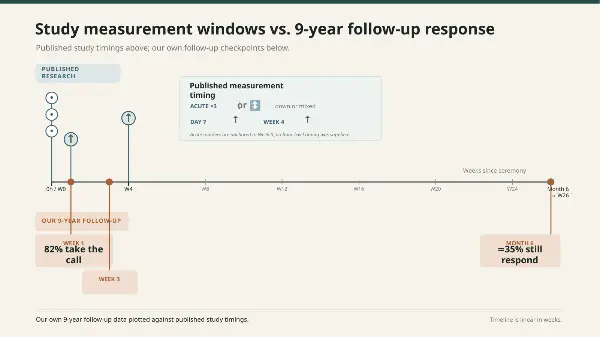
Look at the first 2 items against the research timeline. Mason found more novel ideas at day 7. Uthaug found improved convergent thinking at 4 weeks. Our Week 1 call and Week 3 call land inside both windows. I want to be careful here: that schedule was built in 2019 for integration, not for creativity, and nobody has ever measured a creative outcome at our center. The overlap is real and it is not evidence. It’s a reason I think the timing is right, and you can check the dates yourself.
Three other things come with it. An emergency WhatsApp line staffed by both facilitators, with a 4-hour response commitment during waking hours. A referral network of 25-plus integration-aware therapists across the US, Canada, the UK, Australia and Europe. And an alumni Signal group of roughly 320 former guests, moderated in house. In 9 years, 12 to 15 guests have used the emergency line for a serious post-retreat crisis. All resolved with more support. None needed psychiatric hospitalization.
Who keeps the ideas, and who loses them
About 82% of our guests take the Week 1 call. By Month 6, roughly 35% still respond. That drop is the honest picture of the window the research points at, and it’s a number I’ve never seen another center publish.
It isn’t a failure rate. We don’t chase people, and someone thriving without us is a good outcome, not a lost data point. But it does mean the group that shows up for the weeks where a measurable creative effect lives is smaller than the group that books the retreat.
After 1,900 guests, the split is consistent. People who integrate well:
- Keep a daily practice. Meditation, journaling, breathwork, yoga, time outside. Which one matters less than doing it most days.
- Make at least 1 concrete change in their outside life within 3 months. Not “I feel different.” An actual change.
- Stay connected to somebody who understands the experience. Isolation is the strongest predictor of poor integration we see.
- Accept that progress isn’t a straight line. They have bad weeks and don’t panic when the post-retreat lift fades.
People who struggle:
- Expect the medicine to do the work. It doesn’t.
- Go back to exactly the same environment and change nothing in it.
- Isolate, until the experience becomes a private thing that gets more abstract every month.
- Chase the experience. Serial retreats with no integration between them is one of the more destructive patterns in this industry.
Read that first list again as a description of creative work and it stops sounding like therapy language. Daily practice. One concrete finished thing. Someone to show it to. Tolerance for bad weeks. That’s just what making anything requires, and it’s what the day-7 and 4-week findings are quietly describing.

Should you book an ayahuasca retreat for creative block?
Probably not, if that’s the only reason. Nothing in the research supports paying for a flight to the Amazon to generate ideas, and I’d rather lose the booking than sell you that.
Here’s why people come to us, from intake forms:
| Reason for attending | Share of guests |
|---|---|
| Depression or anxiety | 30% |
| Trauma or PTSD | 24% |
| Addiction recovery | 15% |
| Grief or loss | 11% |
| Spiritual seeking or personal growth | 11% |
| General life transition | 9% |
Creative block isn’t a category, because in 9 years it hasn’t been common enough to be one. Average guest age is 39. Ages run 25 to 70. We reject 13% of applicants outright after a 30 to 45 minute screening call, and a further 18 to 21% who are accepted never come. What gets someone screened out has nothing to do with what they want from the medicine.
The people I’ve seen get creative work out of this were not here for creative work. They came for a marriage, a bereavement, a drinking problem. The work came later, from a life that had changed, and it came out over months. If your block is really a block, that’s a different problem and a cheaper one to solve.
If something underneath the block is what’s actually stuck, that’s a conversation worth having. What our own outcome data shows is a better place to start than this page, including the 30% of guests whose scores didn’t show sustained improvement at 3 months. Who we are and where the lineage comes from is the other thing worth checking before you talk to anyone, at any center.
And if you’re reading about ayahuasca and creativity because you’d rather not do a full ceremony at all, the case against microdosing ayahuasca covers that route. The short version: a self-blinded placebo-controlled study of 191 completers found microdosing’s benefits were matched by placebo once expectancy was controlled for.
FAQs
Does ayahuasca increase creativity?
Not during ceremony, on the measures researchers use. Two double-blind placebo-controlled trials found the opposite: Mason and colleagues in 2021 saw deliberate task-based creativity decrease acutely with psilocybin, and Suay and colleagues found a DMT and harmine formulation impaired convergent thinking in 30 participants. Both studies found people felt more insightful than they performed. The measured gains appear later, at day 7 and 4 weeks.
What did the 2016 ayahuasca creativity study find?
Kuypers and colleagues tested 26 people at 2 ayahuasca workshops and found divergent thinking increased while convergent thinking decreased, on 1 of the 2 tests they used. The decrease is in the paper’s title and it gets left out of most summaries. The study had no placebo and no control group, and the dose commonly quoted from it, 44.5 ml, is 1 of the 2 groups rather than the average.
How long do ayahuasca’s effects on creativity last?
The measurable window that has been studied runs from about 24 hours to 4 weeks. Mason’s group found more novel ideas 7 days after psilocybin. Uthaug’s group followed ayahuasca drinkers and found convergent thinking improved by 4 weeks, with nothing the day after. Frecska’s group tested 40 people 24 to 48 hours after 4 to 5 ceremonies across 2 weeks and found more original solutions. Nobody has measured past 4 weeks.
What is the difference between divergent and convergent thinking?
Divergent thinking is generating many possible answers to an open question, like listing uses for a brick. Convergent thinking is narrowing to the one correct answer, like spotting the single link between 3 pictures. Real creative work uses both: divergent to produce options, convergent to pick and finish. Ayahuasca research has found short-term changes in each, in opposite directions and at different times.
Do artists and writers come to your retreats?
Some, but creative work isn’t why people come here. Our intake data puts depression and anxiety at 30%, trauma and PTSD at 24%, addiction recovery at 15%, grief at 11%, spiritual seeking at 11% and life transition at 9%. Creative block has never been common enough in 9 years to make it a category. The guests who did produce work afterward came for something else.
Is it better to do 1 ceremony or several?
Every study that found an effect lasting past the acute phase involved either repeat ceremonies or a follow-up weeks later. Frecska’s participants drank 4 to 5 times across 2 weeks. We run 4 ceremonies across 10 days, on nights 2, 4, 7 and 9, against a regional norm of 5 to 7 in a week, because the days between are where the work gets done. That’s a design choice about integration, not a proven dose-response curve for creativity.
Does microdosing ayahuasca help creativity?
The evidence doesn’t support it, and ayahuasca is a poor candidate for microdosing regardless. A self-blinded placebo-controlled study with 191 completers found that microdosing’s reported benefits were matched by placebo once expectancy was accounted for. Brew potency also varies batch to batch, which makes a consistent low dose close to impossible to reproduce at home.