Most pages about the benefits of ayahuasca list feelings. This one lists numbers.
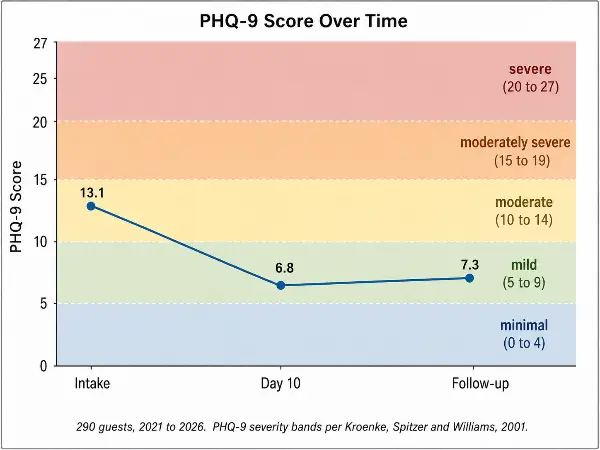
Since 2021 we’ve given every guest a PHQ-9 depression questionnaire and a PCL-5 trauma questionnaire at three points: intake, day 10, and again 3 months after they fly home. We now hold 290 complete datasets. Average depression score at intake was 13.1. At day 10 it was 6.8. At 3 months, 7.3.
That’s the benefit, stated plainly. It’s also half the story, because 30% of our guests show no lasting improvement at 3 months. They’re the more useful half.
I’m Michael Vale. I co-founded Iquitos Ayahuasca Retreats with Maestro Don Enrique Huayta Peña in 2017, after my younger brother Daniel died of an overdose at 29. We’ve served roughly 1,900 guests since.
What are the benefits of ayahuasca?
The benefits of ayahuasca most often reported are reduced depression and anxiety symptoms, processing of stored trauma, and clearer decisions about work and relationships. In our tracked data from 290 guests, average depression scores fell from the moderate range into the mild range and stayed there at 3 months. Roughly 30% saw no lasting change.
That paragraph is the honest version. Everything below is the evidence behind it.
The 2026 numbers: 290 guests, 3 checkpoints
We started collecting standardized outcome scores in 2021 because I got tired of not knowing. Guests would leave glowing and I’d have no idea what happened to them 90 days later. Now we ask.
| PHQ-9 depression score, all 290 guests | Average |
|---|---|
| At intake | 13.1 |
| Day 10, before flying home | 6.8 |
| 3 months later | 7.3 |
What the depression scores mean
A PHQ-9 score isn’t a feeling. It’s a 27-point scale with published bands. The University of Washington’s National HIV Curriculum sets out the standard interpretation from Kroenke, Spitzer and Williams’ 2001 validation paper: 0 to 4 is minimal, 5 to 9 is mild, 10 to 14 is moderate, 15 to 19 is moderately severe, 20 to 27 is severe.
So our group average moved from the moderate band to the mild band, and stayed in the mild band 3 months later. That’s a real move. It is not a cure, and the 0.5-point rise between day 10 and month 3 matters. More on that below.
What the trauma scores mean
About 24% of our guests score above the clinical cutoff for PTSD symptoms at intake. Among that group, average PCL-5 scores dropped from 48.6 to 35.2 at 3 months, and 65% fell below the clinical cutoff.
One caveat I’d rather state myself than have someone else point out: this is observational data with selection bias. People who are doing well are more likely to answer a follow-up email. We are not running a clinical trial and I won’t pretend we are.
Who doesn’t get better?
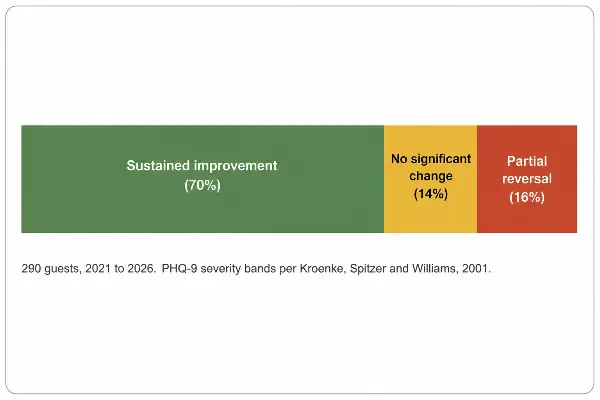
30% of our guests show no meaningful PHQ-9 improvement at 3 months. That number splits in two.
| Outcome group | Share of guests | What happened |
|---|---|---|
| Sustained improvement | 70% | Score dropped and held at 3 months |
| No significant change | 14% | Score barely moved from intake |
| Partial reversal | 16% | Improved by day 10, slid back by month 3 |
The 14% whose scores barely moved
Some of these guests had powerful experiences and still scored the same. Some felt very little in ceremony at all. After 9 years I’ve stopped predicting who lands here.
What I expected, back in 2017, was that guests with the heaviest psychiatric histories would struggle most. That’s not what the data shows. The people who struggle are the most rigid ones: tight control over emotion, strong defenses, everything routed through the intellect first. Don Enrique spots them on the first night, long before I do. He said of one guest who’d barely spoken in 3 days: “He is hiding behind his thinking. The vine is looking for the door underneath.”
The 16% who improved, then slid back
This group is the reason I stopped selling ayahuasca as a reset. They left the Río Momón lighter. By month 3 the score had crept back up.
When we look at what separates them from the 70%, the pattern is consistent and it’s not mystical. Guests who hold onto the change do three things. They keep a daily practice. Which practice matters far less than whether they actually do it. They make at least one concrete external change within 3 months, not a feeling but an actual change. And they stay connected to someone who understands the experience. Isolation is the single strongest predictor of losing the benefit.
What the clinical research actually says
Short version: the evidence is promising and thin. Anyone who tells you otherwise is selling something.
The most cited controlled study is Palhano-Fontes and colleagues’ 2019 trial in Psychological Medicine, a double-blind randomized placebo-controlled trial in treatment-resistant depression. At day 7, 64% of the ayahuasca group met response criteria against 27% on placebo. Remission was 36% against 7%, though that difference only reached p=0.054, which is a trend and not a result. The between-group effect size at day 7 was large, Cohen’s d of 1.49.
The sample was 29 people. Fourteen got ayahuasca. That’s a promising signal, not a settled question, and I’d want to see it replicated at 10 times the size before anyone builds a treatment plan on it.
Longer-term observational work looks similar. Jiménez-Garrido and colleagues followed 40 ayahuasca-naive users for 6 months in a 2020 Scientific Reports study. At baseline, 45% met criteria for at least one psychiatric disorder. At the 1-month follow-up, 61% of those cases no longer met criteria, and depression improvement held at 6 months with an effect size of 0.72.
Insight isn’t healing, and our own scores show it
Here’s the position that annoys people in my industry: ayahuasca is not a shortcut past therapy, and the “one ceremony equals 10 years on the couch” line has done real damage.
Our own data argues against us on this. The group average at day 10 was 6.8. At 3 months it was 7.3. Some of what happens in the maloca does not survive the flight home on its own.
Ayahuasca reaches material that talk therapy can circle for years without touching. I’ve watched it happen more times than I can count. But knowing why you’re depressed is not the same as not being depressed. The medicine opens the door. Walking through it costs the same either way.
That’s why we call every guest at week 1, week 3, and month 2, and why 82% of guests take the week-1 call. It’s also why we cap the retreat at 4 ceremonies across 10 days instead of the 5 to 7 that many centers pack into a single week. Don Enrique’s line on it: “If you drink every night, you are shouting into a canyon. If you leave silence, the canyon answers.”
How long do the benefits of ayahuasca last?
Based on our 3-month follow-ups, most of the measured improvement holds, with a small average rise back toward baseline. The honest answer is that duration depends far more on what a guest does in the 90 days after ceremony than on what happened during it.
We check in at 3, 6 and 12 months. Response rates fall as time passes: 82% take the week-1 call, about 35% still answer by month 6. We don’t chase people. Someone who’s thriving and has stopped replying is a good outcome, not a lost data point.
What we can say from the guests who do report: 22% have come back for at least one more retreat, and 7% have come 3 or more times. Return rates rose from about 14% in our first 3 years to about 26% recently, which lines up with when we built our integration program rather than with anything we changed in ceremony.
What are the side effects and risks of ayahuasca?
This is where most benefits pages go quiet. The largest dataset on the question is the Global Ayahuasca Survey, published by Bouso and colleagues in 2022 in PLOS Global Public Health, covering 8,216 people across more than 50 countries.
Their findings: 69.9% reported acute physical adverse effects. 62.0% reported vomiting or nausea. Of those reporting physical effects, 2.3% needed medical attention afterward. Mental health adverse effects in the following weeks or months were reported by 55.9%. About 88% of that group described those effects as part of a positive process of growth, not as harm.
Read that last sentence twice. Most people have a hard time at some point. Most of them are glad they did.
Will you vomit?
Probably. Roughly 6 in 10 people do, and every guest here has a lined bucket at their mat that a facilitator quietly swaps when it’s full.
Purging lasts 30 to 90 minutes in most cases, usually in the first half of ceremony, and it eases with each subsequent night. There’s no relationship between how hard you purge and how much you get out of it. Some guests barely purge for 4 ceremonies and have the deepest retreat in the group.
Who should not drink ayahuasca
We reject 13% of applicants outright, and another 5 to 8% are accepted on conditions they never meet, usually a medication taper. So roughly 1 in 5 people who apply here never sit in the maloca.
Automatic disqualifications include schizophrenia or schizoaffective disorder, any history of psychosis, Bipolar I, current lithium use, and current pharmaceutical MAOIs. So do uncontrolled cardiac conditions, uncontrolled hypertension, pregnancy, and active suicidal ideation with plan or intent. SSRIs and SNRIs require a 6-week taper supervised by the prescribing physician. Fluoxetine needs 8 weeks because of its half-life. That taper isn’t caution for its own sake. The beta-carbolines in ayahuasca act as monoamine oxidase inhibitors, and the NIH’s StatPearls reference lists SSRIs, SNRIs and St. John’s wort among the drugs contraindicated with MAOIs because of serotonin syndrome risk, which it calls potentially life-threatening.
I learned this the hard way in 2018, before we had a doctor on staff, when I let a guest drink after she told me she’d “skip a few doses” of her SSRI. She spent the night with a racing heart, tremors and heavy sweating while I took her pulse with my fingers. She recovered. That night is why Dra. Carmen Ríos Medina now reviews every intake form, and why the dietary preparation matters for the same pharmacological reason.
If a center will accept you without asking any of this, that tells you what you need to know about the center.
Does the retreat change the outcome?
Yes, and this is the part I’d argue is underrated next to which plant you drink.
Group size and healer attention
We run 3 healers and 2 facilitators for a maximum of 10 guests, so 1 staff member for every 2 people in the room. Plenty of centers in this region run 20 to 30 guests with 1 or 2 healers. At that ratio a guest might get 5 minutes of direct attention across an entire night, or none.
Don Enrique has 54 years with this medicine and a named lineage going back 5 generations along the Río Momón. He cooks every batch himself with his son Wilber, he sets every dose personally, and he owns 35% of the company. That last detail isn’t a bragging point. It’s the reason the tradition sets the protocols here instead of the marketing department. Peru recognized that tradition formally in 2008, and ayahuasca’s legal status as national cultural heritage is part of why this work can happen openly here. You can read more about how the center began and why.
What happens after you fly home
Our integration program is called Raíces, Spanish for roots. Week 1 is a 30-minute video call, week 3 a 20-minute follow-up, then email check-ins at month 2, 6 and 12. It’s run by Lucia Fernández, a former licensed clinical social worker with 650-plus hours of ceremony facilitation, and it’s built into the retreat price rather than sold separately.
Guests in acute difficulty get more. Lucia has run weekly calls with people for 6-week stretches at no extra cost. In 9 years about 12 to 15 guests have used our emergency line for a serious post-retreat crisis. All resolved with added support and none required psychiatric hospitalization.
Before you book anything
Whatever center you’re weighing, ask them five questions. Who are the healers, by name, and who trained them? What’s your screening process, and what will get me rejected? What happens if there’s a medical emergency at 2am? What’s the staff-to-guest ratio in the room? And what happens after I leave?
If a center can’t answer those with specifics, the reviews don’t matter.
The benefits of ayahuasca are real and they are measurable. They are also not universal, not automatic, and not a substitute for the work that follows. Getting to Iquitos is a single flight from Lima. Our ayahuasca retreat program runs 22 times a year at 10 guests maximum. Talk to us first and we’ll tell you honestly whether you should come.
FAQs
How long do the benefits of ayahuasca last?
In our 290-guest dataset, most measured improvement held at 3 months, with the group average rising slightly from 6.8 at day 10 to 7.3 at month 3. Duration tracks what you do afterward more than what happened in ceremony. Guests who keep a daily practice, make one concrete external change, and stay connected to someone who understands the experience hold onto it best.
Can ayahuasca cure depression?
No, and nobody should tell you it can. The strongest controlled evidence is a 2019 trial of 29 people that found a 64% response rate at day 7 against 27% on placebo. In our own data, 70% of guests showed sustained improvement at 3 months, which means 30% did not. Ayahuasca is not a replacement for therapy or prescribed medication.
What are the side effects of ayahuasca?
The Global Ayahuasca Survey of 8,216 people found 69.9% reported acute physical adverse effects and 62.0% reported vomiting or nausea, with 2.3% of that group needing medical attention. Mental health adverse effects were reported by 55.9%, and about 88% of those people described the effects as part of a positive process rather than harm.
Does ayahuasca help with PTSD?
About 24% of our guests score above the clinical cutoff for PTSD symptoms at intake. Among that group, average PCL-5 scores fell from 48.6 to 35.2 at 3 months, and 65% dropped below the cutoff. That’s observational data with selection bias, not a trial result. Trauma work also demands more preparation and more integration support than any other reason people come.
Who should not take ayahuasca?
Anyone with schizophrenia, a history of psychosis, Bipolar I, current lithium use, uncontrolled cardiac conditions or uncontrolled hypertension should not drink. Neither should anyone pregnant or in active suicidal crisis. SSRIs and SNRIs need a 6-week physician-supervised taper first, 8 weeks for fluoxetine. We turn away 13% of applicants outright on these grounds.
How many ayahuasca ceremonies do you need?
We run 4 across a 10-day retreat, spaced with gaps rather than stacked on consecutive nights. Many centers run 5 to 7 in a single week. Our position, and Don Enrique’s, is that ceremonies packed back to back exhaust the body and give the medicine no room to settle. The 3-month outcome scores are the reason we have not moved off 4.
Is ayahuasca legal?
Ayahuasca is legal in Peru. The government declared it national cultural heritage in 2008 and ceremonial use is explicitly protected. Those protections stop at the border. Guests returning to countries where DMT is controlled should understand the law in their own jurisdiction before they travel.