You can swallow a small amount of ayahuasca. You can’t microdose it. Those are different claims, and the gap between them is the whole article.
Microdosing means a repeatable sub-perceptual dose, roughly a tenth of a full one, taken on a schedule. That requires knowing how strong your material is. We’ve kept a written log of every batch we’ve cooked since 2020. That’s 130-plus batches, one recipe, one property, the same 2 men at the pot every time. Our potency still moves across a 3-point band. We can’t promise you two identical cups. Nobody can.
This is written from a 10-guest center on the Río Momón, 90 minutes upriver from Iquitos, running since 2017 with roughly 1,900 guests through it. The microdosing question comes up on our screening calls often enough that we wanted to answer it properly, with our own numbers instead of a speech about tradition.
What microdosing ayahuasca means
Microdosing ayahuasca means taking a sub-perceptual amount of the brew, usually described as a tenth to a twentieth of a ceremonial dose, on a repeating schedule, to get mood or focus benefits without visions. Unlike psilocybin or LSD, ayahuasca is a variable-strength liquid made from 2 plants, so a reproducible small dose is not something the medicine allows.
That paragraph is the honest summary. The rest is the evidence.
How much ayahuasca is a microdose?
Nobody can give you a number, and anyone who gives you one in millilitres is guessing.
The fraction itself is real. Kuypers and colleagues, writing in the Journal of Psychopharmacology in 2019, define a microdose as roughly a tenth to a twentieth of a recreational dose. For LSD that lands at 10 to 20 micrograms. For psilocybin, 0.43 to 0.73 mg of psilocin. The same paper says plainly that there is no agreed scientific consensus on microdosing at all.
Look at why those numbers work and ayahuasca’s don’t.
| LSD | Psilocybin | Ayahuasca | |
|---|---|---|---|
| Form | Measured drops or blotter | Dried mushroom or capsule, weighed | Cooked liquid |
| Active compounds | 1 | 1 main | At least 4 that matter |
| Can you weigh a dose? | Yes | Yes | You can measure volume, not strength |
| Strength known before you take it? | Yes | Roughly | No |
| A tenth of a dose is | 10 to 20 micrograms | Under a milligram | Unknowable |
A tenth of a strong batch can be more than a fifth of a weak one. You’re not dosing a compound. You’re dosing a soup whose recipe changed slightly the last time somebody cooked it.
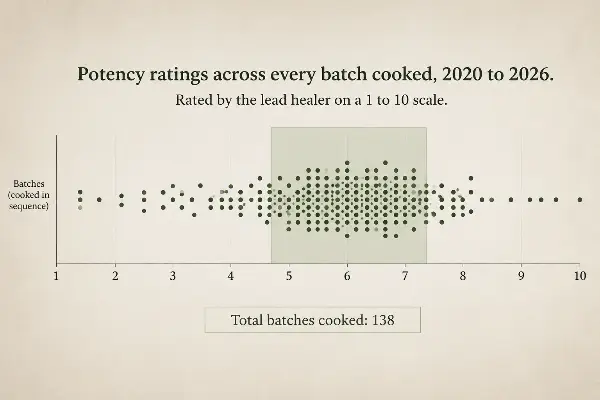
What 130 batches of brew data show about consistency in 2026
Our own log is the clearest argument against microdosing that we have, and it argues against us as much as anyone.
Since 2020 we’ve written down the same things after every cook. Our lead healer tastes each finished batch and rates it on his own 1 to 10 scale. That isn’t science. It’s 54 years of a palate that has never been wrong about a batch being unsafe.
| What we record every batch | Why it matters |
|---|---|
| Vine weight in kg | Largest single driver of final potency |
| Chacruna weight in kg | Sets the DMT side of the ratio |
| Water volume | Determines how far the brew has to reduce |
| Total cook time | Second largest driver. Ours run 14 to 18 hours |
| Number of reductions | We run 2 extractions, then reduce again |
| The healer’s potency rating, 1 to 10 | The only strength measure we have |
Most of our batches land between 5 and 7. That’s the spread after 6 years of records. We grow more than 250 of our own vines on this land. The same 2 people have cooked together for 9 years, with the same 2 plants and no additives. Vine maturity and cook duration turned out to be the 2 variables that move it most. In 9 years our lead healer has thrown out 3 finished batches he judged wrong, unable to say precisely why.
Now picture someone at home with vine ordered from a website, no idea of the plant’s age, cooking it once. Their tenth is a coin flip. Ours would be too, and we log everything.
We don’t send samples for alkaloid testing. Two reasons. No reliable lab for ayahuasca alkaloids exists in Iquitos, and our lead healer’s position is that the medicine is a relationship rather than a chemistry problem. We’ve considered testing for safety verification and haven’t done it. That’s a real limitation of our data, and it cuts both ways. If we can’t measure our brew in a lab, neither can the person selling vine online.
What harmine actually does at a low dose
Very little, based on the only human study that has tested it directly.
The vine supplies harmine, harmaline and tetrahydroharmine, and low-dose enthusiasts often credit harmine with the mood lift they report. In 2024 a team published a Phase 1 trial of pure oral harmine in the Journal of Psychopharmacology, giving 25 healthy volunteers single doses of 100, 200, 300 or 500 mg. They found the maximum tolerated dose at 2.7 mg/kg, with 90% of people above that hitting dose-limiting toxicity, and only “limited psychoactivity” even at those higher amounts. Below 2.7 mg/kg, which is around 190 mg for a 70 kg adult, harmine produced minimal or no effects.
Read that against the microdose claim. A tenth of a ceremonial dose puts harmine well under the level where a controlled trial found anything happening at all. What people describe as a gentle harmine lift is not something the human data supports yet. Antidepressant findings for harmine so far come from animals and test tubes, not from people.
If you want the longer version of what these compounds do at a full dose, we wrote about how ayahuasca affects the brain separately.
Does microdosing work, or is it placebo?
The best controlled evidence says placebo explains most of it, and this is where our industry gives away an argument it could win.
Szigeti and colleagues ran a self-blinded placebo-controlled microdosing study published in eLife in 2021, with 191 people completing it. Participants prepared their own capsules so that neither they nor the researchers knew which weeks were real. The microdose group improved on wellbeing and life satisfaction. So did the placebo group. Once the researchers accounted for what people believed they had taken, the small remaining differences mostly disappeared. The authors concluded the benefits came from expectation rather than from the drug.
That study is about psilocybin and LSD, not ayahuasca, and we won’t stretch it further than it goes. But it’s the closest thing to a settled answer this whole conversation has, and it points the same way our brew log does.
Here’s our complaint with how centers like ours handle this question. When somebody asks about microdosing, the standard answer is that the tradition doesn’t recognise it and the medicine deserves ceremony. That’s true and we believe it. It’s also an argument from authority delivered to a person who came looking for evidence, and it loses to a well-written how-to page every time. We have a placebo-controlled trial and a dose-response study on our side. Use them.
Is microdosing ayahuasca legal?
In the United States, that depends on what’s in the cup, and almost nobody explains the split.
DMT appears on the DEA’s controlled substances list as Schedule I. Harmine, harmaline, tetrahydroharmine, Banisteriopsis caapi and Psychotria viridis do not appear on that list at all.
So a vine-only preparation and a full brew sit in 2 different places under federal law, even though vendors sell both under the word ayahuasca. State law varies, several cities have changed enforcement priorities, and none of that is legal advice. Check your own jurisdiction before you order anything. In Peru the picture is different again, and we cover ayahuasca’s legal status in Peru in its own article.
The diet rules were written for a ceremonial dose
You probably need something, less than you’ve been told, and nobody has measured where the line falls.
You’ll read that a microdose demands the same dietary precautions as a full ceremony because of the MAO inhibition. That claim is repeated everywhere without a source. What the literature actually says is more careful. White and colleagues reviewed 78 articles for the International Journal of Toxicology in 2024 and describe the tyramine and MAOI interaction as a theoretical hypertensive risk. They found no clear confirmed cases of serotonin syndrome attributed to ayahuasca anywhere in the scientific literature, and no deaths in the studies they reviewed.
The mechanism also matters. The vine’s alkaloids inhibit MAO-A reversibly, which is not how the older prescription MAOIs behave, and the classic aged-cheese warning was built for those. That doesn’t make a low dose free of interactions. It means the honest answer is that the precautions probably scale down and no one has run the study that shows by how much. We ask our guests for 2 weeks of dietary preparation before a ceremony, and we ask for it because we know the ceremonial dose. Nobody knows yours.
Can you microdose while you’re on an antidepressant?
No. This is the version of the question that actually hurts people, and it’s the one the how-to pages skip.
In 2018, before we had a doctor on staff, a guest told our director she was on a low-dose SSRI and would “skip a few doses.” He didn’t understand the interaction well enough to say no. She drank, and she spent the night with a racing heart, tremors and heavy sweating while he took her pulse with his fingers, because the center didn’t own a pulse oximeter. She was fine by morning. Within 6 weeks we’d recruited a medical director and rebuilt our screening from scratch.
A microdose doesn’t make that interaction disappear, it just makes it harder to predict, because now neither you nor anyone else knows the dose. Our taper protocol runs 6 weeks off SSRIs, 8 for fluoxetine, and it’s set out in full in our piece on ayahuasca effects. If you’re taking a serotonergic medication, the answer isn’t a smaller amount. It’s a conversation with your prescriber first.
The only low dose we use, and it has a name
There is one legitimate small dose in this work, and it isn’t a microdose. It’s the first night.
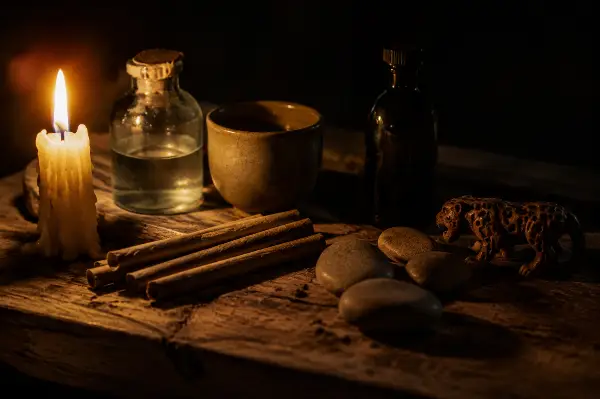
Our lead healer serves first-time guests 40 to 60 ml, which is deliberately conservative. He sets each amount individually after the soplada diagnóstica. He blows mapacho smoke over the guest and hums a low tone for about 45 seconds, reading what he calls their aire. Then he pours. He raises it on later nights if the first was mild, holds or lowers it if it wasn’t. When a second cup is offered around 10 PM, he turns down roughly 20% of the requests, usually from people already deep in it. His line on the first night: “You do not propose marriage on the first meeting.”
That’s a low dose with a healer, a diagnosis, a room and 4 more nights behind it. The man setting it has 54 years with this medicine and a family lineage going back 5 generations on this river. It has almost nothing in common with taking 5 ml of unknown brew at your desk on a Tuesday. If a low first dose is what you’re actually after, that already exists inside a 10-day retreat, and it comes with someone watching you.
What we tell people who ask us this on a screening call
Every applicant here does a 30 to 45 minute video call before we accept them, and we turn away 13% outright. When microdosing comes up, we don’t lecture anybody. We ask what they’re hoping it will do.
Usually the answer is that they want the benefit without the fear. That’s a reasonable thing to want. What we’d say back is that we’ve measured our results. We published the part where 30% of our guests show no lasting improvement at 3 months. The number we can stand behind on benefits came from full ceremonies with integration afterward, not from small amounts taken alone.
We can’t tell you a microdose won’t help you. We can tell you 3 things. Nobody can say what a microdose of this medicine even is. The one human trial of its main vine compound found almost nothing at low doses. And the best placebo-controlled study in the field found expectation doing most of the work.
If microdosing ayahuasca is what brought you here, ask us directly before you order anything from anyone. We’ll tell you honestly whether you should come at all.
FAQs
Can you microdose ayahuasca?
Not reliably. Microdosing requires a repeatable sub-perceptual dose, and ayahuasca is a cooked liquid whose strength varies between batches. Across 130-plus batches logged since 2020 at one property with one recipe, our own potency ratings still range from 5 to 7 on a 10-point scale. A tenth of a strong batch can exceed a fifth of a weak one, so the fraction that defines a microdose cannot be reproduced.
How much ayahuasca is a microdose?
There is no defensible number. A microdose is defined as roughly a tenth to a twentieth of a full dose, which works for LSD at 10 to 20 micrograms and psilocybin at 0.43 to 0.73 mg of psilocin because both can be measured before you take them. Ayahuasca strength is unknown until it’s been drunk, so any millilitre figure is a guess about an unmeasured liquid.
Does microdosing ayahuasca actually work?
No study has tested it. The largest placebo-controlled microdosing study, published in eLife in 2021 with 191 people completing it, found that microdoses of psilocybin and LSD did not outperform placebo once participants’ beliefs about what they had taken were accounted for. Those results don’t transfer directly to ayahuasca, but no evidence exists showing that low-dose ayahuasca beats placebo either.
Is microdosing ayahuasca legal in the United States?
It depends what’s in the preparation. DMT is listed as a Schedule I controlled substance on the DEA’s schedules, while harmine, harmaline, tetrahydroharmine, Banisteriopsis caapi and Psychotria viridis do not appear on that list. A full brew contains DMT and a vine-only preparation does not. State and local law varies, and this is not legal advice.
Do the beta-carbolines in the vine do anything at a low dose?
Very little, based on the only human dose-ranging study. A 2024 Phase 1 trial gave 25 healthy volunteers single oral doses of pure harmine from 100 to 500 mg and set the maximum tolerated dose at 2.7 mg/kg, noting only limited psychoactivity above that level. Below roughly 190 mg for a 70 kg adult, harmine produced minimal or no effects.
Can you microdose ayahuasca while taking antidepressants?
No. The vine’s alkaloids inhibit monoamine oxidase, and combining that with serotonergic medication carries serotonin syndrome risk. A smaller amount doesn’t remove the interaction, it just makes the exposure unpredictable. Our own protocol requires 6 weeks off SSRIs and 8 weeks off fluoxetine before a ceremony, supervised jointly by our medical director and the guest’s prescriber.
Is there a legitimate low dose of ayahuasca?
Yes, but it’s a first ceremonial dose rather than a microdose. Our lead healer serves first-time guests 40 to 60 ml, set individually after a diagnostic reading, then adjusts on later nights based on how each person responded. Roughly 20% of second-cup requests are declined. It’s a conservative dose inside a supervised ceremony, not a sub-perceptual amount taken alone.