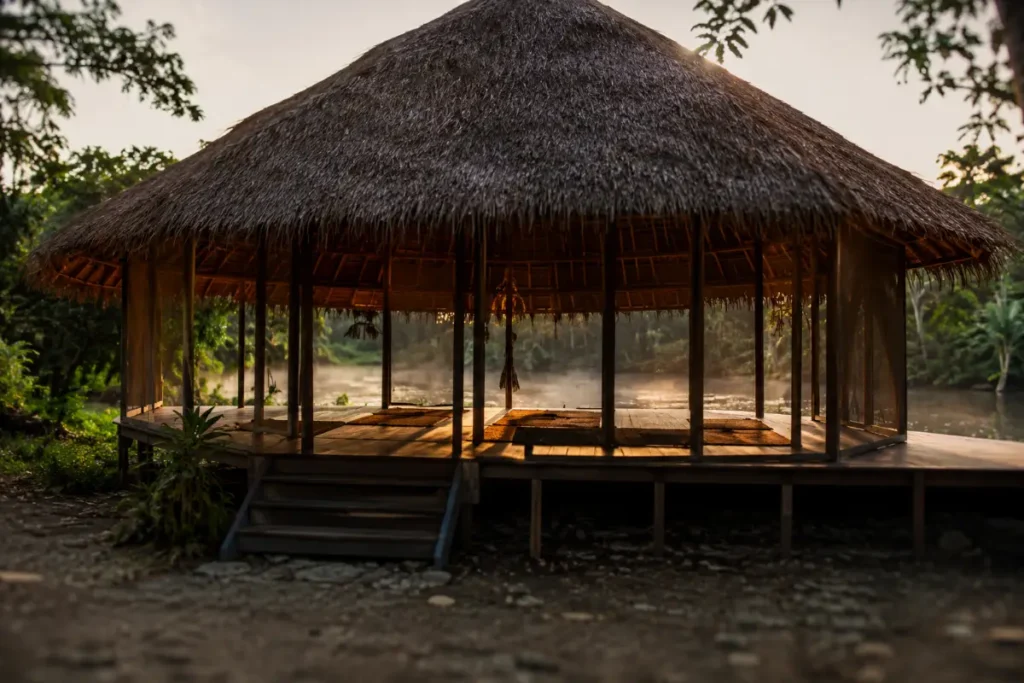
Ayahuasca effects begin 20 to 60 minutes after you drink, peak between 1.5 and 2 hours, and run 4 to 6 hours in total. That timing comes from a controlled human pharmacology study, and it matches what we watch happen in our maloca 4 nights per retreat. The brew combines DMT from chacruna leaf with monoamine oxidase inhibitors from the ayahuasca vine, which is the only reason DMT survives your stomach. Expect nausea, vomiting, a rise in blood pressure, visual changes and heavy emotion. Expect to still feel it the next day. Most of what you will read about ayahuasca effects comes from people who have never sat through one, or from clinics who only meet the people it went badly for. We have run 650 ceremonies for 1,900 guests since 2017. Here is what that looks like from the floor.
Our center sits 90 minutes upriver from Iquitos on the Rio Momon, capped at 10 guests a retreat. I am going to give you numbers other centers do not publish, including the ones that do not flatter us.
What ayahuasca is, and what is in the brew
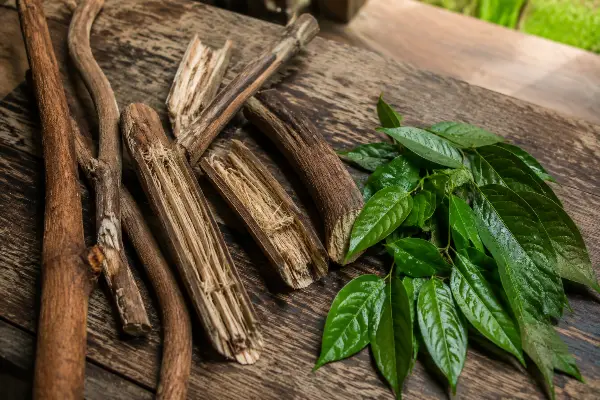
Ayahuasca is a plant medicine brewed from 2 Amazonian species: the Banisteriopsis caapi vine and the leaves of Psychotria viridis, called chacruna. The vine supplies beta-carboline alkaloids that block an enzyme in your gut. The leaf supplies DMT, the compound that produces the visions. Neither works alone. Amazonian healers have combined them for centuries.
That is the whole recipe here. Vine and chacruna, nothing else. Some centers add toé (Brugmansia) to intensify visions or blend tobacco into the brew. Our lead healer, who co-founded this center and has worked with these plants for 54 years, refuses both. His own teacher taught him one combination and he has never varied it. His words: “The vine is the doctor. The chacruna opens the door so the doctor can enter. You do not need more doctors in the room, you need the right one.”
If a center will not tell you what is in the cup, do not drink it.
How ayahuasca works in the brain
DMT acts on a serotonin receptor called 5-HT2A, the same target psilocybin and LSD hit. That receptor sits densely in the parts of the cortex that maintain your ordinary sense of self, which is why the experience can feel like your identity has come apart.
The vine is doing something separate. Its beta-carbolines (harmine, harmaline and tetrahydroharmine) inhibit monoamine oxidase, the enzyme that would otherwise destroy DMT in your gut and liver before any of it reached your brain. Block that enzyme and swallowed DMT gets through. That single pharmacological trick is why ayahuasca lasts hours instead of the 20 minutes smoked DMT lasts, and it is also the reason the medication rules below are strict rather than cautious.
How long do ayahuasca effects last?
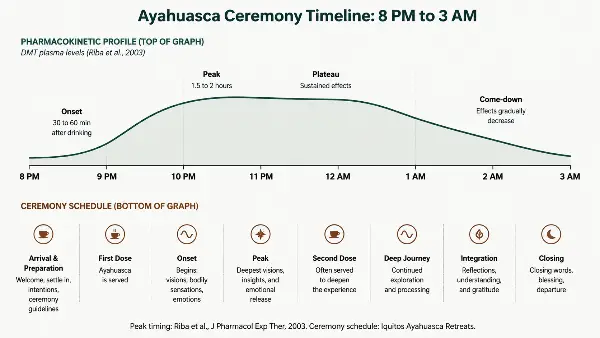
Ayahuasca effects last 4 to 6 hours from the first cup, with the peak between 1.5 and 2 hours in. In a controlled study of 18 volunteers, Jordi Riba and colleagues found DMT reached peak plasma concentration at a median of 1.5 hours, and subjective effects peaked at 1.5 to 2 hours, so the felt experience tracks the drug curve closely. The same study measured a 9 mm Hg rise in diastolic blood pressure at 75 minutes on the higher dose.
Our ceremonies run longer than the medicine does, on purpose.
| Clock | What the medicine is doing | What is happening in our maloca |
|---|---|---|
| 8:00 PM | Nothing yet | The lead healer lights mapacho, sings opening icaros, blows smoke to the 4 directions |
| 8:15 to 8:30 PM | Nothing yet | Soplada diagnóstica on each guest, then dosing. First-night doses run 40 to 60 ml |
| 8:30 to 9:00 PM | Onset. Nausea, warmth, first visual changes | Candle out. Total darkness. Silence. This is the part guests find boring and then unbearable |
| 9:00 PM to midnight | Peak. Visions, ego dissolution, heavy emotion, most purging | 3 healers singing. Second cup offered around 10 PM, and roughly 20% of those requests are declined |
| Midnight to 2:00 AM | Plateau. Visuals soften, emotional processing continues | The deepest individual work. Healers move mat to mat |
| 2:00 to 3:00 AM | Come-down. Perceptual sensitivity, fatigue | Icaros turn gentler. The ceremony closes with tobacco smoke |
| Next 1 to 7 days | After-effects. Mood shifts, vivid dreams, changed sleep | Integration circle at 11 AM. This is where the work happens |
Note the gap between the pharmacology and the ceremony. The drug is finished around 2 AM. The healers keep working. Our lead healer’s position on spacing is unpopular in this industry: 4 ceremonies across 10 days, not the 5 to 7 in a week this region treats as standard. “The vine needs time to settle into the body,” he says. “If you drink every night, you are shouting into a canyon. If you leave silence, the canyon answers.”
The physical effects, and why most people vomit
Nausea and vomiting are the most common physical effects, and they are not a sign something has gone wrong. In the Global Ayahuasca Survey, the largest dataset on this that exists, 69.9% of participants reported a physical adverse effect on at least 1 occasion. Vomiting and nausea accounted for 62.0%. Headache came in at 17.8%, fainting at 4.1% and seizures at 1.3%. The number nobody quotes: 2.3% needed medical attention afterward.
| Effect | Typical onset | Why it happens |
|---|---|---|
| Nausea and vomiting | 20 to 45 minutes | Serotonin receptors in the gut plus MAO inhibition |
| Higher heart rate and blood pressure | 30 to 75 minutes | Beta-carbolines and serotonergic stimulation. Riba measured +9 mm Hg diastolic |
| Pupil dilation | 30 to 60 minutes | Serotonergic and adrenergic stimulation |
| Feeling hot, then cold | 30 to 90 minutes | Serotonin receptor activation and metabolic change. We hand out blankets in 27 degree heat for this reason |
| Diarrhea and cramping | 30 to 90 minutes | Gut serotonin receptors |
| Sweating and heavy salivation | 30 to 60 minutes | Autonomic nervous system activation |
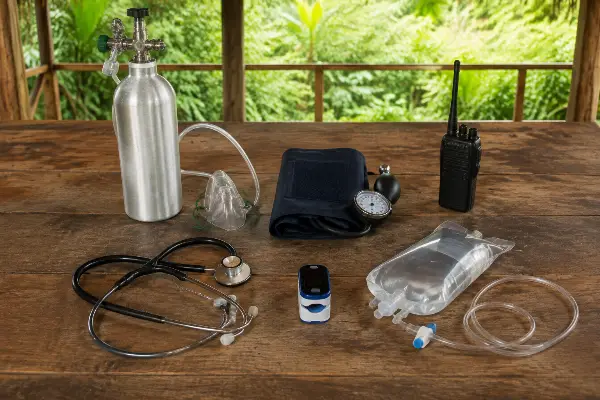
That 2.3% figure is why we keep a physician on site. Our medical director, a Peruvian-trained physician with 18 years in tropical and emergency medicine, is on the property for every ceremony block, awake, with oxygen, a pulse oximeter and injectable diazepam in reach. She does not sit in the maloca. She sits 30 seconds away.
What does purging involve?
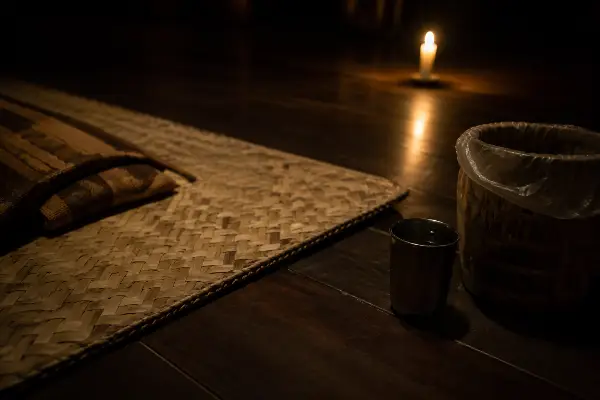
Purging is vomiting, and sometimes diarrhea. Every retreat website mentions it and almost none describes it, so here it is plainly. You have a lined bucket at your mat. A facilitator swaps it quietly when it fills. It usually starts in the first half of ceremony and runs 30 to 90 minutes. It gets lighter with each subsequent night for most people.
The sound of 9 other people purging in total darkness is alarming the first night and background noise by the third. Some guests barely purge at all. Some purge heavily every night. In 9 years we have found no relationship between how hard someone purges and how much they get out of the retreat. Our lead healer’s read on it: “The vine cleans what needs cleaning. Some houses need more work than others.”
Around the third or fourth ceremony, something usually breaks. Someone laughs mid-heave, someone else whispers a joke, and half the room loses it. Our senior facilitator calls it the purge giggle. Nobody writes about that either.
The psychological effects, and the half of the data nobody quotes
Ayahuasca amplifies what is already there rather than suppressing it. Guests report geometric visuals, symbolic scenes, a sense of reviewing their own life, and old memories arriving with full force. Grief, rage and terror surface in the room regularly. That is the mechanism people come for, and it is also the mechanism that hurts people who arrive unprepared or unscreened.
Here is where the public conversation gets dishonest in both directions.
Rehab clinics quote 1 figure from the Global Ayahuasca Survey: 55.9% of participants reported an adverse mental health effect in the weeks or months after drinking. True. The same sentence of the same abstract continues: around 88% of those people considered those effects part of a positive process of growth or integration, and around 12% sought professional support. The exact results were 87.6%, split between 76.3% who said completely and 11.3% who said somewhat.
Retreat centers quote the 88% and drop the 56%. Clinics quote the 56% and drop the 88%. Both halves are in the same paragraph of a peer-reviewed paper. A reader deciding whether to fly to Peru deserves both.
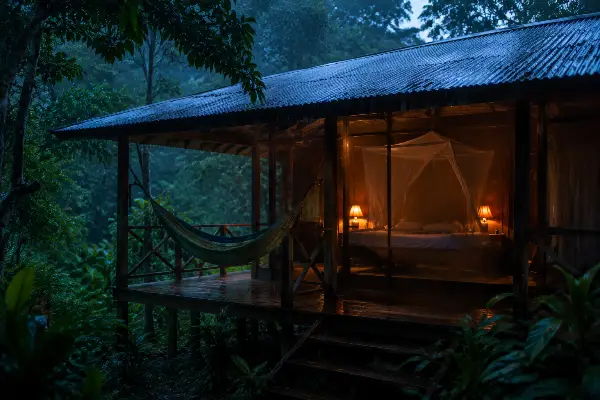
The day after, and the week after
The morning after is often harder than the ceremony. Guests describe raw emotion, vivid dreams, disturbed sleep and a strange openness that some find beautiful and some find frightening. It can last 1 to 7 days.
The 5 things our guests say they wish someone had told them, collected across 9 years:
- How boring the first 30 to 60 minutes is, lying in the dark wondering if anything will happen.
- That nothing might happen on night 1. It is common and it is not a failure.
- That the morning after can hit harder than the night itself.
- How much the jungle sound matters. Frogs, insects and river become part of the medicine.
- That coming home is harder than going. Re-entry hits returning guests like a wall.
Roughly 5 to 8% of individual ceremony opportunities across our retreats get sat out, usually after night 2 or 3 by someone who needs more time. Nobody is pressured. Our lead healer puts it plainly: “The vine invites you. If you do not feel the invitation tonight, wait. It will come.”
Who should not drink ayahuasca
Some conditions are an automatic no here, and no amount of preparation changes that. Schizophrenia or schizoaffective disorder. Any history of psychosis. Bipolar I. A parent or sibling with schizophrenia or psychosis where the applicant has no prior psychedelic experience. Current lithium, which is an absolute contraindication with no exceptions. Uncontrolled cardiac conditions or hypertension. Pregnancy. Active suicidal ideation with plan or intent. Stimulant use within 30 days.
We turn away 13% of applicants outright. Another 5 to 8% are accepted conditionally and never meet the conditions, usually because they will not complete a medication taper, so 18 to 21% of people who apply never attend. Some Iquitos centers report rejection rates of 2 to 3%. That gap is either a difference in screening or a difference in risk appetite, and you should ask which.
Can you drink ayahuasca on antidepressants?
No, and the washout is longer than most people are told. Because ayahuasca’s beta-carbolines inhibit monoamine oxidase, combining the brew with a serotonergic drug creates the same interaction that makes MAOI antidepressants dangerous alongside SSRIs. Serotonin syndrome is the risk, and it can be fatal.
Our protocol, supervised jointly by our medical director and the guest’s own prescriber:
| Medication | Minimum time off before ceremony |
|---|---|
| SSRIs (sertraline, escitalopram and similar) | 6 weeks |
| Fluoxetine | 8 weeks |
| SNRIs (venlafaxine, duloxetine) | 6 weeks, often longer |
| Tramadol | 2 weeks |
| St John’s Wort | 2 weeks |
| 5-HTP | 1 week |
| ADHD stimulants | 2 weeks |
| Benzodiazepines | Case by case, physician supervised. Withdrawal here can be dangerous on its own |
Fluoxetine gets 8 weeks because of how slowly it clears. The FDA-approved label states that at least 5 weeks should pass after stopping fluoxetine before starting an MAO inhibitor. We add 3 weeks on top of the regulatory minimum. The same enzyme block is the reason the dieta rules out aged cheese, cured meat and fermented food for 2 weeks before you arrive. When a guest’s own doctor says “two weeks should be fine,” that is the single most common piece of bad advice we hear, and it is where most of our conditional rejections come from.
We do not always get this right. In 2023 a guest disclosed mid-retreat that she had stopped her SSRI 2 weeks before arrival rather than 6, having said otherwise on her form. Our medical director reassessed, the dose was adjusted, monitoring increased, and no adverse event followed. It changed our verification process. Before we had a physician on staff, a guest with a low-dose SSRI drank in 2018 after saying she would “skip a few doses”, and spent hours with a racing heart, tremors and heavy sweating while our founder took her pulse with his fingers because the center did not own a pulse oximeter. That night is the reason the protocols exist.
What the research shows about ayahuasca and depression
The strongest evidence is 1 small trial, and it is worth stating its size out loud. Palhano-Fontes and colleagues ran a double-blind placebo-controlled trial of a single ayahuasca dose in treatment-resistant depression, published in Psychological Medicine in 2019. 29 patients: 14 on ayahuasca, 15 on placebo. At day 7, 64% of the ayahuasca group responded against 27% on placebo, a difference that reached statistical significance at p = 0.04.
That is a real result and it is 29 people. Anyone selling you a jungle retreat as clinically proven treatment is overreading it. In that trial, participants were screened hard, were off serotonergic medication, and had clinicians present throughout. A retreat is not a clinical trial, and we do not pretend to be one.
What our own outcome data shows in 2026
Since 2021 every guest completes a PHQ-9 depression score and a PCL-5 PTSD score at intake, on day 10, and again at 3 months. Across 290 complete datasets:
- Average PHQ-9 at intake: 13.1, which is moderate depression
- Day 10: 6.8
- 3 months: 7.3
- 70% showed sustained improvement at 3 months
- 14% showed no meaningful change
- 16% improved and then partly slid back
Among the 24% of guests who scored above the clinical cutoff for PTSD at intake, average PCL-5 fell from 48.6 to 35.2, and 65% dropped below the cutoff.
Read the second half of that carefully. 30% of our guests did not sustain improvement at 3 months. This is observational data with obvious selection bias, since the people who answer follow-up surveys are more likely to be doing well. We are not a clinical trial and we do not present it as one. We publish it because almost no center in this region collects the data at all, which means they do not know their own number.
Is ayahuasca legal in Iquitos?
Yes. Ayahuasca is legal in Peru, and its traditional use carries formal protection. On 12 July 2008 Peru’s Instituto Nacional de Cultura issued National Directorial Resolution No. 836/INC, declaring the traditional knowledge and uses of ayahuasca practiced by Amazonian native communities to be Cultural Heritage of the Nation. No guest here faces legal risk for participating in ceremony.
The part centers leave out: that same resolution explicitly rejects decontextualized Western uses, consumerist applications and commercial purposes. Peru protected the ritual, not the retreat industry that grew around it. Read honestly, the 2008 declaration is closer to a criticism of ayahuasca tourism than an endorsement of it, and any center quoting it as a license is quoting it backwards. There is no licensing regime for retreat centers in Peru. Nobody inspected our maloca. Nobody checks our medical kit. That absence is exactly why screening and published data should carry the weight that a license would.
Peru’s protection also stops at the border. If DMT is controlled where you live, the declaration does nothing for you at home. Our full breakdown of ayahuasca’s legal status in Peru covers what changes when you fly north.
What goes wrong, and what we do about it
In 9 years, 1,900 guests and 650-plus ceremonies we have evacuated 2 people. Zero deaths. Zero incidents of sexual or physical misconduct. Zero lawsuits.
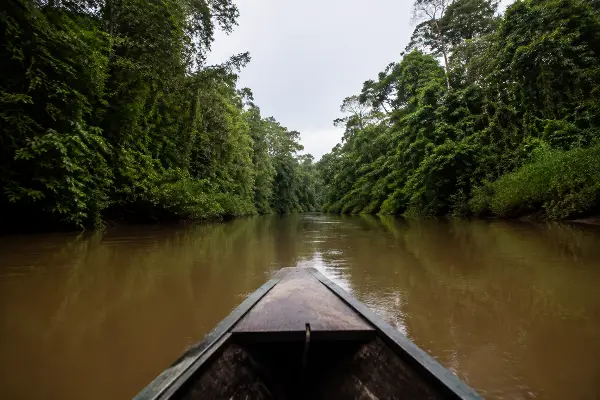
The first evacuation was 2018: a guest with an undisclosed heart condition developed chest pressure and breathing difficulty during ceremony. We ran the boat downriver in the dark to Hospital Regional de Loreto. He recovered fully. There is no road in or out, so getting to the Momon means a flight into Iquitos and then a boat, and that isolation is the whole reason the evacuation plan has to be real rather than written down. That night led to cardiac screening questions and required ECG documentation for anyone over 50, and our founder’s description of it has not softened: it was the night he realized he was running a medical operation disguised as a retreat center.
The second was 2022: a guest developed acute psychosis roughly 90 minutes in. Our medical director administered intramuscular diazepam, he stabilized within 20 minutes, and he was evacuated at dawn. He recovered fully, and later disclosed a father diagnosed with schizophrenia that he had left off his application because he did not think it relevant. Family psychiatric history became a required disclosure the following month.
Beyond those 2, our medical director has been called to assess a guest during ceremony 6 to 8 times for racing heart, extreme panic or prolonged dissociation. All were handled on site. Post-retreat, 12 to 15 guests have contacted our emergency line in crisis across 9 years, and none required psychiatric hospitalization.
A center that claims a spotless record across years of operation either opened recently or is not telling you everything.
How do you check a retreat before you book?
Do not start with reviews. A 5-star review tells you someone had a good night. It tells you nothing about what happens when a guest stops breathing at 2 AM.
Ask these 5 questions of any center, including this one:
- Who are the healers, by name, and who trained them?
- What is the screening process, and what percentage of applicants do you reject?
- Who provides medical cover during ceremony, what are their credentials, and where is the nearest hospital?
- What is the staff-to-guest ratio inside the maloca?
- What integration support exists after departure, and for how long?
Our answers: 3 healers from one family lineage, all trained inside it, traceable back 5 generations, and named to you in full during screening. The story of how this center started explains why they own part of it. 13% of applicants rejected. A physician on site, 45 minutes by fast launch to Hospital Regional de Loreto. 3 healers and 2 facilitators for a maximum of 10 guests, so 1 staff member for every 2 people in the room. A 12-month integration program with calls at week 1, week 3, month 3, month 6 and month 12.
If a center cannot answer those with specifics, the ayahuasca effects you should worry about are not the ones in the cup. Read what our 10-day retreat involves, or ask us anything before you apply.
If you are already home and something has not settled, meaning visual changes, paranoia, disturbed sleep or emotional volatility weeks after a ceremony anywhere, get assessed. Do not wait it out. Ayahuasca can access material talk therapy struggles to reach, but insight is not the same thing as healing, and the people who struggle longest are usually the ones who waited 6 months before telling anyone.
FAQs
How long do ayahuasca effects last?
Ayahuasca effects last 4 to 6 hours, with the peak between 1.5 and 2 hours after drinking. A controlled study of 18 volunteers found DMT reached peak plasma concentration at a median of 1.5 hours, and subjective effects peaked at 1.5 to 2 hours. Physical effects like nausea usually settle within the first 2 to 3 hours. After-effects including vivid dreams, mood shifts and disturbed sleep can run 1 to 7 days.
What are the most common ayahuasca effects?
The most common physical ayahuasca effects are nausea and vomiting, reported by 62.0% of participants in the Global Ayahuasca Survey. Higher heart rate and blood pressure, pupil dilation, sweating, temperature swings and diarrhea are also standard. Psychologically, most people report visual imagery, intense emotion and old memories surfacing. Around 69.9% of survey participants reported some physical adverse effect, and 2.3% needed medical attention afterward.
Can ayahuasca cause lasting psychological harm?
Yes, in some people. Prolonged dissociation, persistent visual disturbances and psychosis are documented, and risk is highest in people with a personal or family history of psychotic illness. The Global Ayahuasca Survey found 55.9% of participants reported an adverse mental health effect in the weeks or months afterward, though around 88% of those considered it part of a positive process of growth and around 12% sought professional support.
What medications interact dangerously with ayahuasca?
Serotonergic medications are the dangerous ones, because ayahuasca’s beta-carbolines are monoamine oxidase inhibitors and that combination can cause serotonin syndrome. This includes SSRIs, SNRIs, tricyclic antidepressants, tramadol, lithium and linezolid. We require 6 weeks off SSRIs and 8 weeks off fluoxetine, which exceeds the 5-week minimum the FDA-approved fluoxetine label sets before starting an MAO inhibitor.
Is ayahuasca legal in Iquitos, Peru?
Yes. On 12 July 2008 Peru’s Instituto Nacional de Cultura declared traditional ayahuasca knowledge and use Cultural Heritage of the Nation under National Directorial Resolution No. 836/INC. Guests face no legal risk taking part in ceremony in Peru. The same resolution explicitly rejects decontextualized and commercial Western uses, and there is no licensing regime for retreat centers, so legality is not the same as oversight.
Why do people vomit during an ayahuasca ceremony?
Vomiting happens because ayahuasca activates serotonin receptors in the gut while its MAO-inhibiting compounds are active. It is the single most common effect, reported by 62.0% of Global Ayahuasca Survey participants. In ceremony it typically starts in the first half and lasts 30 to 90 minutes, and it usually gets lighter on later nights. Across 650 ceremonies we have seen no relationship between how heavily someone purges and how much they get from the retreat.
Does ayahuasca help depression?
The evidence is promising and thin. A 2019 double-blind placebo-controlled trial in Psychological Medicine found that at day 7, 64% of patients with treatment-resistant depression responded to a single ayahuasca dose against 27% on placebo, but that trial had 29 participants. Our own follow-up data on 290 guests shows average PHQ-9 falling from 13.1 at intake to 7.3 at 3 months, with 70% sustaining improvement and 30% not.