Ayahuasca affects the brain in three ways we can measure. DMT from the chacruna leaf binds serotonin 5-HT2A receptors and the sigma-1 receptor. Harmala alkaloids in the vine block the gut enzyme that would otherwise destroy that DMT, which is the only reason a drinkable brew does anything at all. And for the 4 to 6 hours that follow, the default mode network, the circuit that runs your internal narrator, drops in activity and rewires how it talks to the rest of the brain.
That is the mechanism. It is not the same thing as knowing what happens to a person.
I have sat outside 650 ceremonies on the Rio Momon since 2017. The published research explains maybe half of what I watch happen in the maloca. This article gives you both halves, and it tells you where the science stops.
What is ayahuasca doing to your brain?
Ayahuasca is a brew of two Amazonian plants that changes brain activity for about 4 to 6 hours. The chacruna leaf supplies DMT, which activates serotonin 5-HT2A receptors. The Banisteriopsis caapi vine supplies harmala alkaloids, which inhibit monoamine oxidase so the DMT survives digestion. Together they suppress the default mode network and increase communication between brain regions that normally stay separate.
That is the answer in 60 words. The rest of this page is the evidence behind it, and the parts of the experience that no brain scan has explained yet.
Here is the honest state of the evidence in 2026, because most pages on this topic blur the line between a mouse study and a human one.
| Claim you have read somewhere | Evidence type | Studied in | What it actually supports |
|---|---|---|---|
| Ayahuasca quiets the default mode network | Neuroimaging, fMRI | Humans | Strong. Replicated since 2015 |
| Ayahuasca relieves treatment-resistant depression | Randomized placebo-controlled trial | Humans, n=29 | Moderate. One small trial, large effect |
| Ayahuasca raises BDNF, a plasticity marker | Randomized controlled trial | Humans, n=73 | Moderate. Blood marker at 48 hours |
| Ayahuasca grows new neurons | Lab and animal study | Cultured cells and mice | Weak in humans. Never shown in a person |
| Ayahuasca reprograms traumatic memory | Hypothesis paper | Neither. Theory built on animal data | Untested. A proposed mechanism, not a finding |
| Ayahuasca changes how you see other people | Crossover fMRI trial | Humans, n=12 | Early. Published January 2026 |
Anyone selling you certainty on rows 4 and 5 is selling you something.
The two plants, and why one of them is the reason any of this works
Swallow DMT on its own and nothing happens. An enzyme in your gut and liver called monoamine oxidase A breaks it down before it reaches your blood. The ayahuasca vine solves that. Its harmala alkaloids, mainly harmine and harmaline, inhibit that enzyme long enough for the DMT to get through.
This is not folklore that happened to work. It is a two-drug pharmacological system that Amazonian healers arrived at without a laboratory, and it is the reason our dieta rules around aged and fermented foods exist. The same enzyme that protects the DMT also clears tyramine from your food. Block it, eat aged cheese, and your blood pressure can spike.
Our lead maestro, who co-founded this center and has worked with these plants for 54 years, puts it in his own terms: “The vine is the doctor. The chacruna opens the door so the doctor can enter.” He is describing pharmacokinetics. He just learned it from his teacher rather than from a paper.
We brew vine and chacruna only. No toe, no datura, no additives. Every extra plant is an extra variable a healer cannot control, and there is no published safety data on most of the combinations sold around Iquitos.
The default mode network, and what quieting it feels like from a mat
The default mode network is the set of brain regions most active when you are not doing anything in particular. It runs self-referential thought: rehearsing the past, planning, narrating yourself to yourself. In depression it tends to be overactive and rigid.
In 2015, Fernanda Palhano-Fontes and colleagues at the Brain Institute in Natal published fMRI scans showing that ayahuasca reduces activity across the default mode network, including the posterior cingulate cortex and medial prefrontal cortex, and loosens the connectivity that holds it together. Every serious page on this topic cites this study. Almost none of them tell you what it looks like.
What it looks like is a person who stops sounding like themselves. In integration circles the morning after, guests do not say “my default mode network was suppressed.” They say some version of what a corporate attorney from New York told us in 2024: that she had watched her whole life as a courtroom where she was the prosecutor, the defendant, and the judge at once, and realized the trial had been running since she was 8 years old.
The narrator did not go quiet. It got small enough to look at.
Does ayahuasca rewire your brain?
Not in the way the internet says, and the gap between the claim and the evidence is worth understanding before you decide anything on the strength of it.
The neurogenesis claim traces to one study. In September 2020, Jose Morales-Garcia and colleagues published work in Translational Psychiatry showing that DMT stimulates adult neurogenesis in the subgranular zone of the hippocampus. The mechanism runs through the sigma-1 receptor: block that receptor and the effect disappears. Treated animals also did better on the Morris water maze and novel object recognition.
The animals were mice. C57/BL6 mice. The cells were cultured neural stem cells. Nobody has shown a human being growing new neurons from ayahuasca, and with current technology nobody can, because you cannot count neurons in a living person’s hippocampus.
The best human plasticity evidence we have is smaller and less exciting. In a randomized controlled trial published in June 2019, Raissa de Almeida, Ana Cecilia Galvao and colleagues measured serum BDNF in 73 volunteers, 45 healthy and 28 with treatment-resistant depression. Forty-eight hours after dosing, the ayahuasca group had higher BDNF than the placebo group, and in the treated patients only, higher BDNF tracked with lower depression scores.
BDNF is a growth factor associated with plasticity. A change in blood BDNF is not a rewired brain. It is a signal that something plastic may be happening, measured in the least direct way available.
So: your brain probably becomes briefly more changeable. It does not get rebuilt. Anyone promising you a rebuilt brain is quoting a mouse.
How ayahuasca works on traumatic memory
The leading theory is that ayahuasca opens a window in which a fear memory can be recalled, altered, and re-stored differently. Antonio Inserra, then at the South Australian Health and Medical Research Institute, laid this out in Frontiers in Pharmacology in April 2018. His words: “As Ayahuasca alkaloids enhance synaptic plasticity, increase neurogenesis and boost dopaminergic neurotransmission, and those processes are involved in memory reconsolidation and fear extinction, the fear response triggered by the memory can be reprogramed and/or extinguished.”
Read the label on that paper. It is filed as Hypothesis and Theory. Inserra proposed a mechanism. He did not demonstrate one in a person. Six years on, it remains the most plausible explanation we have and it remains untested in humans.
What I can tell you is what the pattern looks like from outside it. A retired firefighter from Chicago came to us in 2025. Powerfully built, stoic, said almost nothing in the first two integration circles. “Nothing happened” was his entire contribution. On the third night our lead maestro spent nearly 2 minutes on him during the pre-serving reading instead of the usual 45 seconds, then directed songs at him for 25 minutes straight. Around 1am he made a sound for half an hour that was not crying and was not screaming. When it stopped he said: “I can breathe. I have not been able to fully breathe in 31 years.”
The next morning he told the group about a child he could not reach in a house fire in 1994. He said the medicine took him back into that house and let him say goodbye. “Thirty-one years of therapy could not get me into that room.”
That is one man. It is not data. The data is in the next section, and it is more mixed than that story.
What our own follow-up data shows in 2026
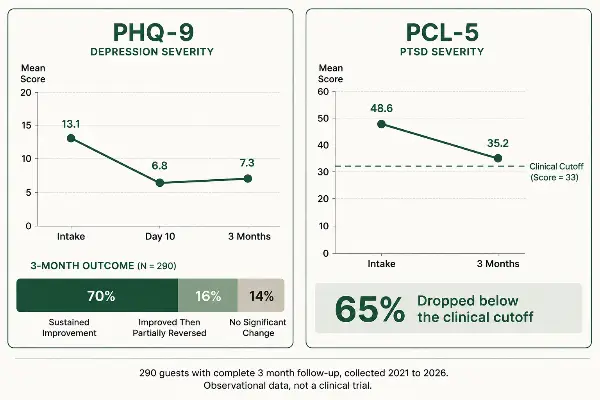
Since 2021 we have run the PHQ-9 depression scale and the PCL-5 PTSD checklist on every guest at intake, on day 10, and again at 3 months. We now have 290 complete data sets.
PHQ-9 scores average 13.1 at intake, which is moderate depression. On day 10 they average 6.8. At 3 months they average 7.3, so most of the drop holds. Seventy percent of guests show sustained improvement at 3 months. Fourteen percent show no significant change at all. Sixteen percent improve, then partially slide back.
That last part matters more than the first. Thirty percent of the people who come here do not get a durable lift from this, and we would rather publish that than let you find out at month 3.
For PTSD, about 24% of guests score above the clinical cutoff on the PCL-5 at intake. Among those, the average score falls from 48.6 to 35.2 at 3 months, and 65% drop below the cutoff.
Two honest caveats. This is observational data with obvious selection bias, because the people who answer a 3-month questionnaire are more likely to be the ones doing well. And we are a retreat center, not a clinical trial. But it is real data, collected the same way every time, and almost no center in this region collects any.
Compare that to the strongest controlled evidence in the field. In the only randomized placebo-controlled trial of ayahuasca in treatment-resistant depression, Palhano-Fontes and colleagues gave a single dose to 29 patients. At day 7, 64% of the ayahuasca group responded versus 27% on placebo, with a Cohen’s d of 1.49. Remission was 36% versus 7%.
That is a large effect from 29 people, once. It is the best evidence there is, and it is still one small trial.
Why does the first hour feel like nothing is happening?
Because it mostly is. Oral DMT has to clear digestion and survive an enzyme that is only partly blocked, so onset runs roughly 30 to 60 minutes. That window is the single most misunderstood part of the night.
Guests lie in total darkness convincing themselves they got a weak cup. Some of them start bargaining. A few decide it has failed. Then it arrives.
Our lead maestro doses conservatively on the first night, usually 40 to 60 ml, and he decides each person’s amount individually after reading them with mapacho smoke before he pours. It is one reason the retreat runs across 10 days rather than a long weekend, with gaps between ceremonies instead of four nights back to back. He turns down about 20% of second-cup requests, almost always from people who are already deep in it and cannot tell. In 54 years he has built a calibration no instrument replaces, and we log every batch (vine weight, chacruna weight, water volume, cook time, reductions) so that his read has consistent material to work with. That log now covers more than 130 batches since 2020.

Why do some people feel nothing for two nights?
This happens often enough that we brief every guest on it before arrival. Roughly speaking, when a guest reports “nothing,” probing usually turns up body sensations, temperature changes, mild emotional shifts, or unusually vivid dreams. They expected an explosion and got a whisper, so they filed it as nothing.
The pattern we see most: nothing on night 1, nothing on night 2, and the third ceremony takes the roof off. Both of the transformations described above followed exactly that shape.
Our lead maestro’s version: “The vine is learning you. Sometimes it walks through your house at night and rearranges the furniture so quietly you do not notice until morning.”
There is no imaging study of this. I am telling you it happens because I have watched it happen for 9 years, not because a scan says so.
What ayahuasca does to a brain on antidepressants
This is the section that matters most for your safety, and the one the other pages on this topic leave out.
Ayahuasca contains monoamine oxidase inhibitors. SSRIs, SNRIs, and several other drugs raise serotonin by other routes. Combine them and you risk serotonin toxicity: elevated heart rate, agitation, tremor, heavy sweating, and in severe cases something far worse. Lithium is the hard line. A 2021 analysis of online experience reports by Nayak and colleagues found that combining classic psychedelics with lithium, but not with lamotrigine, was associated with seizures. That is report data rather than trial data, and it is more than enough for us to refuse.
We learned this the hard way. In 2018, before we had a physician, a guest disclosed a low-dose SSRI and said she would skip a few doses. I did not understand the interaction. She drank, and spent hours with a racing heart, tremors, and heavy sweating while I monitored her pulse with my fingers because we did not own a pulse oximeter. She recovered by morning. Within 6 weeks we had recruited a full-time medical director, bought equipment, and rebuilt screening from scratch.
These are the taper windows our medical director now enforces, jointly with each guest’s own prescribing physician:
| Medication | Minimum time off before ceremony |
|---|---|
| SSRIs (sertraline, escitalopram and similar) | 6 weeks |
| Fluoxetine | 8 weeks, because of its long half-life |
| SNRIs (venlafaxine, duloxetine) | 6 weeks, often longer |
| Lithium | Never. Absolute contraindication |
| ADHD stimulants (Adderall, Ritalin, Vyvanse) | 2 weeks |
| Tramadol | 2 weeks |
| St. John’s Wort | 2 weeks |
| 5-HTP | 1 week |
| Benzodiazepines | Case by case, physician supervised. Withdrawal itself can be dangerous |
The most expensive preparation mistake we see is a guest whose doctor said “two weeks should be fine.” They arrive in withdrawal, dizzy and emotionally raw, and the medicine lands on an already destabilized nervous system.
Who we turn away, and why
We reject 13% of applicants outright. Another 5% to 8% are accepted on condition and never meet the conditions, usually because they will not complete a taper. So about 1 in 5 people who apply never sit in our maloca.
Automatic disqualifications include schizophrenia or schizoaffective disorder, any history of psychosis, Bipolar I, a parent or sibling with schizophrenia or psychosis in someone with no prior psychedelic experience, current lithium, uncontrolled cardiac conditions, uncontrolled hypertension, pregnancy, and active suicidal ideation with a plan.
That last category is the one people argue with. Someone in acute crisis needs stabilization, not a 10-day process that deliberately destabilizes you before it settles you.
Every application is read by a physician. Every applicant does a 30 to 45 minute video call. Some centers in this region report rejection rates of 2% to 3%, which means either their screening is thinner than ours or they are carrying risk we are not willing to carry.
On the broader safety picture, the largest survey ever run on this is worth knowing. In 2022, Jose Carlos Bouso and colleagues published results from the Global Ayahuasca Survey covering 10,836 people. Nearly 70% reported acute physical adverse effects, overwhelmingly vomiting, and only 2.3% needed medical attention afterward. In the weeks and months after drinking, 55.9% reported mental health effects, and 88% of those considered them part of a positive process. About 12% sought professional support.
Read that honestly. Most of the physical difficulty is the purge. The mental after-effects are common, usually workable, and occasionally not. That 12% is why we run structured follow-up calls at week 1, week 3, and month 2 instead of sending you home with a hug.
What the research still cannot tell you
PubMed now returns 796 results for ayahuasca, up from 336 when most of the articles you have read on this topic were written. The newest work is getting more specific. In January 2026, Carla Soares and colleagues at the University of Coimbra published a randomized crossover fMRI study in Social Cognitive and Affective Neuroscience: 12 experienced drinkers, two doses, showing that ayahuasca strengthens connectivity between a region involved in reading other people and both the visual cortex and the motor system. Connectivity strength tracked closely with how much guests reported seeing things from another person’s perspective.
That is interesting. It is also 12 people.
Here is what no study has measured: whether the healer matters. Every trial gives a dose in a clinical room. Nobody has run a trial comparing the same dose with and without 5 hours of directed icaros from a curandero who has dieted 50 plants. In our maloca the songs are not ambience, they are the intervention, and the entire research literature is silent on them.
Part of the reason that study has not happened is jurisdictional. Peru declared traditional ayahuasca use national cultural heritage in 2008, and ceremonial practice here is protected under Peruvian law, while most of the countries funding neuroscience treat DMT as a controlled substance. The tradition is intact in the one place the research money is not.
Until someone designs that study, treat any page that tells you exactly how ayahuasca heals with suspicion. Including this one. What I can point at is a mechanism that is well described, an outcome record that we publish including the failures, and a screening process built out of the two nights that scared us most.
If you are weighing this seriously, look at the work we actually run here before you read another word about neuroscience. And if you have a question about how ayahuasca affects the brain on your particular medication, put it in front of our team before you book flights.
FAQs
How does ayahuasca affect the brain?
Ayahuasca affects the brain by delivering DMT to serotonin 5-HT2A and sigma-1 receptors while harmala alkaloids from the vine block the enzyme that would otherwise destroy it. The most consistent finding across human imaging studies is reduced activity in the default mode network, the circuit behind self-referential thought. Effects last about 4 to 6 hours.
Does ayahuasca permanently change the brain?
There is no evidence of permanent structural change in humans. A 2019 randomized controlled trial in 73 volunteers found higher serum BDNF, a plasticity marker, 48 hours after dosing. The widely repeated claim that ayahuasca grows new neurons comes from a 2020 study in cultured cells and mice, not people.
Can ayahuasca damage your brain?
A 2024 cross-sectional study of long-term ritual users in European Archives of Psychiatry and Clinical Neuroscience found preserved global cognitive function and better memory scores, so structural damage is not the concern. The real risk is pharmacological. Combining ayahuasca with SSRIs, SNRIs, lithium, or other serotonergic drugs can cause serotonin toxicity. We require a 6 week SSRI taper, 8 weeks for fluoxetine, and we reject lithium users outright.
How does ayahuasca affect the brain in people with PTSD?
The leading explanation, published as a hypothesis paper in 2018, is that ayahuasca opens a window where a fear memory can be recalled and re-stored with less charge. It has not been tested directly in humans. In our own follow-up data, guests scoring above the PCL-5 clinical cutoff at intake dropped from an average of 48.6 to 35.2 at 3 months, with 65% falling below the cutoff.
Why do some people feel nothing during their first ceremony?
Onset takes roughly 30 to 60 minutes because oral DMT has to clear digestion, and first-night doses are deliberately conservative, usually 40 to 60 ml. Most guests who report feeling nothing actually experienced body sensations or vivid dreams and expected something louder. The most common pattern we see is a quiet first two nights and a powerful third ceremony.
Is ayahuasca more effective than antidepressants?
No study has compared them head to head. The one randomized placebo-controlled trial in treatment-resistant depression found 64% of the ayahuasca group responded at day 7 versus 27% on placebo, from a single dose in 29 patients. That is a large effect from a small trial, and it is not the same as evidence that ayahuasca outperforms daily medication over months.
How long do ayahuasca’s effects on the brain last?
The acute effects run 4 to 6 hours. Blood markers of plasticity have been measured at 48 hours. In our own data, PHQ-9 scores average 13.1 at intake, 6.8 on day 10, and 7.3 at 3 months, so most of the change holds for at least 3 months in 70% of guests. Thirty percent do not hold it.