Ayahuasca can lower grief severity. Until last year, nobody had tested that against a control group.
In September 2025 a Spanish research team published the first controlled trial of ayahuasca for grief. 84 bereaved adults, 3 groups, everyone inside 12 months of losing a parent, a sibling or a child. One group got ayahuasca plus 9 weeks of therapy. One got the same therapy without ayahuasca. One got nothing.
The ayahuasca group improved most. The therapy-only group did not separate from the group that got nothing at all.
That finding is the reason this page exists. It says the ceremony was the smaller half of what worked, and nearly every page you will read about grief and this medicine has that the other way around.
I’m Michael Vale, and I co-founded this center on the Río Momón in 2017. I started it after my younger brother Daniel died, which is a longer story. Grief is 11% of why people come here.
Does ayahuasca help with grief?
The evidence says yes, and it says the help comes from a package, not from a night.
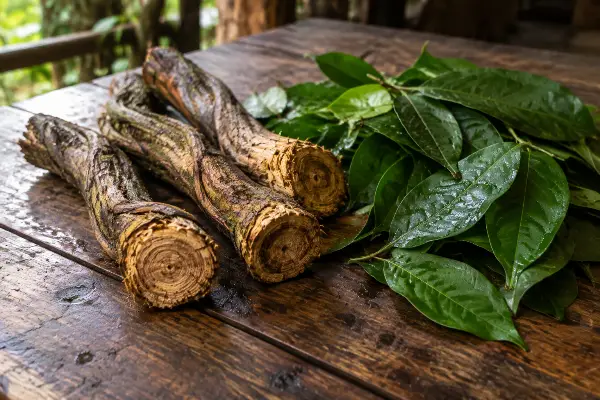
Ayahuasca for grief means drinking a brew of Banisteriopsis caapi and Psychotria viridis in a ceremony led by a trained healer, while bereaved, with preparation before and structured support afterward. Across 3 published studies it has lowered measured grief severity in bereaved adults. No study has tested the brew on its own, without therapy or ceremony around it.
That last sentence matters more than it looks. Every result below came from ayahuasca plus something else.
The only controlled trial of ayahuasca for grief
84 adults. 28 per group. 82 finished.
Everyone had lost a first-degree relative within the past 12 months and scored 40 or higher on the Texas Revised Inventory of Grief, so nobody entered with mild symptoms. The 3 arms were ayahuasca plus meaning reconstruction therapy, meaning reconstruction therapy alone, and no treatment. The ayahuasca arm drank 0.75 mg of DMT per kilo, split into a first cup and a second one 30 minutes later, across 1 to 2 sessions. Everyone in both therapy arms got 9 weekly sessions of 50 minutes.
On the Traumatic Grief Inventory, the measure built to screen for prolonged grief, here is what happened by the end of treatment and again 3 months later. Effect sizes are Cohen’s d, where 0.8 is usually called large.
| Group | What they received | End of treatment | 3 months later |
|---|---|---|---|
| Ayahuasca plus therapy | 1 to 2 ayahuasca sessions and 9 weekly therapy sessions | 2.44 | 2.48 |
| Therapy alone | 9 weekly therapy sessions | 1.84 | 1.81 |
| No treatment | Nothing | 0.74 | 0.96 |
Every one of those is a real improvement. Grief gets better on its own, and the bottom row is what that looks like.
The comparisons between groups are where it gets interesting. Ayahuasca plus therapy beat therapy alone (d = 0.86, p = .012) and beat no treatment (d = 1.07, p = .0008). Therapy alone did not beat no treatment at either timepoint. The published trial reports p at or above .990 for that comparison, which is as close to nothing as a number gets.
Safety: no serious adverse events. 16 people had nausea or vomiting, 4 had headaches, 2 fainted, 2 reported anguish.

Was it the ayahuasca or the therapy?
Neither, on its own. That’s the honest reading, and the trial’s authors say so themselves.
No arm in that study received ayahuasca without preparation, therapy, integration and a group. So the trial cannot tell you what ayahuasca alone does for a bereaved person. It can tell you that adding 1 or 2 ceremonies to 9 weeks of grief therapy moved people further than the therapy did by itself, and that the therapy by itself did not outperform time.
I have watched this from the other side of the maloca for 9 years. People book a retreat believing the ceremony is the treatment and the follow-up is aftercare. The trial suggests they have it backwards, or at least sideways. The ceremony opened something. 9 weeks of weekly work closed it into a life.
Our own follow-up is lighter than what that trial delivered. Ours is a call in week 1, another in week 3, then check-ins at months 2, 6 and 12. Theirs was 9 consecutive weekly hours with a therapist. I’d rather say that plainly than claim a match we don’t have. If you are choosing a center for grief, ask every one of them what happens in the 9 weeks after you fly home, and compare the answers to that trial.
How soon after a death is too soon?
Nobody in this industry publishes an answer, including us. Here is what the research says, and what we screen on instead.
The ayahuasca trial deliberately treated people early. Its inclusion window was a first-degree loss inside the past 12 months, with no lower limit at all. Its title calls the approach an early resource for bereavement, and the protocol argues that making grieving people wait 6 to 12 months for evidence-based support leaves them alone at their most vulnerable.
The grief research outside psychedelics pushes back hard on that. A meta-analysis of 14 randomized trials covering 1,655 bereaved people found that interventions offered to bereaved people in general did nothing measurable: a standardized mean difference of -0.03 at the end of treatment and 0.13 at follow-up, neither of them statistically meaningful. The same analysis found that interventions aimed at people already showing a complicated grief reaction worked well, at -0.53 and -1.38. An American Psychiatric Association review puts it flatly: no effect was found for preventive interventions, suggesting that early intervention may not be required. What that review recommends in the first months is support, sleep and people.
Both of those can be true, and I think they are. The studies that found early help useless were testing counselling offered to bereaved people as a class, with no screen at the door. The ayahuasca trial screened first and took only people scoring 40 or above. That makes it targeted treatment delivered early, not prevention sprayed at everybody. Read that way, the 2 literatures stop arguing.
We don’t publish a fixed waiting period, and neither does anyone else in this field. I went looking before I wrote that, through the most detailed public screening documents the Peruvian Amazon centers put out, and bereavement appears in none of them.
Here is what already applies here. Active suicidal thinking with a plan is an automatic no on our application, bereavement or not, and we turn away 13% of applicants outright after a 30 to 45 minute call. Ask any center you’re weighing what they do with an application from someone bereaved 6 weeks ago. An answer that isn’t a number is fine. No answer at all isn’t.
Someone in crisis right now doesn’t need a retreat 6 weeks from now. They need local emergency help today.
Most grief is not a disorder, and 2 diagnoses disagree on when it becomes one
Between 4% and 15% of bereaved adults develop prolonged grief disorder. So 85% to 96% do not.
Prolonged grief disorder entered the DSM-5-TR in March 2022. To meet it, the American Psychiatric Association requires that the death happened at least 12 months ago for an adult, 6 months for a child or adolescent, with intense grief that is still cutting into daily life. The ICD-11 sets its threshold at 6 months instead of 12. The 2 systems used worldwide disagree by half a year on when ordinary sorrow becomes a diagnosis, which should tell you how uncertain this line is.
I’m not a clinician and this page isn’t a diagnosis. Take the arithmetic from it, if nothing else. If you are 3 months out from a death and you feel destroyed, that is the common outcome, not a condition. Most of the people in that no-treatment group got better without anyone doing anything to them.
Some don’t. If a year has passed and you still can’t work, can’t sleep and can’t put the person down, that is the group the treatment research is about, and it is worth a conversation with a doctor before it is worth a conversation with us.
What bereaved people report happening in ceremony
5 things, named by the researchers who interviewed them. Not 10, and not a mechanism with a catchy name.
A 2021 book chapter analyzing bereaved participants at a Peruvian retreat grouped their reports into emotional processing, making meaning of the past, reconstructing identities, continuing bonds with the deceased, and finding existential meaning. An earlier survey of 60 people, half of them ayahuasca drinkers and half in peer support groups, named 3 categories in the ayahuasca group: emotional release, biographical memories, and contact with the deceased.
Read those lists closely and the same idea shows up more than once under different names. Continuing bonds, contact with the deceased, keeping a relationship going in a changed form. That is 1 finding, not 4, and it is the one that surprises people most. The research does not describe ayahuasca as helping people let go. It describes people arriving at a different arrangement with someone who is still, in some way, theirs.
The 2020 follow-up study measured 2 things underneath all of that. Experiential avoidance, meaning the habit of steering away from painful feeling, fell and tracked with the drop in grief (r = 0.55). Decentering, the ability to watch your own pain instead of being inside it, rose (r = -0.47). Put plainly: people stopped running, and got a little distance at the same time. What the brew is doing while that happens is better understood than it was 5 years ago. What that looks like in the body during a night is a separate subject, and mostly it looks like crying.
The night a dead man’s song came through
A man sat in our maloca carrying the death of his child.
Don Enrique had been singing to him for close to 20 minutes. Then he stopped and sat still. When he started again, it was a song I had not heard in 9 years of ceremonies, and his voice had changed. It sounded older and thinner, like it was coming from further away. Wilber, on the other side of the room, stopped what he was doing and turned toward his father.
Afterward I asked what the song was. Don Enrique said: “That was not my song. That was Julio’s song. The one he sang to me when my own father died. I did not choose to sing it. Julio came and sang it through me because this man needed a song for a dead child, and I do not have one. Julio does.”
Maestro Julio had been dead for 19 years. Wilber recognized the song from the family’s recordings of him and had never heard his father sing it.
I can’t explain that and I’ve stopped trying. I can tell you what it costs to have that available: a lineage you can check by name, 3 healers in the room for a maximum of 10 guests, and 54 years of one man’s practice. In Shipibo and mestizo practice alike, grief is treated as something lodged in the body that gets sung out rather than talked out. The research uses the words emotional processing. The maloca uses a song. I’ve watched both do the same thing to the same person.
One more, because a single story proves nothing. A man in his 60s said almost nothing through 2 ceremonies. On the third night he made a sound for close to 30 minutes that was not crying and not screaming. When it stopped he said: “I can breathe. I have not been able to fully breathe in thirty-one years.” The next morning he told the circle about a child he had not been able to reach in a fire, decades earlier. He had never told anyone, and he came back 3 months later to sit a dieta.

What 12 months of follow-up showed, at another center near Iquitos
Grief severity fell and stayed down for a year. That study was run at another retreat center in the Iquitos area, which makes it the closest thing to local research that exists.
50 bereaved people enrolled, and the group thinned out fast. The published paper reports effect sizes between 0.84 and 1.39 at every checkpoint, on the Texas Revised Inventory of Grief.
| When | Average grief score | People still reporting |
|---|---|---|
| Before the retreat | 40.5 | 50 |
| 15 days after | 31.1 | 39 |
| 3 months | 29.7 | 31 |
| 6 months | 31.8 | 29 |
| 12 months | 29.7 | 27 |
Read the attrition alongside the scores. 46% of the sample had stopped answering by month 12, and the people who keep answering a grief questionnaire are not a random sample of the people who drank. The authors list that themselves, along with no control group, no placebo, and 9 participants who took up psychotherapy during the year. They also note that 76% expected to improve before they arrived.
Their retreats averaged 18.1 days and 6.62 ceremonies. Ours is 4 ceremonies across 10 days. I’m not going to pretend their result is our result.
A 2025 scoping review of psychedelics and grief looked at 18 reports and 7 empirical studies and concluded there is not a strong evidence base to guide clinical recommendations at this time. That is the correct summary of this field, and anyone selling you more certainty than that is selling.
What we won’t claim about grief in 2026
Ayahuasca is not a treatment for prolonged grief disorder. Nobody has run that trial.
The 2025 trial tested a therapy program with ayahuasca inside it, in people inside their first year of loss, and followed them for 3 months. It was open-label and not randomized, participants were allocated in sequence rather than by chance, and 75% of them had used a psychedelic before. Those are the authors’ own listed limits. A good result from a study like that is a reason to run a randomized one, not a reason to book a flight.
We have 1,900 guests across 9 years and grief is 11% of why they came, which works out to roughly 200 people. We don’t have grief scores for them. We measure depression and trauma, not bereavement, so I can tell you what our guests report and I can’t tell you what their grief did on a scale. That gap is real and I’d rather name it than fill it with something adjacent.
What we do have is the part the trial says matters: 3 healers for 10 people, a screening call that turns away 13%, 4 ceremonies spaced across 10 days rather than stacked, and a year of follow-up built into the price. If you are considering ayahuasca for grief, judge us and everyone else on that, on what happens in the weeks after, and on whether anyone will tell you what they cannot prove. Our retreat structure is here, and the screening call is a conversation, not a form.
FAQs
Can ayahuasca for grief replace therapy?
No, and the only controlled trial argues the opposite. Its best-performing group received 9 weekly 50-minute therapy sessions alongside 1 to 2 ayahuasca sessions. No arm of that study received ayahuasca without therapy around it, so there is no evidence at all for the medicine on its own.
How soon after a death can you drink ayahuasca?
There is no established answer. The 2025 ayahuasca trial enrolled people inside 12 months of a first-degree loss with no minimum interval, while a meta-analysis of 14 trials found that grief support offered to bereaved people generally had no measurable effect. The practical distinction is symptom severity rather than the calendar, and any center should be screening on that.
Is ayahuasca for grief a treatment for prolonged grief disorder?
No. Prolonged grief disorder is a DSM-5-TR diagnosis added in March 2022 that requires a death at least 12 months earlier for adults, and no trial has tested ayahuasca in a diagnosed group. Between 4% and 15% of bereaved adults meet the criteria, so most people asking this question do not have it.
Will ayahuasca let me see or speak to the person who died?
Some people report exactly that. Contact with the deceased was 1 of 3 categories researchers found when they analyzed bereaved ayahuasca drinkers’ own accounts, and continuing bonds appeared again in a later analysis of participants at a Peruvian retreat. Nobody can promise it, and going in demanding it is the most reliable way to have a hard night of it.
Does grief get worse before it gets better?
Often, during the ceremony itself. In the 2025 trial 2 participants reported anguish as an adverse effect and 16 had nausea or vomiting, with no serious adverse events recorded. Most of what happens on a grief night here is weeping, and people describe it afterward as relief rather than damage.
Who should not attend a retreat while grieving?
Anyone in active suicidal crisis, which is an automatic disqualification on our application and should be on every center’s. The standard exclusions also apply: psychosis or a history of it, Bipolar I, current lithium, uncontrolled cardiac conditions, pregnancy, and SSRIs or SNRIs without a supervised taper. Grief itself is not a contraindication. Being unable to keep yourself safe is.
Is grief the same as trauma?
Not the same, and they often arrive together. A sudden or violent death tends to produce both, and the research on ayahuasca handles them separately: grief studies measure grief inventories, while trauma work is measured on PTSD scales. Tell your screening call which one you think you are carrying, and then let the screener decide.