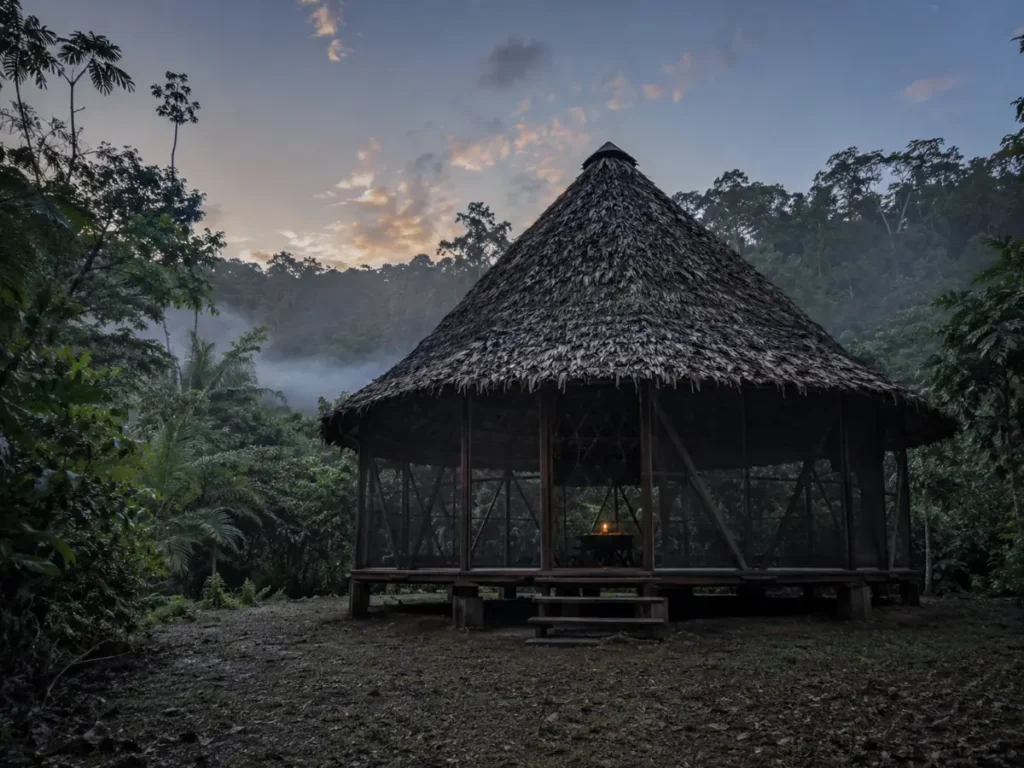
Shipibo and mestizo are 2 different Amazonian healing traditions. Most retreat websites blur the difference between Shipibo and mestizo ayahuasca on purpose. The Shipibo-Konibo-Xetebo are an indigenous people of the Ucayali river basin, around Pucallpa. Mestizo vegetalismo is the river-healer tradition of Loreto, the region around Iquitos, and it is mixed heritage by definition. I co-founded a center on the Río Momón in 2017 with a mestizo curandero, so I’ll say it plainly: we aren’t Shipibo. Any center that can’t tell you which tradition it works in is the first one to walk away from.
Below is what separates the 2 traditions. Where the marketing copy gets the vocabulary wrong. And the 7 questions that tell a lineage you can check from one somebody claims.
What is the difference between Shipibo and mestizo ayahuasca?
Shipibo ayahuasca comes from the indigenous Shipibo-Konibo-Xetebo people of the Ucayali basin, whose healers are called onanya and whose visual tradition is kené. Mestizo ayahuasca comes from vegetalismo, the mixed-heritage river-healer tradition of Loreto around Iquitos, whose healers are called curanderos or maestros. Same vine. Different peoples, different songs, different words.
The confusion is not accidental. “Shipibo” sells. It signals indigenous, ancient, uncontacted. So centers with no Shipibo healers write pages about Shipibo tradition, and centers in Loreto imply a Ucayali lineage from hundreds of kilometres away, in a different region. The Shipibo Conibo Center puts the Shipibo-Konibo-Xetebo population at roughly 35,000. It has asked the industry to stop calling their healers shamans and to use onanya instead. Most retreat sites haven’t noticed.
Are kené designs the same as icaros?
No. Kené are the geometric designs. Icaros are the songs. They are 2 separate art forms and Peru recognized them as 2 separate things, 8 years apart.
The Ministerio de Cultura declared kené, the Shipibo-Konibo design tradition, Patrimonio Cultural de la Nación in April 2008. The íkaros of the Shipibo-Konibo-Xetebo got their own declaration on 22 June 2016, reported by Andina, Peru’s state news agency. The official definition is worth reading in the original: “Los íkaros son cantos de carácter sagrado cuyo componente central es la dimensión energética y cuyo propósito, en la mayoría de los casos, es la sanación.”
Plenty of retreat pages use the 2 words interchangeably, and some describe the embroidery itself as icaros. That is like calling a hymnal a stained-glass window. If a page gets the tradition’s 2 most recognizable words backwards, ask what else on it came from a template.
The Shipibo tradition, in the tradition’s own vocabulary
The Shipibo-Konibo-Xetebo live along the Ucayali and its tributaries, concentrated around Pucallpa in the Ucayali region. Their healers train through extended plant dietas, receive icaros from the plants during those dietas, and sing them in ceremony. Kené appears on textiles, ceramics, wood and skin, painted by women and carved by men.
3 words worth knowing before you book anywhere:
- Onanya. The Shipibo term for an ancestral healer. Their own representative body asks that this word replace “shaman.”
- Kené. The designs. State-recognized since 2008.
- Íkaro. The song. State-recognized since 2016.
None of that is my tradition. I’m reporting it because the difference is the point, and because a center that borrows the words without the lineage is telling you something about itself.
Mestizo vegetalismo on the Río Momón: 5 generations, named
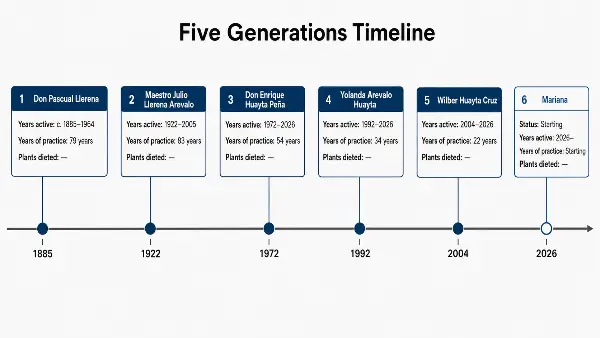
Mestizo vegetalismo is the plant-healing tradition of the Loreto rivers, and it’s honest about being mixed. It’s the tradition behind the center we built on the Río Momón. Don Enrique Huayta Peña, my co-founder, does not claim to be indigenous. He’s mestizo, as most Loretanos are, and his tradition carries Cocama, Bora and Yagua influence layered onto the herbalism of the river communities.
Here’s the lineage, with dates, because this is exactly what I’m about to tell you to demand from anyone else:
- Don Pascual Llerena (about 1885 to 1964), curandero of the upper Nanay.
- Maestro Julio Llerena Arevalo (1922 to 2005), Don Pascual’s son, and Don Enrique’s teacher.
- Don Enrique Huayta Peña (born 1958), training from 1972, a 12-year apprenticeship under Maestro Julio, 54 years with the medicine, 50-plus master plants dieted.
- Maestro Wilber Huayta Cruz (born 1988), Don Enrique’s son, training from 2004, 22 years, 25 master plants.
- Maestra Yolanda Arevalo Huayta (born 1976), Don Enrique’s cousin, training from 1992, 34 years.
Wilber’s eldest daughter Mariana, 19, has started her own plant work. That would be 6. How the 2 of us ended up as partners is a longer story than this page has room for.
The icaros Don Enrique sings are in Spanish with Cocama and Quechua words worked through them. That’s characteristic of Loreto mestizo practice and it sounds nothing like a Shipibo ceremony. He puts it better than I can: “Your ears hear Spanish but your blood hears something older.”
A real apprenticeship runs 8 to 12 years
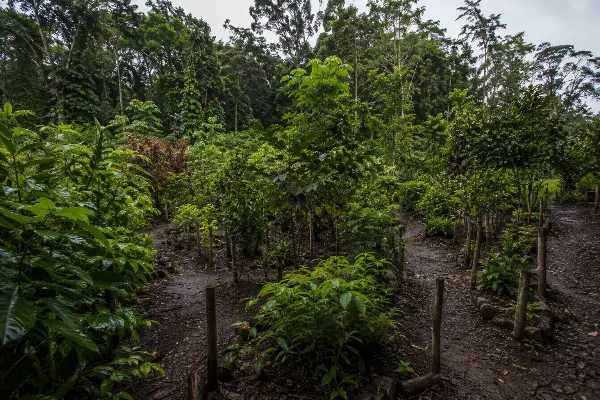
Both traditions train healers the same slow way: isolation, restricted food, one plant at a time, for years. The plant teaches the song. No dieta, no repertoire.
Don Enrique’s formal apprenticeship under Maestro Julio ran 12 years, from 1972 to 1984, and he kept dieting new plants under Julio’s guidance until Julio died in 2005. Wilber’s intensive period was 8 years, from 2004 to 2012, before he was allowed to assist in ceremony at all. Yolanda’s was about 9 years.
A dieta is not a retreat activity. The plants we still work with show the range:
- Chiric sanango, 8 days. Brings tingling and temperature swings.
- Bobinsana, 8 days. Gentler. For grief.
- Ajo sacha, 8 to 15 days. For mental clarity and grounding.
- Piñon blanco, 10 to 15 days. For boundaries.
- Renaquilla and chullachaqui caspi, 15 to 30 days. Don Enrique keeps these for experienced practitioners.
During any of them you eat boiled plantain, rice and bland fish, you don’t touch anyone, and you don’t talk much.
We still run dietas with those plants, and the retreat and dieta formats sit on one page. Run the arithmetic on any center claiming a “master shaman.” 12 years of dietas is one number. “Extensive experience” is not a number. And the physical and mental effects people actually report depend far more on who’s holding the room than on which tradition they learned in.
Neither tradition is better, and here’s what varies instead
Neither is, and anyone who tells you otherwise is selling. Both traditions produce healers with 40 or 50 years of practice and both produce people who learned 6 icaros off a recording and bought a shacapa.
What varies isn’t the tradition. It’s whether the center will show you the specifics.
After 1,900 guests I expected the people with the heaviest psychiatric histories to struggle most. That’s not what our records show. The guests who struggle most are the rigid ones, the ones who intellectualize everything and hold tight control over what they let themselves feel. The ones who do best hold an intention loosely and let themselves be surprised. Willingness beats diagnosis, and it also beats which river your healer trained on. If you want the mechanism side of that, we’ve written separately on how ayahuasca acts on the brain.
| What to compare | Shipibo (Ucayali, around Pucallpa) | Mestizo vegetalismo (Loreto, around Iquitos) |
|---|---|---|
| Healer term | Onanya | Curandero, maestro, vegetalista |
| Song language | Shipibo | Spanish with Cocama and Quechua words |
| Visual tradition | Kené, state-recognized 2008 | No comparable design cosmology |
| Icaro recognition | State-recognized 2016 | Not separately recognized |
| Heritage claim | Indigenous | Mixed, and says so |
| Nearest city and airport | Pucallpa | Iquitos |
| What to verify | Named onanya, community ties, training years | Named curandero, named teacher, training years |
Ours is the right-hand column. If the left-hand column is what you want, book in Ucayali and book with a center that names its onanya.
Why do so many centers claim a lineage they can’t show you?
Because demand outran the number of trained healers, and nobody checks. Peru declared the traditional knowledge and ritual use of ayahuasca Patrimonio Cultural de la Nación in 2008. The tourism that followed became real income for curandero families. It also pulled in people with almost no training.
A paper hosted by Peru’s own Ministerio de Cultura on how kené and ayahuasca became state heritage names the pattern. Healers with almost no training enter the world market. They skip the dieta work the whole tradition is built on. Plant knowledge gets sold as a product. That’s a state document, not a rival’s complaint.
There are more than 60 ayahuasca centers in the Iquitos area at last count. I’ve read the copy on a lot of them. “Centuries-old lineage” appears constantly. A named teacher almost never does.
7 questions that separate a real lineage from a claimed one
Ask these before you pay a deposit. Any center working in either tradition should answer all 7 in writing, in a day.
- Name the lead healer, and name the teacher who trained them. A lineage with no second name in it is a slogan. Ours is Maestro Julio Llerena Arevalo, 1922 to 2005.
- How many years, and how many master plants dieted? In both traditions the plants teach the songs during dieta. No dietas means no repertoire. Don Enrique: 54 years, 50-plus plants.
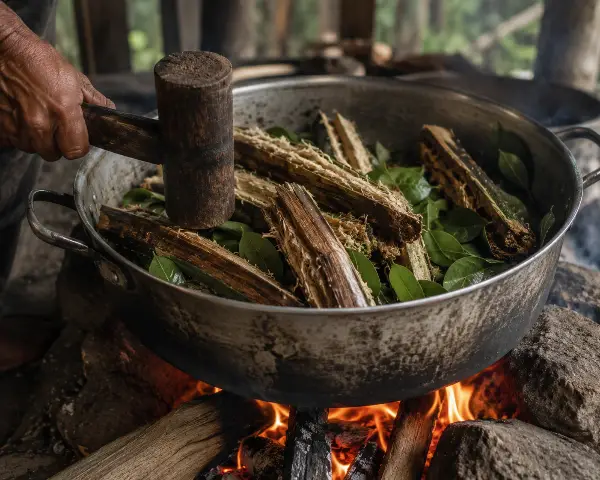
- Who cooks the brew, and what goes in the cup? Don Enrique and Wilber cook every batch themselves, 18 to 22 hours across 2 days. Vine and chacruna, no toé, no tobacco in the brew. We’ve kept a written brew log since 2020, and 130-plus batches in, we know what our medicine does before we pour it. 3 batches got thrown out in 9 years.
- How many healers and facilitators are in the room per guest? We run 3 healers and 2 facilitators for a maximum of 10 guests. Many centers in this region run 20 to 30 guests with 1 or 2 healers. Ask for the number, not the adjective.
- Is it the same healers every ceremony, or a rotating cast? You drink with the same 3 every night. Don Enrique won’t work any other way, because he thinks a healer has to build a read on a patient across ceremonies.
- What percentage of applicants get rejected? We reject 13% outright, and another 5 to 8% never meet their conditions. Some centers here report 2 to 3%. A screening process that can’t say no isn’t a screening process.
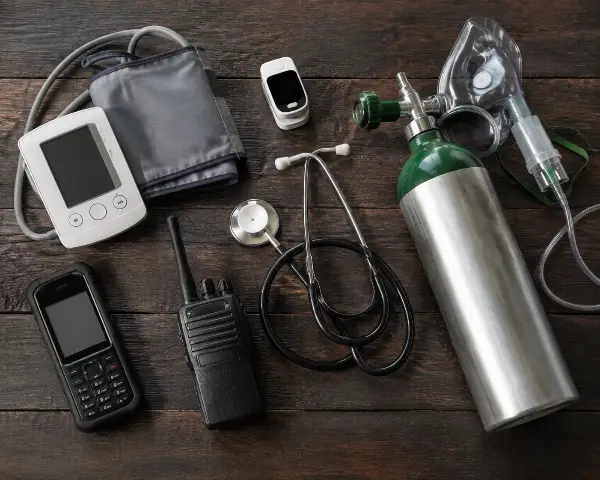
- Who is on site medically, and how far is the hospital? Dra. Carmen Ríos Medina, MD, is on the property and awake for every ceremony night. Hospital Regional de Loreto is about 45 minutes by fast launch.
A center that answers 7 for 7 might still not suit you. A center that dodges 4 of them has told you everything.
Does lineage make a retreat safer?
No, and this is where I’ll part company with most of the field. Lineage tells you what the healing looks like. Protocol tells you what happens when a night goes wrong.
The largest survey ever run on this medicine, the Global Ayahuasca Survey published in PLOS Global Public Health in 2022, asked 8,216 people about physical adverse effects. 69.9% reported at least one. 62.0% reported vomiting or nausea. Of those reporting physical effects, 2.3% needed medical attention. Another 7,839 were asked about mental health effects in the weeks and months after. 55.9% reported some. About 88% of that group read them as part of a positive process. Those numbers come from ceremonies across more than 50 countries, in every tradition there is. Lineage didn’t zero them out anywhere.
Our own record makes the same point from the other direction. In early 2018 Don Enrique had 46 years of practice and a named 5-generation lineage. We still nearly lost a guest that year to an undisclosed cardiac condition. I had no doctor on site, no pulse oximeter and no protocol. The lineage was identical before and after. What changed was Dra. Ríos, the screening rebuild, and the equipment. Across 9 years, 1,900 guests and 650-plus ceremonies we’ve had 2 evacuations, both full recoveries, and no deaths. I credit the protocol for that, not the songs.
The songs are why people get better. The protocol is why they get home. Ask about both.
What this means if you’re choosing a center in 2026
Pick the tradition on fit, then pick the center on what it will put in writing. If Shipibo work is what you want, book in Ucayali with a center that names its onanya and gets kené and icaros the right way round. If you want mestizo vegetalismo in Loreto, ask us the 7 questions and hold us to them.
We publish the uncomfortable numbers too. Across roughly 290 guests with complete 3-month follow-up, our average PHQ-9 score fell from 13.1 at intake to 7.3 at 3 months, and 70% held a sustained improvement. Which means 30% didn’t. That’s observational data with selection bias, not a clinical trial, and I’d rather you hear the 30% from me than find it out yourself. Most centers can’t tell you their number because they don’t collect it.
Want the hour-by-hour version of what a ceremony involves? Our breakdown of ayahuasca effects covers the timeline. The dieta rules and the tyramine reason behind them explain the food restrictions before you arrive. When you’re ready to ask us the 7 questions, our ayahuasca retreat page has the schedule and the contact form reaches me. The difference between Shipibo and mestizo ayahuasca isn’t a ranking. It’s a fork in the road, and you should know which one you’re on before you get on the boat.
FAQs
What is the difference between Shipibo and mestizo ayahuasca?
Shipibo ayahuasca comes from the indigenous Shipibo-Konibo-Xetebo people of the Ucayali basin around Pucallpa, whose healers are called onanya. Mestizo ayahuasca comes from vegetalismo, the mixed-heritage river-healer tradition of Loreto around Iquitos, whose healers are called curanderos or maestros. The vine is the same. The peoples, the songs and the vocabulary are not.
Are kené designs the same as icaros?
No. Kené are the Shipibo geometric designs and icaros are the healing songs. Peru recognized them separately: kené as Patrimonio Cultural de la Nación in April 2008, and the íkaros of the Shipibo-Konibo-Xetebo on 22 June 2016. A retreat page that uses the words interchangeably is working from a template.
What is a Shipibo healer called?
An onanya. The Shipibo Conibo Center, which represents a population of roughly 35,000 Shipibo-Konibo-Xetebo people, has asked the industry to use onanya rather than “shaman.” Curandero and maestro are Spanish terms from the mestizo tradition and are not the Shipibo words.
Is Shipibo ayahuasca better than mestizo ayahuasca?
Neither tradition is better. Both produce healers with 40 or 50 years of practice, and both produce people who learned a handful of icaros from recordings. What varies is whether a center will name its healers, name their teacher, and give you numbers for the healer-to-guest ratio and the rejection rate.
How long does it take to train an ayahuasca healer?
Years of plant dietas, not months. Don Enrique Huayta Peña’s formal apprenticeship under Maestro Julio Llerena Arevalo ran 12 years, from 1972 to 1984, and he kept dieting new plants under his teacher until 2005. His son Wilber trained 8 years before assisting in ceremony at all.
Does working with an indigenous lineage make an ayahuasca retreat safer?
No. The 2022 Global Ayahuasca Survey asked 8,216 people about physical adverse effects and 69.9% reported at least one, across more than 50 countries and every tradition. Safety comes from screening, medical cover and protocol. We reject 13% of applicants outright and a physician is on site and awake for every ceremony night.
How do I check that a retreat’s lineage claim is real?
Ask 7 questions in writing: name the lead healer and their teacher; years of practice and plants dieted; who cooks the brew and what is in it; healers and facilitators per guest; whether the healers rotate; the percentage of applicants rejected; and who is on site medically. Any center working in either tradition should answer all 7 in a day.