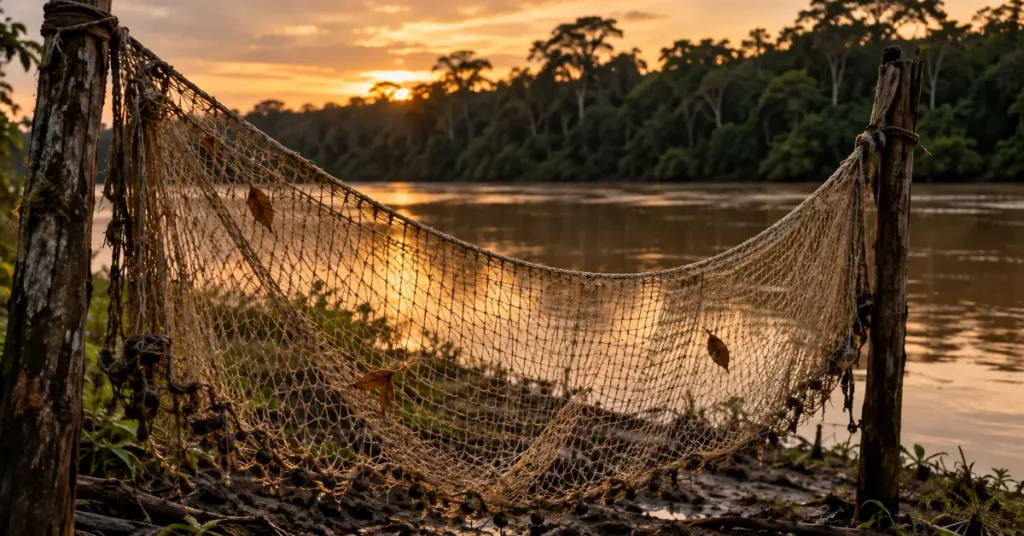
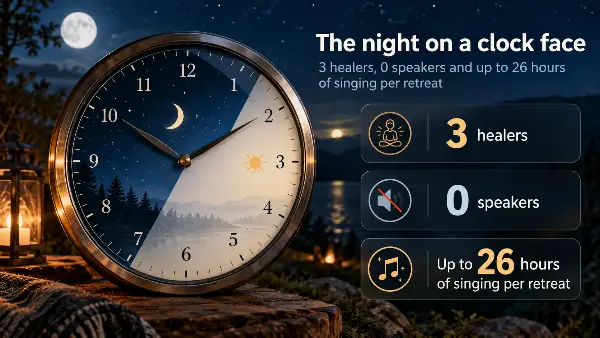
In the Loreto tradition we follow, ayahuasca ceremony music is 3 healers singing icaros through the night. The first song comes at 8 PM, before anyone drinks, and the last at 3 AM, when the candle is lit again. In between come 30 minutes of silence, songs for the whole room and songs for 1 guest at a time. There’s no speaker in the room and no playlist. The only instrument is a rattle made of dry leaves.
The research on why this matters is thinner than most websites suggest. A 2023 study of icaros gets quoted online as covering 180 participants. It counted 180 responses. And the brainwave explanation you’ll read most often is the only claim I checked where most studies point the other way.
What is ayahuasca ceremony music?
Mostly, it’s live singing, and in Peru that means icaros.
Ayahuasca ceremony music is the live singing that guides an ayahuasca ceremony. In the Peruvian Amazon it centers on icaros. Healers say they receive these songs from plants during dietas, long stretches of isolation with 1 plant. A healer sings them to protect the room, to work with 1 person at a time and to close the night.
In our Momón River maloca, 3 healers sing at every ceremony, and a 10-day retreat has 4 ceremonies. That’s up to 26 hours of live singing. Our lead healer has led all 650-plus of our ceremonies since 2017. He’d been working with plant medicines for 45 years before that.
What are icaros, and where do they come from?
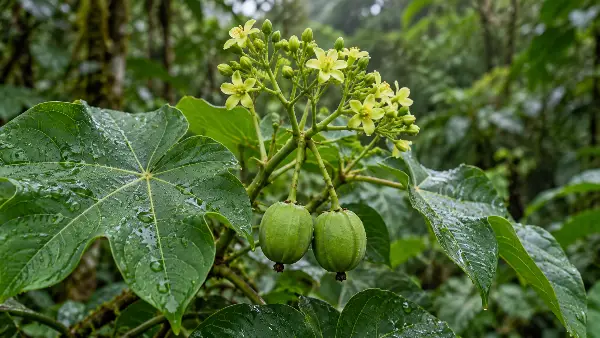
Icaros are healing songs that Amazonian healers say the plants teach them. In our tradition, a healer receives them during a master plant dieta: weeks or months alone with 1 plant, on bland food.
In a 2021 study in Frontiers in Pharmacology, people who had done dietas described receiving icaros from the plants they dieted. 1 said the songs get “prepared and refined in the diets,” along with the tobacco and the blowing of smoke.
Our lead healer has dieted more than 50 master plants over 54 years, and he carries hundreds of icaros. His son, our second healer, has dieted 25. Our third healer, a maestra from the same family, sings gentler, more melodic songs.
At a guest’s mat, our lead healer chooses the song from what he perceives in that person. A song received from piñon blanco is for emotional blockage. One from renaquilla is for trauma that runs deep, and one from ajo sacha is for confusion and grounding.
The words are mostly Spanish, mixed with Cocama and Quechua, and nobody translates them during ceremony. “The songs are not messages for the mind,” he says. “They are instructions for the body and the spirits.”
Some songs reach further back than he does. For a grieving father, he once sang his late teacher’s song.
The 4 songs of a night in our maloca
A night here moves through 4 kinds of song: protection, reading, healing work and closing. Near the start, there’s half an hour with no singing at all.
| Song | When | Who sings, and to whom | What you hear | Closest research finding |
|---|---|---|---|---|
| Protect | 8:00 PM, before anyone drinks | Our lead healer, to the whole room, after blowing tobacco smoke toward each of the 4 directions; then a low hum over each guest as they’re served | 1 voice | Patients in a 2023 study said icaros helped them feel safe |
| Silence | 8:30 to 9:00 PM | Nobody | Frogs, insects and the river | No study found |
| Read | After the silence | Our lead healer’s diagnostic songs, to the group | 1 voice, then 2 or 3 | No study found |
| Work | 9:00 PM to about 2:00 AM | Songs aimed at 1 guest at a time, 5 to 20 minutes each; the shacapa often joins after midnight | Up to 3 voices, sometimes at once | The same study: icaros shifted patients’ emotions and guided them through hard memories |
| Close | 2:00 to 3:00 AM | Our lead healer, with the other 2 following; then his closing songs | Gentler, more melodic singing; the candle is relit at 3:00 AM | No study found |
Our ceremony clock covers what the brew does at each of those hours. This table covers only what you hear.
When 2 healers sing at once
Our lead healer and his son sometimes sing different icaros over each other, on purpose. His name for it is cruzar los cantos, Spanish for crossing the songs. He says the layered singing “weaves a net that catches things a single voice cannot reach.” Guests describe it as 3-dimensional sound.
Our ceremony rules ask for quiet on the mats, because a guest’s voice breaks the space the songs hold for everyone.
How ayahuasca ceremony music differs by tradition
Who runs the ceremony decides what you hear. Peruvian healers sing icaros, often with a leaf rattle; Upper Putumayo taitas in Colombia add harmonica; Santo Daime churches in Brazil sing hymns together.
| Tradition | What you hear |
|---|---|
| Loreto mestizo vegetalismo, our tradition | Icaros sung or hummed by the healers, with a shacapa leaf rattle |
| Shipibo-Konibo, Ucayali River | Rao bewa, Shipibo for medicine songs, sung in a poetic form of Shipibo |
| Yagé in Colombia’s Upper Putumayo | Singing, whistling, harmonica, a waira sacha (dry leaves tied at 1 end) and cascabeles, necklaces of seeds, beads and teeth worn by the taita |
| Santo Daime, Brazil | Hymns that members sing together and treat as gifts received, not composed |
| União do Vegetal, Brazil | Chamadas, which are sacred chants, plus selected Brazilian popular songs |
| Retreats that advertise medicine music | Guitar, drums, flutes and songs written for ceremony, live or recorded |
| Psilocybin trials, for comparison | Recorded playlists, usually Western classical; 1 trial tested singing bowls, gongs and chimes |
The Shipibo, yagé, Santo Daime, União do Vegetal and psilocybin rows draw on 5 studies. They appeared in Literatura: Teoría, Historia, Crítica (2022), TRANS (2016), Revista de Antropologia (2017), Boitatá (2022) and ACS Pharmacology & Translational Science (2021). The 2016 study found that taitas in the Upper Putumayo play the harmonica and the leaf bundle over participants’ bodies, from head to toe.
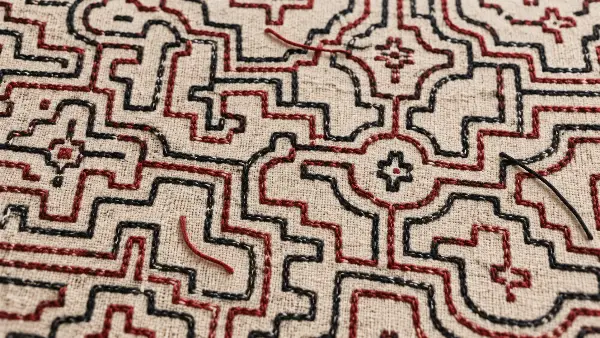
Shipibo healing also centers on kené, the geometric designs of that tradition, and the 2 lineages differ in more than their songs.
What studies say about icaros in 2026
Little has been measured, and the clearest evidence that music shapes a session comes from psilocybin, not ayahuasca.
A 2023 study in Anthropology of Consciousness looked at men in a residential addiction program in Peru, where traditional healers lead the ayahuasca ceremonies. The patients said the icaros helped them feel safe, shifted their emotions and the brew’s effects, and guided them through hard memories. The University of California, Riverside, which announced the study, says an analysis from 2017 to 2019 assessed 180 responses. Every patient reported that the icaros changed their psycho-emotional state. They described the healing as unblocking, a purge of body and emotions.
Some websites turn that 180 into 180 participants or patients. It’s 180 responses. The study is qualitative, it covers men in 1 treatment program, and it has no comparison group. It tells you what the icaros felt like to these patients. It can’t show whether the icaros caused anyone’s recovery.
Psilocybin research gives the clearest picture. In a 2018 Psychopharmacology study, 19 patients whose depression hadn’t responded to other treatment described how the music affected their sessions. How they experienced the music predicted how far their depression scores fell 1 week later. The strength of the drug’s effects didn’t.
A 2021 trial in ACS Pharmacology & Translational Science gave psilocybin to 10 people trying to quit smoking. 1 session used a Western classical playlist, and another used overtone-heavy music such as singing bowls, gongs and chimes. Mystical experience scores tended to run higher with the overtone music, and 6 of the 10 chose it for their 3rd session. At long-term follow-up, 4 of the 6 who chose it were still off cigarettes, against 2 of the 4 who chose classical. The authors question whether classical music holds any unique benefit. With 10 people, it’s a clue at best.
The 3 studies side by side:
| Study | Who took part | What they heard | What it found | What it can’t show |
|---|---|---|---|---|
| Anthropology of Consciousness, 2023 | Men in 1 residential addiction program in Peru | Live icaros in ayahuasca ceremonies | Patients said icaros helped them feel safe and work through hard memories | Whether icaros caused anyone’s recovery; there was no comparison group |
| Psychopharmacology, 2018 | 19 patients whose depression hadn’t responded to treatment | Recorded playlists during psilocybin sessions | How patients experienced the music predicted how far their depression fell 1 week later | Anything about icaros or ayahuasca |
| ACS Pharmacology & Translational Science, 2021 | 10 people trying to quit smoking | Western classical and overtone music during psilocybin sessions | 6 of 10 chose overtone music for their 3rd session, and mystical scores tended to run higher with it | Whether 1 genre works better; 10 people are too few |
I haven’t found a trial that tests icaros against a playlist, or against silence, in a real ceremony. The brain research on ayahuasca has the same blind spot.

Is brainwave entrainment why ceremony music works?
Probably not. It’s the explanation you’ll read most often, and more of the studies that tested it found against it than for it.
The idea is that your brainwaves fall into step with the rhythm or pitch you hear, and that this shifts your state of consciousness. Researchers call it the brainwave entrainment hypothesis. They test it with binaural beats: 2 tones of slightly different pitch, 1 played in each ear.
A 2023 systematic review in PLOS ONE pulled together 14 EEG studies of binaural beats. 5 found results in line with entrainment. 8 contradicted it, and 1 was mixed. The studies were run so differently that the authors called for standard methods before anyone draws firm conclusions.
Earlier EEG and MEG studies did show the brain responds to these beats. What the review couldn’t confirm is the next step: brainwaves settling at the beat’s frequency. And icaros are live voices, so even a strong result for binaural beats wouldn’t settle the question for them.
The better-supported idea is fit. In the 2018 psilocybin study, researchers rated each patient’s experience of the music on 3 scales: liking, openness and resonance. Resonance meant how well the music matched the patient’s emotional state. Those ratings tracked mystical experience, and the music experience predicted the drop in depression 1 week later.
That’s close to how our lead healer works. He doesn’t run a set list for the room. At each mat he picks a song for what he perceives in that person and sings it to them for 5 to 20 minutes. When a guest is terrified at 2 AM, a healer comes to sing at the mat while a facilitator stays close. In most cases, the fear passes inside 20 minutes.
I can’t prove icaros work through fit. The 2018 patients heard recorded music on psilocybin, and I haven’t found anyone who has measured icaros that way. What I can say: the evidence for frequency is mixed at best. The stronger evidence points to the match between a song and the person hearing it.
Why our maloca has no speakers or playlists
Our tradition doesn’t use them. The songs belong to the healers who received them, and each is sung to someone in the room.
We play no recorded music, and there are no speakers. The 1 instrument is the shacapa, a rattle of dry leaves that our second healer often shakes during cleansing work after midnight. The maloca runs without electricity. It’s an octagon about 10 m across. The palm-thatch roof peaks at about 7 m, and the screened walls open onto the forest. When the healers pause, the jungle fills the gap with frogs, insects and the river’s noise.
If you love melody, you may miss it here, and that’s fair. Medicine music can be lovely, and the 2021 trial found no clear edge for the classical music most trials use. We keep to voices because it’s the tradition our healers carry, and because a song chosen at your mat can change when you do. A playlist can’t.
What if you don’t like the music, or it scares you?
Put up a hand, and a facilitator will kneel at your mat, stay with you and call a healer to sing. In most cases, that eases the fear within 20 minutes.
Disliking the music isn’t a failure. Even in the 2018 psilocybin study, patients described unwelcome effects of the music alongside welcome ones. If the songs seem to take you apart, that can be ego dissolution, and our staff know how to tell it from a crisis.
You don’t need the words. Nobody translates the icaros in ceremony, and our healers would tell you the songs speak to the body first.
If you’re hard of hearing, tell us at screening, and we’ll put your mat closer to the healers. Bring earplugs for sleeping in your tambo, your guest cabin, where the night is loud, but leave them out of the maloca. Phones and other electronics stay out of the ceremony, so no one records the icaros.
Ayahuasca music after the retreat
Listening at home can bring back the feeling of a ceremony. It won’t do the work of integration for you.
Medicine music and icaro recordings are easy to find online, and you can play whatever helps you feel steady. Know what you’re hearing, though. A medicine song is written for anyone to hear. An icaro, in our tradition, is 1 healer’s tool, received for a purpose.
The weeks after your flight home matter more than any playlist. Every guest gets a video call during the first week back, and most take it. If you feel overwhelmed back home, don’t wait for a call. Message our WhatsApp support line, and a facilitator will answer within 4 hours, except overnight.
Ayahuasca ceremony music, as we practice it, is 3 people singing to you in the dark for most of a night. If that’s the ceremony you want, read about a retreat week with us and what a booking includes. Then send us a question.
FAQs
What is ayahuasca ceremony music like?
In the Peruvian Amazon it’s mostly live singing: icaros, often kept with a leaf rattle called a shacapa. At our center, 3 healers sing between 8 PM and 3 AM, with 30 minutes of silence near the start. Other traditions add harmonica, hymns or guitar.
Do you need to understand the words of the icaros?
No. Our healers sing mostly in Spanish, mixed with Cocama and Quechua, and nobody translates during ceremony. Healers in this tradition say the songs work on the body more than the mind. If you’re hard of hearing, ask to be placed nearer the healers.
Does ayahuasca work without music?
Yes. The brew takes effect whether or not anyone sings, and our nights include 30 minutes without singing after the candle goes out. In traditional ceremonies, though, the singing guides the night, and our healers treat icaros as their main healing tool. No study we’ve read compares ceremonies with and without it.
Is ayahuasca ceremony music the same as medicine music?
No. Medicine music is a modern genre of songs written for ceremonies, often with guitar, drums and flutes. An icaro is a healing song a healer says he received from a plant during a dieta and sings for a purpose. Some retreats play medicine music, while we use only our healers’ voices and a leaf rattle.
Is there scientific proof that icaros help?
Not proof. Men in addiction treatment in Peru said icaros helped them feel safe and work through hard memories, in a 2023 qualitative study. The study assessed 180 responses, not 180 participants, and had no comparison group. We haven’t found a trial that tests icaros against other music or silence.
Can I bring headphones or record the icaros?
No. Our ceremony rules allow no phones or other electronic devices, and the maloca has no electricity. Bring earplugs for sleeping in your tambo instead, because the jungle is loud at night.
How long do the healers sing?
At our center, the first song comes at 8 PM and the last at 3 AM. A healer may sing to 1 guest for 5 to 20 minutes before moving to the next mat. Over 4 ceremonies, that’s up to 26 hours of live singing in a 10-day retreat.