If you feel emotionally overwhelmed after ayahuasca, you’re in the majority, and it usually doesn’t mean something went wrong. In the Global Ayahuasca Survey, 55.9% of the people who took part reported negative effects on their mental health in the weeks or months that followed. Around 88% of that group counted those effects as part of growth or integration, and around 12% looked for professional help.
One feeling stands apart from the rest. When researchers reanalyzed the same survey in 2025, “feeling down, depressed, or hopeless” was the after-effect most strongly tied to worse mental health at the time people answered. Tears and rawness are usually part of processing what came up. Hopelessness is the one to act on.
What is emotional overwhelm after ayahuasca?
Emotional overwhelm after ayahuasca is a stretch of days or weeks after a ceremony when feelings run stronger than usual. It can look like crying without a clear trigger, grief, irritability, anxiety, flat days, or feeling cut off from people. It’s common and usually temporary. It needs attention when it turns into hopelessness or stops easing.
The survey gives a sense of scale. Of the 7,839 people who answered its questions on mental health after-effects, 21.0% felt disconnected or alone. Feeling nervous or anxious came in at 17.5%, and losing interest or pleasure in everyday things at 14.8%. That made disconnection the most common emotional item on the list.
Is it normal to feel emotionally overwhelmed after ayahuasca?
Yes. Emotional difficulty is the most common type of lasting trouble people report after a psychedelic. Most people who go through it later see it as part of processing what came up.
A 2023 study of 608 people with extended difficulties after psychedelics sorted what they went through into 7 types. Emotional difficulties came first, reported by 76% of them. Ayahuasca was the substance in 10% of that group, so read it as a picture of psychedelics in general, not ayahuasca alone.
Some of the overwhelm is physical. A ceremony night runs into the small hours, purging takes it out of you, and sleep is short. Some of it is what surfaced. Old grief and memories you’d parked can come up in the dark, and resurfacing trauma isn’t a sign the night went wrong. It can still leave you tender afterward.
You don’t need to fix anything on day 2. Expect it, and learn which signs are worth a call.
When your old life doesn’t fit anymore
For some people, the hardest stretch starts after the retreat, when the old routine doesn’t fit what came up in ceremony.
Researchers who read the open-ended answers of 1,630 ayahuasca drinkers about life afterward found the same themes again and again. People described going back to their “old life” with new understandings that didn’t fit it. Some felt that others didn’t understand them. Others struggled to find professionals or a like-minded community once they were home. One respondent put integration at about 15 months.
So if the retreat felt clear and home feels jarring, that’s a recognized pattern. If you’re returning to children and a full calendar, the practical side of coming home to kids is worth planning before you leave. Vivid dreams and broken sleep in the week after can add to it.
The 1 feeling to take seriously: hopelessness
Of all the feelings that follow a ceremony, hopelessness is the one to watch.
The 2025 reanalysis looked at 5,400 complete survey responses and asked which after-effects tracked with people’s mental health at the time they answered. Of the after-effects linked to worse mental health, “feeling down, depressed, or hopeless” had the strongest link. Grief, tears and sensitivity can be part of working something through. A sense that nothing will get better is different, and it’s the feeling to act on early.
The clearest public number on how often people get worse comes from an earlier analysis of the same survey, covering 11,912 drinkers. Among 1,571 drinkers with depression, 2.7% said their depression got worse after ayahuasca, while 78% said it was “very much” improved or “completely resolved.” Among 1,125 with anxiety, 4.5% said it got worse. Everyone in that analysis chose to answer a survey about ayahuasca and reported on themselves, so the true share who got worse may be higher.
A second sign deserves the same attention. In the survey, 12.9% reported trouble knowing what was real at some point after drinking. If that keeps going or gets stronger instead of fading, get a medical assessment the same day.

Who is more likely to struggle afterward?
In the survey research, 5 things went with more trouble afterward: past depression, past anxiety, extreme fear during the session, drinking outside a traditional or church setting, and physical health conditions.
| Linked to more trouble | What the study found | Source | What you can do |
|---|---|---|---|
| A past depression diagnosis | More of every adverse state measured, afterward | 2025 survey reanalysis | Line up support for your first weeks home before you fly |
| A past anxiety diagnosis | More adverse mental health effects, and more nervousness afterward | 2022 Global Ayahuasca Survey and the 2025 reanalysis | Same, and tell the people screening you |
| Extreme fear during the session | More of every adverse state afterward | 2025 survey reanalysis | Speak up before the next ceremony |
| Drinking outside a traditional or church setting | More adverse states afterward | 2022 Global Ayahuasca Survey and the 2025 reanalysis | Drink with experienced healers in a traditional ceremony |
| Physical health conditions | More adverse mental health effects | 2022 Global Ayahuasca Survey | List every condition on your medical form |
One more pattern from the study of 1,630 drinkers: women, and people who drank outside church settings, described integration as challenging more often than men and church members did. There’s more on what’s different for women at a retreat in our separate guide.
The figures in this table come from surveys of people who chose to respond, looking back. They show which groups reported more difficulty. They can’t show that any 1 factor caused it.
A terrifying ceremony is a reason to slow down
A frightening night isn’t proof the medicine is working. In the 2025 reanalysis, the more extreme fear people reported during the session, the more adverse states they reported afterward, across every state the researchers measured. The 2023 study of 608 people points the same way: less difficulty during the experience predicted a shorter stretch of trouble after it.
You’ll hear the opposite in this field: there’s no such thing as a bad trip, and the medicine only gives you what you can handle. The data doesn’t back either line. Both studies are surveys, self-selected and done in hindsight, so they can’t prove cause. They also don’t say every hard night does harm. In the larger survey, most people with after-effects still called them growth. What they don’t support is pushing through terror as if terror were the point.
At our center, the 4 ceremonies fall on nights 2, 4, 7 and 9 of a 10-day retreat, so there’s at least 1 night off between any 2 of them. A frightening night should change what happens next. If your last ceremony turned to terror, tell the healers before the next one. The healer sets each dose and can adjust it next time, and you can sit any ceremony out, for any reason. Neither choice is a failure.
How long does emotional overwhelm last?
It varies, and there’s no reliable way to predict it for any individual. What the research shows is a split.
In the 2023 study of 608 people, reported durations peaked at under a week and again at over a year, with a dip around a month. About 1 in 3 still had difficulties after a year, and about 1 in 6 after 3 years. Keep in mind who was in that study: people who had difficulties that lasted past the experience itself, recruited because of them. It describes the long tail, not the typical drinker.
Our take on that split is a judgment call, not a finding. If the overwhelm hasn’t started to ease within about a month, don’t wait for it to lift on its own. Get support then. There’s no prize for holding out until month 6.
The 3 checks for when to get help
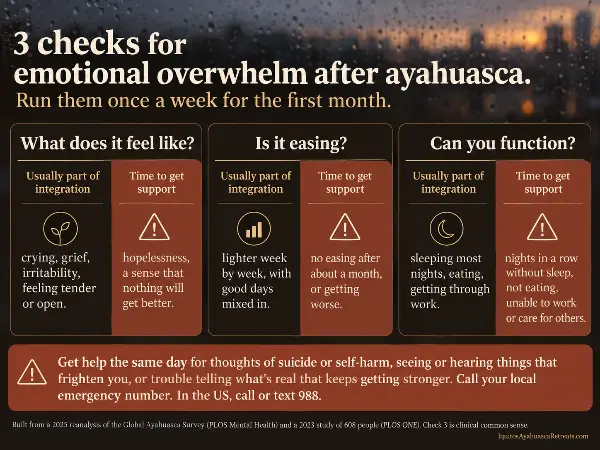
These 3 checks turn the research into something you can use at home. Run them once a week for the first month.
| Check | Usually part of integration | Time to get support |
|---|---|---|
| 1. What does it feel like? | Crying, grief, irritability, feeling tender or open | Hopelessness, a sense that nothing will get better |
| 2. Is it easing? | Lighter week by week, with good days mixed in | No easing after about a month, or getting worse |
| 3. Can you function? | Sleeping most nights, eating, getting through work | Nights in a row without sleep, not eating, unable to work or care for others |
Check 1 comes from the 2025 reanalysis. Check 2 is our reading of the 2023 duration data. Check 3 is clinical common sense rather than a study finding.
Certain signs need help the same day, not a weekly check. They include thoughts of suicide or self-harm, seeing or hearing things that frighten you, and trouble telling what’s real that keeps getting stronger. Call your local emergency number. In the US, you can call or text 988 at any hour.
What helps in the first 2 weeks home
The people in the 1,630-drinker study named what helped them, and most of it is ordinary.
- A buffer before real life. People described planning 1 to 3 days, and sometimes a week, off work after drinking. Build that into the trip home before you book flights.
- People who’ve been there. Sharing with others who had also drunk ayahuasca came up often as a help. A friend who listens without judging counts too.
- 1 or 2 daily practices. Meditation or prayer, time outside, journaling, yoga and creative work all came up. What respondents stressed was keeping them regular.
- A therapist, if you have one. Therapy helped people make sense of what happened, though most respondents named practices other than therapy as what helped.
- A framework for what happened. Respondents who had a way to make sense of the experience, whether psychological, spiritual or religious, said it’s what let them integrate it.
Our advice on big decisions: hold off for the first 2 weeks. Write the idea down and look at it again in a month.

If you have a history of depression or anxiety
If you have a history of depression or anxiety, set up your support before the retreat starts, not once you’re home.
The authors of the 2025 reanalysis put it directly: “Individuals with a history of depression require special attention, as they are more prone to experiencing post-ayahuasca adverse mental states and may benefit from additional psychological support.” A past anxiety diagnosis was tied to more nervousness afterward.
In practice, book a session with your therapist for your first or second week home, and tell 1 person at home what to watch for. Keep your prescriber involved in any medication decision. Don’t stop or restart a medication on your own after a retreat.
We don’t turn people away for a history of depression, anxiety or PTSD, but it gets extra review at screening. Current lithium use is an absolute no. You can read how our screening works before you apply.
Before you book anywhere
If you feel emotionally overwhelmed after ayahuasca, the 3 checks apply wherever you drank. If you’re still choosing a center, ask what support you get after you fly home, and who provides it. Our 10-day retreat takes 10 guests at most, with 3 healers and 2 facilitators for the group.
FAQs
Is it normal to feel emotionally overwhelmed after ayahuasca?
Yes. 55.9% of the people in the Global Ayahuasca Survey reported negative effects on their mental health in the weeks or months that followed. About 88% of that group counted those effects as growth. Crying, rawness and feeling disconnected are common, while hopelessness that doesn’t lift is the sign to get support.
How long does feeling emotionally overwhelmed after ayahuasca last?
It varies. In a 2023 study of 608 people who had difficulties after a psychedelic, the most common durations were under a week and over a year. About 1 in 3 still had difficulties after a year. If it hasn’t started to ease within about a month, get support then.
Why do I cry so much after ayahuasca?
Ceremonies often bring up grief, old memories and strong feelings, and they don’t always settle by morning. A night of little sleep and the physical toll of purging make tears come easier. Crying on its own isn’t a warning sign, so watch instead for hopelessness or distress that keeps building after a month.
Can ayahuasca make depression worse?
It can for some people. In a survey of 11,912 drinkers, 2.7% of those with depression said it got worse after ayahuasca, while 78% said it was “very much” improved or “completely resolved.” A 2025 reanalysis found that people with a depression history reported more adverse states afterward and may benefit from extra support.
Does a bad ayahuasca trip mean it’s working?
No. In a 2025 reanalysis of the Global Ayahuasca Survey, more extreme fear during the session went with more adverse states afterward. A frightening night is a reason to slow down: tell the healers, ask about a lower dose next time, or sit the next ceremony out.
When should I get help after an ayahuasca retreat?
Get support if hopelessness sets in, if things haven’t started to ease after about a month, or if you can’t sleep, eat or work. Get help the same day for thoughts of suicide or self-harm, or if trouble telling what’s real keeps getting stronger. In the US, call or text 988.