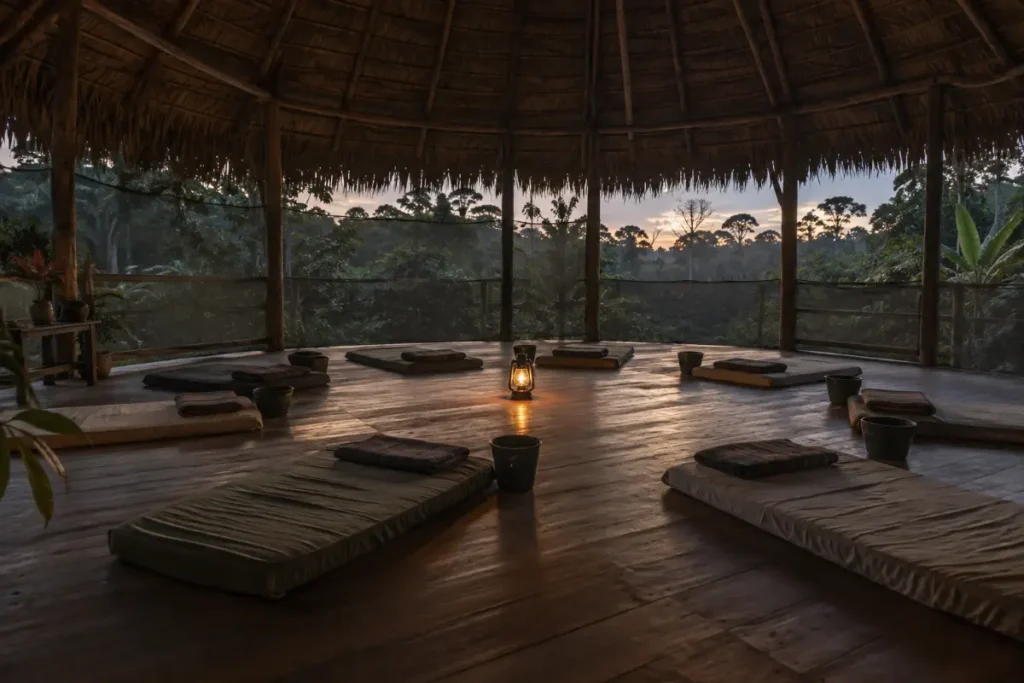
The first controlled study of ayahuasca’s pharmacology in humans used 6 volunteers, and every one of them was a man. The paper says so on purpose: “For ethical reasons, participation in this initial study was limited to six healthy male volunteers having previous experience with ayahuasca.” The follow-up trial, the one that produced the blood pressure number every safety page now quotes, ran 18 people. 15 men, 3 women.
No published trial has measured where a woman was in her cycle.
So when a retreat site tells you what ayahuasca does to a female body, it’s extrapolating. We are too. What you should be shopping for isn’t confidence. It’s a center that will tell you which part is evidence, which part is tradition, and which part is just how they run the room.
The short version: menstruation is not a medical contraindication and never has been. Pregnancy is an absolute no and it’s 1 of our 15 automatic disqualifications. Breastfeeding means waiting. Perimenopause is workable with a blood pressure check. And the things that actually hurt women at retreats aren’t hormonal. They’re undisclosed medications, unscreened cardiac history, and facilitators nobody supervises.
Ayahuasca and women covers 5 questions: whether menstruation changes anything, whether pregnancy or breastfeeding rules it out, how perimenopause shifts cardiovascular risk, which medications interact, and whether the ceremony room is safe. Only 1 of those 5 is about hormones. The other 4 are about screening and supervision, which is why they’re the ones with real answers.
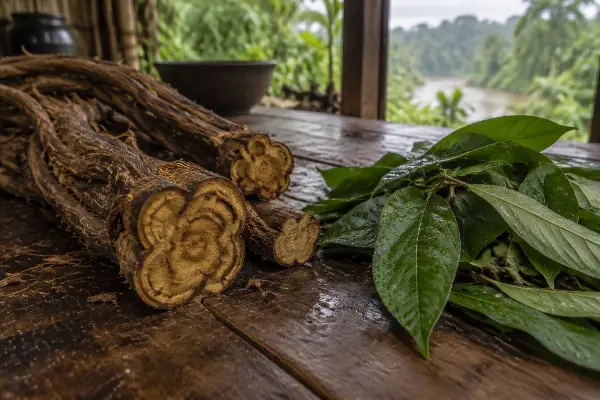
Has ayahuasca ever been studied in women?
Barely, and that’s the most useful thing on this page.
The human pharmacology of ayahuasca rests on a small set of controlled trials run in Barcelona in the early 2000s. The 2001 dose-finding study, published in Psychopharmacology, limited its sample to 6 healthy men and said the restriction was for ethical reasons. The 2003 trial in the Journal of Pharmacology and Experimental Therapeutics widened it to 18 volunteers, 15 male and 3 female. That 2003 study is where the cardiovascular figure comes from: a diastolic blood pressure rise of 9 mmHg above placebo at 75 minutes after the high dose, the only cardiovascular change that reached statistical significance. Systolic pressure rose 6 mmHg and heart rate rose 4 beats per minute, and neither result was significant.
Three women. That’s the female sample underneath almost every claim you’ll read about ayahuasca and women.
Neither paper mentions menstrual cycle, cycle phase, hormonal status or contraception anywhere. Their eligibility criteria cover prior psychedelic use and psychiatric history and nothing reproductive. So a page that tells you the research shows menstruation is safe is overstating it. The research hasn’t looked. That’s a different sentence, and it’s the honest one.
The largest dataset in the field isn’t a trial at all. The Global Ayahuasca Survey, published in PLOS Global Public Health in 2022, collected 10,836 respondents across more than 50 countries. Its adverse-effect analyses ran on subsamples of 8,216 and 7,839 people. Around 70% reported a physical adverse effect, mostly vomiting, and 2.3% needed medical attention afterwards. Useful numbers. Self-reported ones, from people who chose to answer a survey.
This vacuum is where the divine-feminine marketing grows. When nobody has measured something, anyone can say anything about it, and the industry has filled 20 years of silence with language about sacred feminine energy that no study supports and no study contradicts. We’d rather tell you the shelf is empty. If you want the pharmacology we do have, how the brew reaches the brain is the better place to start.
Can you drink ayahuasca on your period?
Medically, yes. There’s no mechanism by which menstrual bleeding interacts with DMT or the harmala alkaloids, and no trial has found a problem, partly because no trial has looked for one.
Culturally, it depends entirely on whose maloca you’re sitting in. Some Amazonian lineages ask menstruating women not to attend group ceremony. The reasoning given is usually energetic rather than medical: the body is already doing one kind of work and ceremony adds another. Other traditions have no such rule. Both positions are real and neither is a medical finding.
So ask before you book, and ask it as a specific question rather than a general one. Does this lineage have a practice on menstruation, what is the reason given, and what happens if my cycle shifts while I’m there. A center that has thought about it will have an answer ready. A center that hasn’t will improvise one, and you’ll hear the difference.
The part nobody writes about is physiological, and it isn’t the blood. A ceremony runs 4 to 6 hours and reliably produces vomiting. Add a day of light eating, sometimes diarrhea, and heavy menstrual bleeding on top, and the thing to watch is fluid and iron, not DMT. If you bleed heavily and you already run low on iron, tell the center and tell your doctor before you travel. That’s a conversation worth having in advance, and it’s the reason purging and fasting feature in our screening at all.
Practical notes, in descending order of how often we get asked. Pads work better than tampons across a 4 to 6 hour ceremony, both for the duration and because some traditions restrict tampons on the same energetic logic. Cramps make sitting still harder, and there’s a medication answer further down. And a facilitator who can’t have this conversation without flinching is telling you something about the center.
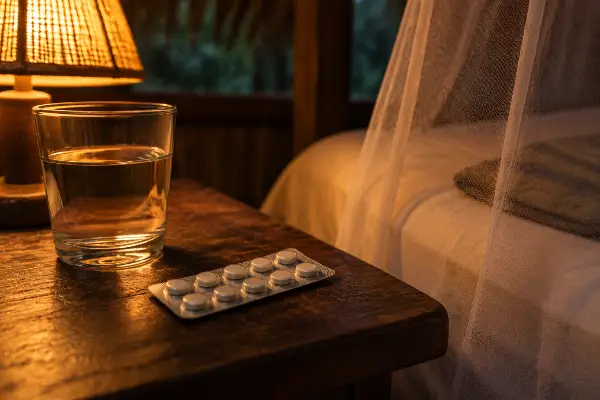
Does vomiting in ceremony affect your birth control?
For a single night, almost always no. For a 10-day retreat, possibly, and the 2 major national guidelines disagree about exactly where the line sits.
This is the question that gets answered wrong everywhere, usually as “there’s no interaction, you’re fine.” Pharmacologically that’s true. There’s no documented dangerous interaction between hormonal contraception and ayahuasca’s MAO-A inhibition. But an oral contraceptive has to be absorbed through your gut, and ceremony empties it.
Here’s where the 2 guidelines land.
| CDC, 2024 US Selected Practice Recommendations | NHS, United Kingdom | |
|---|---|---|
| Vomiting soon after a pill | Under 48 hours, no replacement pill and no backup needed | Under 3 hours, take another pill straight away |
| Diarrhea | Under 48 hours, no action | Over 24 hours, keep taking pills and use condoms |
| When backup starts | At 48 hours or more of vomiting or diarrhea | As soon as sickness continues past a single episode |
| How long backup runs | Until 7 consecutive hormonal pills after symptoms resolve | Until 7 days of pills without being sick |
| If it hits the last week of hormonal pills | Skip the hormone-free interval, start the next pack immediately | Same, take the pills then start the next pack with no break |
| Emergency contraception | Consider it if symptoms hit in week 1 with unprotected sex in the prior 5 days | Not specified in the same terms |
Both are current national guidance and they don’t agree. Most of our guests are American and the CDC recommendation is the more recent of the 2, so that’s the one we’d point you to first. But the conservative route means using condoms for a week, and being wrong means a pregnancy, so if you want to follow the tighter rule, follow the tighter rule.
Here’s the part that’s specific to a retreat rather than a single night, and that we haven’t seen written anywhere. We run 4 ceremonies across 10 days, on nights 2, 4, 7 and 9. One ceremony night clears both thresholds comfortably. A run of days doesn’t necessarily: the dieta changes what you eat for a week and a half, GI upset is common, and purging can carry into the following morning. If you cross 48 hours of vomiting or diarrhea, the CDC backup window then runs 7 pills past the day symptoms stop, which for a late-retreat episode carries past your departure and onto the flight home. That’s the scenario to plan for, not the ceremony itself.
Two things that simplify it. If your contraception isn’t swallowed, none of this applies. An IUD, an implant, an injection, a patch or a ring doesn’t depend on your gut, so vomiting has no effect on any of them. And progestin-only pills run on their own set of rules, so if that’s what you take, ask your prescriber rather than reading across from the combined-pill guidance above.
Bring it up on your screening call. Any center that can’t discuss it has told you how carefully they read a medication list.
Ayahuasca and pregnancy: why it’s 1 of our 15 automatic no’s
No, at any stage, and it isn’t a close call.
The animal data is the clearest part of the picture. A 2018 study in Reproductive Toxicology dosed pregnant rats across a range built as multiples of the average human ritual dose. At 4 times that dose, 44% of the mothers died during treatment. At 8 times, 52% died. Survivors in both groups showed kidney injury. Rats surviving the 8 times dose showed neuronal loss in hippocampal regions and the raphe nuclei, and rats at only twice the human dose showed neuronal loss in CA1.
At 1 and 2 times the human dose, which is the range a strong brew and a second cup can reach, the authors report enhanced embryolethality and an increased incidence of fetal soft-tissue and skeletal anomalies. Their no-observed-adverse-effect level for maternal toxicity landed at 1 times the human dose. The threshold sat at the dose women actually drink.
An earlier study in Birth Defects Research reached the same direction in Wistar rats: visceral fetal findings at every dose tested, skeletal findings at the higher doses, and reduced fetal body weight at the highest.
Now the counterweight, because leaving it out would be dishonest. The 2024 systematic review in the International Journal of Toxicology that carries the abortifacient and teratogenic finding also concludes that ayahuasca is generally safe, and warns in the same abstract that animal models using higher-dose synthetic isolates may not extrapolate to human use of plant-based preparations at ceremonial doses. Both halves of that review are true. On pregnancy the cost of being wrong isn’t symmetric, which is why the guidance doesn’t hinge on the extrapolation being perfect.
ICEERS puts it in its 2019 guide for organizers and participants as a direct exclusion, and the phrasing matters: taking ayahuasca is not recommended if “you are pregnant or you think you might be.”
Read that second clause again, because it’s doing real work and almost nobody in this industry treats it as anything but a sentence. If there is any chance at all, the resolution is a test, and a test takes 3 minutes. Take one before you fly, not after you land in the Amazon. Ask your center what they do about it too. Most have no answer, and that absence is informative.
If you’re actively trying to conceive, the practical advice is to schedule ceremony outside a 2-week wait. There’s no good evidence that ayahuasca harms long-term fertility, and there’s very little evidence of any kind, which is a different statement from a clean bill of health. Postpartum is its own conversation, and if you’re weighing it alongside young children at home, what 10 days away actually looks like covers the logistics.
Breastfeeding, and the clearance nobody calculates properly
Wait. And if you want to know why the standard advice is vague, it’s because the measurement doesn’t exist.
DMT and the harmala alkaloids are small, lipid-soluble molecules, and that class of molecule generally transfers into breast milk. No published human study has measured how much of any of them reaches milk. The prediction comes from the drug class, not from data, and anyone who gives you a precise figure is making it up.
What we do know is how long they take to clear, and one of them is slower than people assume. A 2022 review in the Journal of Clinical Medicine collates the human pharmacokinetic data and reports average elimination half-lives of roughly 2.2 hours for DMT and 1.9 hours for harmine, but 6.12 hours for tetrahydroharmine, which it notes persisted in blood the longest by a factor of more than 3. The general lactation rule is to allow about 5 half-lives. For tetrahydroharmine that’s around 30 hours, before you account for individual variation or a brew whose potency nobody assayed.
So a pump-and-discard window is more than a day, and that’s the floor rather than a recommendation. Pumping removes milk from the breast. It doesn’t speed clearance from the rest of you. For most women the simpler and safer call is to schedule ceremony after weaning rather than trying to time a window around a nursing infant, and that’s what we’d tell you on a screening call.
Perimenopause, menopause and the screening that matters in 2026
Menopause doesn’t rule ayahuasca out. An unscreened cardiovascular system does, and that combination is more common in this age group than in any other.
Go back to the 9 mmHg figure. In a healthy 30-year-old, a diastolic rise of 9 mmHg for an hour or 2 is a tolerable acute load. Estrogen decline through perimenopause is associated with rising baseline blood pressure and reduced vascular flexibility, so the same load lands on a system with less room. The pharmacology doesn’t change with age. The reserve absorbing it does.
That’s an argument for screening, not for exclusion. Uncontrolled hypertension and uncontrolled cardiac conditions are both on our 15 automatic disqualifications. Controlled ones are a conversation.
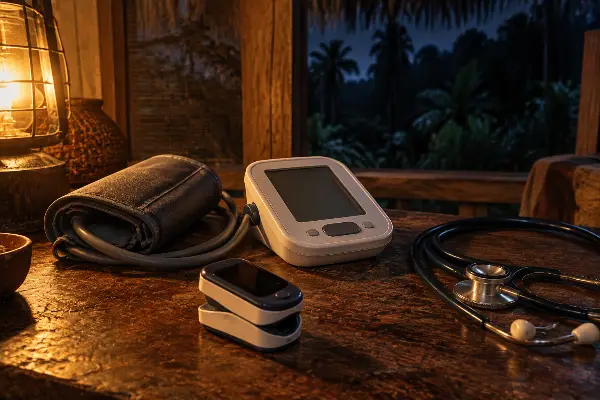
What that looks like at our center on the Rio Momon: our medical director, a Peruvian-trained physician with 18 years in tropical and emergency medicine and 10 years working with ayahuasca centers in Loreto, reads every application within 72 hours. We require ECG documentation for every guest over 50, a rule that exists because of a night in 2018 when a guest with an undisclosed heart condition developed chest pressure during ceremony and we took the boat down the river in the dark. She keeps an automated blood pressure monitor and 2 pulse oximeters on the property, and she’s awake on site every ceremony night. If you want the full version of what safe screening looks like, it’s written up separately.
On hormone replacement therapy: estrogen and progestin don’t carry the serotonergic interaction risk that makes antidepressants dangerous here. Sex hormones and MAO-A don’t collide in that direction. Disclose the therapy anyway, along with everything prescribed alongside it, because the medications that often accompany hormone therapy are the ones that matter.
Hot flashes during ceremony are common and unremarkable. Thermoregulation is already unstable and the autonomic load of ceremony amplifies it. Bring layers, drink water, and know that stepping out of the maloca for a few minutes is normal and nobody will stop you.
One thing worth naming, because a lot of women arrive at this medicine in midlife for reasons that have nothing to do with hormones. Depression, grief and the question of what the second half is for are the 3 most common reasons women in this age bracket apply here. We publish what 290 guests’ depression scores actually did rather than promise an outcome, and roughly 30% of those guests didn’t improve.
What you can take for cramps and nausea
Ordinary painkillers are fine pharmacologically. The anti-nausea drug most women pack is the one to leave at home.
Ondansetron, sold as Zofran, is the obvious thing to bring to a ceremony famous for vomiting, and it’s the interaction no table in this category lists. The FDA’s own label for Zofran carries a serotonin syndrome warning that names the drug classes to worry about: “Most reports have been associated with concomitant use of serotonergic drugs (e.g., selective serotonin reuptake inhibitors (SSRIs), serotonin and norepinephrine reuptake inhibitors (SNRIs), monoamine oxidase inhibitors, mirtazapine, fentanyl, lithium, tramadol, and intravenous methylene blue).” Monoamine oxidase inhibition is the entire mechanism that makes ayahuasca work orally. So ondansetron sits inside the window where the label tells you not to put it.
Ibuprofen and naproxen are a different class. They aren’t serotonergic and they carry no monoamine oxidase interaction, so cramps have an answer. Dieta rules on ordinary painkillers vary between centers, so confirm yours rather than assuming.
Here’s the medication picture as we screen it. Our taper timelines are longer than the numbers you’ll see quoted elsewhere, and that’s deliberate. Most published guidance says 2 weeks off an SSRI. We require 6.
| Medication | Why it matters | What we require |
|---|---|---|
| SSRIs (sertraline, escitalopram, paroxetine, citalopram) | Serotonin syndrome risk against MAO-A inhibition | 6 weeks minimum |
| Fluoxetine | Clears far more slowly than the rest of its class | 8 weeks |
| SNRIs (venlafaxine, duloxetine) | Same risk, plus withdrawal effects | 6 weeks minimum, often longer |
| Tramadol | Serotonergic, and named on the Zofran label for the same reason | 2 weeks |
| St John’s Wort | Serotonergic, and often not disclosed because it’s sold as a supplement | 2 weeks |
| 5-HTP | Direct serotonin precursor | 1 week |
| ADHD medication (Adderall, Ritalin, Vyvanse) | Blood pressure load plus serotonergic activity | 2 weeks |
| Benzodiazepines | Withdrawal is dangerous on its own | Case by case, physician supervised |
| Ondansetron (Zofran) | FDA label names MAO inhibitors in its serotonin syndrome warning | Not during the retreat |
| Ibuprofen, naproxen | No monoamine oxidase interaction | Permitted, confirm with us on the call |
| Hormonal contraception (pill, IUD, implant, patch, ring) | No documented dangerous interaction | None required. See the vomiting section above |
Every taper here is supervised jointly by our medical director and your own prescriber, and she signs off before a spot is confirmed. If your physician won’t support the taper or thinks it’s unsafe, we don’t accept you for that cycle. Never stop a psychiatric medication on your own to qualify for a retreat.
Two corrections while we’re here, because both are repeated constantly. The tyramine diet is real but it’s routinely oversold: the vine’s MAO-A inhibition is reversible, unlike the pharmaceutical MAOIs the classic cheese-and-cured-meat warning was built for, and no tyramine crisis from ayahuasca is on record. And if you’re managing a chronic pain condition, the medications are usually the barrier rather than the condition. Fibromyalgia is a useful example, diagnosed overwhelmingly in women and typically treated with drugs that sit on the list above.
Who’s in the room at 3am?
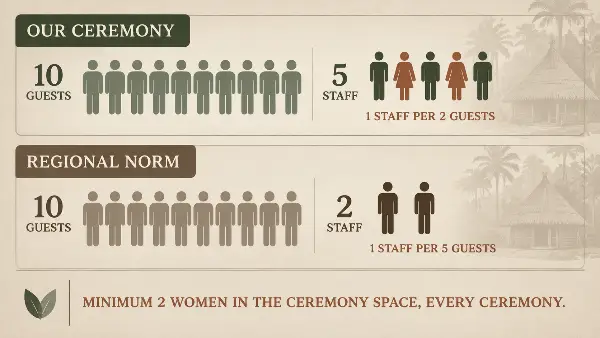
At this center, always at least 2 women, and we’ll tell you who they are before you book.
Our third healer is a woman. So is our head facilitator, a licensed clinical social worker in California, trained to Level 2 in somatic experiencing and in IFS and EMDR, with more than 650 hours of ceremony facilitation across 6 years and 12 months of her own plant dieta behind it. Both are present at every ceremony. Women have told us during screening that they wouldn’t attend without female healers in the room, and our answer hasn’t changed: you will never be in a ceremony held only by men.
Five staff are in the maloca for a maximum of 10 guests, 3 healers and 2 facilitators, so 1 staff member for every 2 people in the room. The regional norm runs closer to 1 for every 5, and at some centers 1 for every 10.
The reason to ask any of this is documented. BBC News reported in January 2020 on women sexually abused by ayahuasca facilitators, including allegations against internationally celebrated healers. The US Embassy in Lima put its own version in writing in January 2025, noting that US citizens in Peru had reported being sexually assaulted, injured or robbed at healing and retreat centers, and that those centers are licensed by nobody. That alert is about the country we operate in and we’d rather link it than pretend it doesn’t exist. Peru recognised ayahuasca as cultural heritage in 2008. Recognition isn’t regulation, and no inspector is coming.
What fills that gap here is a written policy. No staff member, healer, facilitator, kitchen or grounds, may have romantic or sexual contact with a guest during a retreat or within 90 days of its end. The 90 days exist because the medicine opens people up and the power imbalance doesn’t close when the boat leaves. Feelings of deep connection to a facilitator are normal and common. Acting on them while that imbalance is live is an abuse of trust. Every staff member signs the agreement on hire, violation means immediate termination, and the directors review it with the team before every season. We’ve never had a violation, and we’d tell you if we had.
Facilitators aren’t put in that room quickly either. The minimum is 6 months across 3 phases: attending a retreat as a guest and completing an extended plant dieta, then 2 months observing ceremonies in silence, then 2 months of supervised practice. Our lead healer’s vote at the end is decisive, and he has vetoed a candidate who completed every phase because he didn’t trust their presence in the space. How this place came to run this way is most of the reason those rules are written down rather than assumed.

Six questions to ask any center, as a woman
None of them are about the medicine.
- Are there women in the ceremony room, and what are their names? A center that can’t name them doesn’t have them.
- What’s your policy on staff contacting guests after the retreat, and how long does it run? Almost nobody has a post-retreat window. Ask anyway, and listen to how the question lands.
- Is pregnancy an automatic disqualification, and what do you do about the “might be” case? The first half is easy to answer. The second half separates a policy from a sentence on a website.
- What share of applicants do you reject? We reject 13% outright, and another 5 to 8% are accepted on conditions they never meet, usually a medication taper. So roughly 1 in 5 people who apply here never attend. Some centers in this region report 2 to 3%, which means their screening is lighter or their risk tolerance is higher.
- Who reads my medical form, with what credentials, and how fast? Here it’s our medical director, an MD, within 72 hours. Then a 30 to 45 minute video call with our intake lead, who holds an MSW, for every single applicant.
- Is a physician on the property during ceremony, or on call from town? On the property, awake, every ceremony night. A fast launch sits at our dock with an operator sleeping on it, because there’s no road, and the regional hospital is about 45 minutes downriver.
Checking a lineage is its own skill, so we published the method for checking one rather than asking you to take ours on faith.
One caveat on our own numbers, because centers use figures like these dishonestly. Across 9 years, roughly 1,900 guests and more than 650 ceremonies, we’ve had 2 emergency evacuations and no deaths. That is not a risk rate. Our sample is small and our screening removes the highest-risk people before they ever arrive. Any center open long enough will eventually have a bad night, and a spotless record means the place is young, is selective, or isn’t telling you everything. Ours is the middle one.
What this comes down to
The honest position on ayahuasca and women is that the research has barely looked, so most of what gets published about the female body and this medicine is extrapolation wearing a lab coat, and the rest is marketing. That won’t change until someone runs a trial that recruits more than 3 women and records what week of the month it is.
What you can check today is operational. Who reads your medical form. How long they make you wait off your antidepressant. Whether anyone will say the word pregnancy out loud before you get on a plane. Who is awake in the room at 3am, and what happens to a facilitator who crosses a line 2 months after you fly home.
Those answers exist. Ask for them in writing, and be suspicious of any center that gives you a feeling instead of a policy.
If you want to talk through your own situation, every applicant gets a real conversation before anyone books you in. We’ll tell you honestly if this isn’t the right time.
FAQs
Can you drink ayahuasca on your period?
Medically, yes. There’s no mechanism by which menstrual bleeding interacts with DMT or the harmala alkaloids, and no published trial has found a problem, in part because no trial has measured cycle phase at all. Some Amazonian lineages ask menstruating women not to sit in group ceremony for energetic reasons, and that varies by tradition and by maestro, so ask the center before you book. The practical considerations are comfort and fluid loss: a ceremony runs 4 to 6 hours and reliably produces vomiting, so heavy bleeding on top of that is worth mentioning to the center and to your doctor.
Has ayahuasca ever been studied in women?
Barely. The 2001 dose-finding study that underpins the human pharmacology used 6 volunteers and limited participation to men for stated ethical reasons. The 2003 follow-up that produced the 9 mmHg blood pressure figure ran 18 people, 15 male and 3 female. No published clinical trial has recorded menstrual cycle phase as a variable, so claims about what ayahuasca specifically does to a female body are extrapolation rather than finding.
Is ayahuasca safe during pregnancy?
No, at any stage. In a 2018 study in Reproductive Toxicology, 44% of pregnant rats died at 4 times the average human ritual dose and 52% at 8 times, and at only 1 to 2 times that dose the authors reported enhanced embryolethality and increased fetal soft-tissue and skeletal anomalies. Their no-observed-adverse-effect level for maternal toxicity sat at 1 times the human dose. Pregnancy is 1 of our 15 automatic disqualifications, and ICEERS phrases the exclusion as applying if you are pregnant or think you might be.
Does vomiting during ayahuasca affect birth control?
For a single ceremony night, almost always no, but 2 national guidelines set the threshold differently. The CDC’s 2024 recommendations say vomiting or diarrhea lasting under 48 hours needs no replacement pill and no backup contraception, while the NHS advises taking another pill if you vomit within 3 hours. Past 48 hours the CDC advises barrier methods until you’ve taken 7 consecutive hormonal pills after symptoms resolve. None of this applies to an IUD, implant, injection, patch or ring, because those don’t depend on gut absorption.
Can you take ayahuasca while breastfeeding?
Not recommended. DMT and the harmala alkaloids are small, lipid-soluble molecules that are likely to transfer into milk, and no human study has ever measured the concentration. Tetrahydroharmine is the slow one: a 2022 review in the Journal of Clinical Medicine reports an average half-life of 6.12 hours against roughly 2.2 hours for DMT, and the usual lactation rule of 5 half-lives puts clearance past 30 hours. Pumping and discarding removes milk from the breast but doesn’t speed clearance from the rest of you, so timing ceremony after weaning is the simpler call.
Is ayahuasca safe during perimenopause or menopause?
It isn’t ruled out by menopause itself, but the cardiovascular screening matters more in this age group. The only statistically significant cardiovascular change in the controlled trials was a diastolic rise of 9 mmHg at 75 minutes, which a healthy younger adult absorbs easily and a system with declining vascular flexibility may not. Uncontrolled hypertension and uncontrolled cardiac conditions are both automatic disqualifications here, we require ECG documentation for every guest over 50, and our medical director is on the property and awake every ceremony night.
How do I know a retreat is safe for women?
Ask 6 questions and none of them are about the medicine: are there women in the ceremony room and what are their names, what’s the policy on staff contacting guests afterwards and how long does it run, is pregnancy an automatic disqualification and what happens in a “might be” case, what share of applicants do you reject, who reads the medical form and with what credentials, and is a physician on the property during ceremony. We reject 13% of applicants outright with a further 5 to 8% never meeting their conditions, and our staff conduct policy runs 90 days past the end of a retreat.
This article is for educational purposes and isn’t medical advice. Decisions about pregnancy, breastfeeding, contraception and any change to prescription medication need a clinician who knows your history.