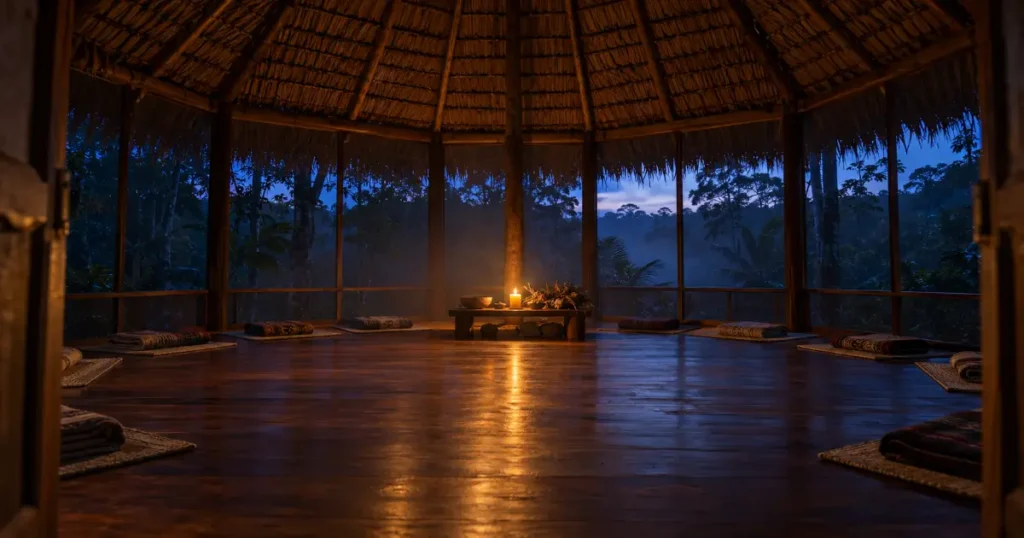
During ayahuasca ego dissolution, your sense of being a separate person fades. You stay aware, but the line between you and everything else goes. It usually comes at the peak, which in our ceremonies falls between about 9 PM and midnight. For some people it feels like peace, and for others it feels like dying. A stronger experience goes with better results in clinical settings, but that link is weak in real-world ceremonies. So our lead healer says no to about 1 in 5 requests for a second cup.
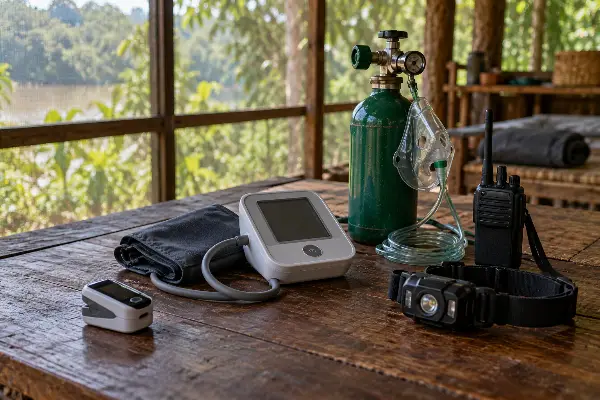
I co-founded Iquitos Ayahuasca Retreats on the Río Momón in 2017 with our lead healer, who has worked with this medicine for 54 years. We’ve held more than 650 ceremonies since. On every ceremony night at our ayahuasca retreats in Iquitos, 5 staff sit in the maloca with 10 guests at most, and a physician stays awake on the property.

What is ayahuasca ego dissolution?
Ayahuasca ego dissolution is a temporary loss of the sense of being a separate self during an ayahuasca ceremony, usually at the peak. The line between you and the world fades, but awareness stays on, and your personality comes back as the medicine wears off. Researchers measure it with the 8-item Ego-Dissolution Inventory. Outside research, it’s called ego death.
The 2 names describe the same thing at different strengths. Researchers say “dissolution” because it can be rated, and because it passes. “Ego death” is the older, spiritual phrase. People tend to save it for the far end: a complete loss of identity, often with the certainty that you’re dying.
The Ego-Dissolution Inventory came out of Imperial College London in 2016. You rate 8 statements from 0 to 100. Here are 2 of them: “I felt at one with the universe” and “All notion of self and identity dissolved away.”
The research team tested it on 1,828 drug experiences reported by 691 people. They also asked about ego inflation, the feeling of being more important or sure of yourself. Those 2 sets of ratings alone told psychedelic experiences apart from cocaine 90.1% of the time, and from alcohol 85.2% of the time. Being drunk or high on cocaine doesn’t produce it the same way.
What ego dissolution feels like
It feels like the sense of “me” loosening while you stay awake. The Inventory’s own wording is plainer than most guidebooks. One item reads: “I experienced a dissolution of my ‘self’ or ego.” Another: “I felt far less absorbed by my own issues and concerns.”
You don’t black out, and you can still hear the icaros, the songs our healers sing through the night. What changes is the feeling that a specific someone is doing the listening.
The far end, what most people mean by ego death, has its own definition in the research. A 2023 University of Haifa study asked Israeli ayahuasca drinkers whether they’d had “an overwhelmingly authentic and convincing sensation of acutely dying or being dead.”
Timing is more predictable than content. We serve the medicine around 8:15 PM. Dissolution, when it comes, tends to arrive in the peak between about 9 PM and midnight, along with the strongest visions and most of the purging. Our hour-by-hour clock shows the rest of the night.
How common is ego dissolution on ayahuasca?
Studies that have asked put it at about half to 2 in 3 drinkers. The number depends on how experienced people are and on what exactly gets measured.
| Study | Who took part | What they reported |
|---|---|---|
| 2023, Israel (Frontiers in Psychiatry) | 54 experienced ayahuasca drinkers | 66.7% had felt they were dying or dead |
| 2023, Israel (same paper) | 305 less experienced drinkers | 49.2% had felt the same |
| 2022, North America (Frontiers in Pharmacology) | 53 first-time drinkers at 2 ayahuasca churches, after 1 night | 55.6% of those assessed had a “complete” mystical experience |
The mystical experience measure is related to ego dissolution, not identical: it includes a sense of unity. By that measure, close to half of those first-timers didn’t get there.
We can’t give you our own figure yet. We already track depression and PTSD scores for our guests and publish those numbers. What we’ve never asked is how far anyone’s sense of self went. That’s changing: the 8 Inventory statements are going into the survey guests fill in on Day 10. I haven’t found a published study with these scores from a retreat in Peru.
When nothing dissolves
A quiet night is common, and it doesn’t mean the ceremony failed. In that 2022 study, 44.4% of the first-time drinkers assessed didn’t reach a complete mystical experience after their night. First doses are kept small on purpose, so a mild first ceremony is part of the plan.
What the brain seems to be doing
The main brain-scan finding is that ayahuasca quiets the default mode network, the circuit most active when you think about yourself. I know that quiet from the inside. After my first ceremony, in 2013, the running ticker in my head, full of client deadlines from the digital marketing agency I ran, went quiet for 2 days.
One theory for why, called REBUS, appeared in Pharmacological Reviews in 2019. It says psychedelics loosen the brain’s confidence in its highest-level beliefs. The paper gives “the belief that one has a particular personality and set of characteristics and views” as an example. In that model, the belief in a fixed self is part of what loosens. It’s a model, and nobody has proven it. Our post on how ayahuasca affects the brain covers the scans themselves.
Bliss or dread: the same dissolution, 2 outcomes
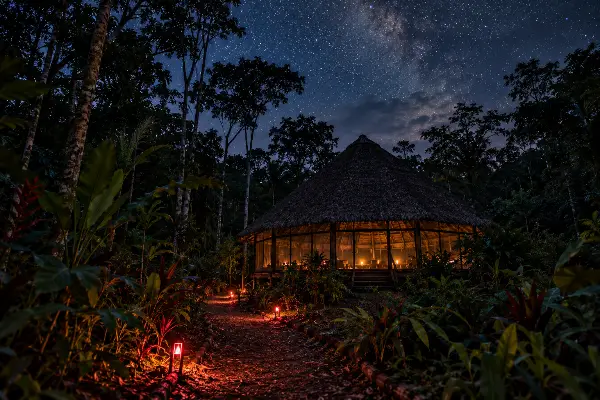
The same loss of self can feel like peace or like dying, and the research suggests the 2 versions don’t lead to the same place.
A team at Imperial College London gave psilocybin to 20 people with depression that hadn’t responded to treatment, and 19 finished. They measured 2 sides of the experience. “Oceanic boundlessness” covers unity, bliss and insight. “Dread of ego dissolution” covers anxiety and losing control of your thoughts. More oceanic boundlessness predicted more improvement 5 weeks later. More dread predicted less. You’ll find articles saying the frightening version helped these patients. The paper says the opposite.
That doesn’t make a hard night a wasted one. The Global Ayahuasca Survey, published in 2022, drew answers from 10,836 people. 55.9% reported mental health effects they called adverse in the weeks or months after drinking, and 87.6% of them saw those effects as part of their growth.
That psilocybin trial ran in a clinical setting. A vegetalismo ceremony works differently. The healer isn’t a trip-sitter: our healers work on each guest through the night with icaros.
What our staff do when it turns to terror
The first job is to tell dread apart from something that needs a doctor. The nearest facilitator gets down beside the guest and says, “I’m here. You’re safe. Can you hear me?” Then they check whether the guest is answering, breathing normally and aware of where they are. Most frightened guests are. That’s dread, and the ceremony team handles it. The facilitator touches only with spoken permission and calls a healer over to sing icaros chosen for terror and dissolution. Most of the time it eases in under 20 minutes. If any of those 3 checks fails, the physician is called.
The guest’s part is simple to say and hard to do: stop fighting it. Our facilitators give frightened guests something to hold on to: “Feel the mat under your body. Feel your feet on the wood. I am right here and I am not leaving.” After 9 years, I think giving up control is the hardest lesson in ceremony and the most important one. It’s also why I believe willingness beats diagnosis.
Is ego dissolution dangerous?
It passes for most people as the medicine wears off. It isn’t risk-free, though, and in the dark it can look like 3 other states that need a different response.
The risk numbers come from large surveys and small reviews. The Global Ayahuasca Survey found that 11.9% of the people with adverse mental health effects sought professional help for them. The same survey linked a stronger spiritual experience to more of those effects. Psychotic episodes look rare. A 2017 systematic review of human studies cites a Brazilian church’s estimate: 13 to 24 episodes in 25,000 servings. The authors note that nobody reported how the estimate was made.
A 2023 study in PLOS ONE recruited 608 people who’d had problems lasting more than a day after a psychedelic. For about 1 in 3, the problems lasted over a year, and for 1 in 6, over 3 years. Feeling unreal or cut off from yourself was among the common problems. Because that study recruited people with problems, it can’t tell you how common they are.
How can you tell ego dissolution from psychosis?
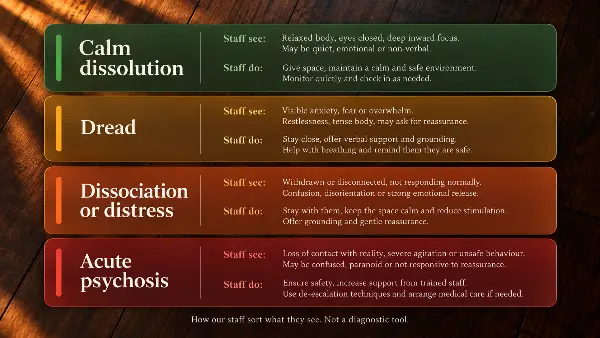
In ego dissolution you stay aware and can usually answer when someone speaks to you. In psychosis, contact with what’s real breaks and doesn’t come back when someone speaks to you. Here’s how our staff sort what they see on a mat at 2 AM.
| State | What it’s like inside | What staff see | What staff do |
|---|---|---|---|
| Calm dissolution | The edges of “me” fade, and you stay aware | Still and quiet; answers when spoken to | Nothing new; the healers keep singing |
| Dread of dissolution | Sure you’re dying; panic; fighting it | Crying, gripping, calling out, but answers and knows where they are | A facilitator stays at the mat and touches only with permission; a healer sings to the guest until it passes |
| Dissociation or distress that won’t lift | Cut off and unable to answer, or chest and breathing symptoms | No answer, fast breathing, doesn’t know where they are | The physician is called by radio, reaches the mat in 2 to 3 minutes and checks vital signs |
| Acute psychosis | Contact with what’s real breaks and doesn’t come back | Speech stops making sense; tries to leave; may get agitated | The physician takes over, with medication and a hospital transfer if needed |
This is how our staff sort what they see. It isn’t a diagnostic tool, and it doesn’t replace the physician’s judgment.
Screening does most of the work before anyone reaches a mat. We turn away anyone with a history of psychosis, and anyone whose parent or sibling has had it if they’ve never taken a psychedelic. The 2017 review draws the same line: people with a personal or family history of psychosis or mania should avoid these substances. Our screening process takes 1 to 3 weeks, and antidepressants need a supervised taper timeline first.
Why consent matters more when the self dissolves
When the line between you and everything else goes, you can’t always tell a real hand from a vision. That makes consent harder to give and easier to abuse.
Researchers have raised the same problem. A 2020 paper in the Journal of Psychedelic Studies, written while building a community guide on sexual abuse in ayahuasca settings, asked “whether consent can ever be granted in any circumstances in which one or more individuals are in an altered state of consciousness.”
Our staff ask out loud before any touch, a yes from earlier in the night doesn’t carry over, and we keep 2 women in every ceremony. The full written consent policy, including who you report to, is in our safety guide.
Should you chase ego death? What the 2026 evidence says
No. Outside clinical settings, how intense the night gets does little to predict who improves.
A 2025 meta-analysis in Neuroscience & Biobehavioral Reviews pooled 34 studies. It measured correlation, where 0 means no link and 1 means a perfect one. Across all 34, a stronger mystical-type experience went with more improvement, at r = .33. The split is what matters for a retreat. The link was r = .50 in protocol-based clinical settings. For naturalistic use, which is what a retreat is, it was r = .14.
Ayahuasca studies point the same way.
| Study | Who took part | What the peak predicted |
|---|---|---|
| 2022, North America (Frontiers in Pharmacology) | 53 first-time drinkers | Little. The traits people arrived with predicted who improved: more negative emotion, more disconnection from their bodies, less belief in their own abilities |
| 2022, Netherlands (Psychopharmacology) | 20 people screened for depression who drank an ayahuasca analogue | Lower depression scores on day 1 and at 1 month, with no link left at 1 year |
| 2018, Netherlands and Colombia (Psychopharmacology) | 57 ceremony drinkers | Improvements the day after; at 4 weeks, with 31 people left, only 1 measure still tracked it |
These are correlations, and correlations can’t show cause. Intensity does track improvement in clinical settings. At a retreat, drinking for a bigger night has weak support.
That’s why our lead healer decides every dose and says no to about 1 in 5 requests for a second cup. More isn’t the goal. We also hold 4 ceremonies across 10 days, with nights off between them, so nobody stacks one peak on top of another.
After the self comes back
The research on lasting change is thin. What I see is that the weeks after a ceremony decide more than the peak does.
2 recent studies are worth knowing. The first, a 2025 University of Haifa study, compared 54 long-term ayahuasca drinkers with 53 people who had never taken a psychedelic. Among the drinkers, more lifetime ego dissolution predicted more acceptance that things change and end. That acceptance explained their lower fear of death. The study is a snapshot, so it can’t show that ayahuasca caused the difference.
The second, a 2026 study in Human Psychopharmacology, compared 37 ayahuasca users with 137 meditators on everyday traits like acceptance, stepping back from your thoughts, and not clinging. Meditators scored higher, and meditation practice was linked to scores. The number of ayahuasca sessions wasn’t, in that sample.
That fits what I’ve seen. A big night doesn’t change a life on its own. The guests who do well change 1 real thing in their lives within 3 months and stay in touch with someone who understands what happened. The ones who struggle tend to isolate, or book another retreat to chase the feeling. That’s why every retreat we run keeps checking in with guests until the 1-year mark, starting with 2 calls in the first 3 weeks.
Ayahuasca ego dissolution can show you that the self you defend all day is looser than it feels. What you do with that happens later, on ordinary weekdays. If you want to drink with people who’ll stay beside you through the frightening version, and who won’t pour you more to chase it, start your application.
FAQs
What does ayahuasca ego dissolution feel like?
Your sense of being a separate person fades while you stay aware, so you can still hear the healers’ songs. The Ego-Dissolution Inventory describes it with statements like “I felt at one with the universe” and “All notion of self and identity dissolved away.” In our ceremonies it tends to come at the peak, between about 9 PM and midnight.
Is ayahuasca ego dissolution the same as ego death?
They describe the same experience at different strengths. “Ego dissolution” is the research term, and “ego death” usually means the far end, often with the certainty that you’re dying. In a 2023 study, 36 of 54 experienced Israeli ayahuasca drinkers (66.7%) reported that sensation of dying.
How long does ego dissolution last on ayahuasca?
It’s temporary and sits inside the peak of the night, not the whole ceremony. Our ceremonies run from about 8 PM to 3 AM, and dissolution tends to come between about 9 PM and midnight. Your sense of self comes back as the medicine wears off, though a minority of people report difficulties for weeks or longer afterwards.
Is ego death dangerous?
It passes for most people, but it isn’t risk-free. In the Global Ayahuasca Survey of 10,836 people, 55.9% reported adverse mental health effects afterwards, and 11.9% of those sought professional help. Psychotic episodes look rare, and people with a personal or family history of psychosis shouldn’t drink.
How can you tell ego death from psychosis?
In ego dissolution you stay aware, and most people can answer a facilitator who asks, “Can you hear me?” In psychosis, contact with what’s real breaks and doesn’t come back when someone speaks to you. Our staff call the physician for any guest who can’t answer or doesn’t know where they are, and our screening turns away anyone with a history of psychosis.
Should you try to have an ego death on ayahuasca?
No. A 2025 meta-analysis of 34 studies found that experience intensity tracked improvement at r = .50 in clinical settings but only r = .14 in naturalistic use, which includes retreats. Our lead healer says no to about 1 in 5 requests for a second cup, because more isn’t the goal.
What if I don’t experience ego dissolution on ayahuasca?
That’s common, and it doesn’t mean the ceremony failed. In a study of 53 first-time drinkers, 44.4% of those assessed didn’t reach a complete mystical experience. First doses are kept small on purpose, so a mild first ceremony is part of the plan.