Reputable ayahuasca retreats answer 8 questions in writing, with names, numbers and times you can check before you pay. They’ll tell you who the healers are and who trained them, who reads your medical file, how often they say no, how many guests share each healer, how far the hospital is, what’s in the cup, how the healers get paid, and who calls you after you fly home. A center whose email reply is all warmth and no detail won’t do better at 2 a.m.
I co-founded Iquitos Ayahuasca Retreats on the Río Momón in 2017 with Maestro Don Enrique Huayta Peña. In 9 years we’ve hosted about 1,900 guests, and we turn down 13% of the people who apply. Below are the 8 questions, the answers that pass, the answers that fail, and our own answers, so you can hold our ayahuasca retreat to the same test.
How do you identify a reputable ayahuasca retreat?
Send every center on your shortlist the same 8 questions by email, then compare the replies side by side. Specific answers pass. Vague ones fail, however warm they sound.
A reputable ayahuasca retreat names who leads its ceremonies and who trained its healers, has a physician read your medical history before accepting you, turns some applicants away, tells you how many guests share each healer, can time its route to a hospital, lists what’s in the brew, says how its healers are paid, and schedules calls after you leave.
Ask in writing for 2 reasons. First, the setting is the part of the risk you get to choose. An analysis of the Global Ayahuasca Survey, which gathered answers from 10,836 people in more than 50 countries, appeared in PLOS Global Public Health in 2022. It found that drinking in a non-supervised setting was linked with more physical adverse effects. Supervision is what these questions measure.
Second, an email is a record. Phone calls blur. A written answer is something you can hold a center to when you arrive.
Why “licensed” means nothing in Peru
Peru has no licensing system for ayahuasca retreats or healers, so there’s no certificate for you to check. Retreat guides that tell you to confirm a center’s accreditation are describing something Peru doesn’t have.
The U.S. Embassy in Lima said so in a health alert on January 23, 2025: “Facilities or groups offering ayahuasca/kambo are not regulated by the Peruvian government and may not follow health and safety laws or practices.” The same alert reports deaths and severe illness, including mental health episodes, among U.S. citizens who drank ayahuasca in 2024. Its advice is not to take ayahuasca at all. You should know that before you read anything else we say.
What Peru did do, in 2008, was declare the traditional knowledge and use of ayahuasca by native Amazonian communities part of the nation’s cultural heritage, under Resolución Directoral Nacional N° 836/INC. That resolution protects a tradition. It licenses nobody, and it sets traditional use apart from what it calls decontextualized, consumerist Western uses with commercial purposes. Our breakdown of the 2008 heritage ruling covers what it does and doesn’t protect.
A business permit shows that a lodge exists. It says nothing about what happens in the ceremony. We don’t hold an ayahuasca license either, because there isn’t one to hold. So the checking falls to you, and a center’s written answers are the best evidence you’ll have.
The 8 questions to send before you pay
Put all 8 in a single email, send it to every center you’re considering, and line up the replies. The table shows what a passing answer looks like, what a failing one looks like, and how we answer.
| # | Ask this | A passing answer | A failing answer | Our answer |
|---|---|---|---|---|
| 1 | Who are the healers, who trained them, and for how many years? | The lead healer’s full name, each healer’s teacher and years, and who will be at your ceremonies | “Experienced shamans from a long lineage” | Maestro Don Enrique Huayta Peña (54 years) and 2 family healers (22 and 34 years). All 3 at every ceremony |
| 2 | Who reads my medical file, and before or after I’m accepted? | A named physician, before acceptance | “Our team reviews every form,” or a yes the same day | Dra. Carmen Ríos Medina, MD, within 72 hours, then a video interview of 30 to 45 minutes |
| 3 | How often do you say no, and how long does screening take? | A percentage, and a timeline in weeks | “Everyone who feels called is welcome” | 13% declined outright; 1 to 3 weeks |
| 4 | How many guests per ceremony, and who is in the room? | Guest count, healer count, facilitator count | “Small, intimate groups” | Up to 10 guests, 3 healers, 2 facilitators |
| 5 | How far is the hospital, and who is awake overnight? | A named hospital, a timed trip, a named person awake | “We’re close to town” | Hospital Regional de Loreto, about 45 minutes by fast launch; physician on site and awake every ceremony night |
| 6 | What’s in the brew, and who cooks it? | 2 plant names and the cook’s name | “Traditional Amazonian medicine” | Caapi vine and chacruna leaf only; Don Enrique and his son cook every batch |
| 7 | How are the healers paid? | A salary, an ownership share or a per-night fee, with a figure | “Our healers are well cared for” | S/ 3,500 a month plus health insurance; Don Enrique co-owns 35% |
| 8 | What happens after I fly home, and with whom? | A call schedule with a named person | “Lifetime integration support” | Calls at week 1 and week 3, check-ins to month 12, led by Lucia Fernández |
1. Healers: names, teachers, years
Look for the full name of the healer who leads your ceremonies, who trained each healer, their years of practice, and whether they’ll be in the room with you. “Experienced shamans from a long lineage” tells you nothing. Neither does a list of names that changes between the website and the email.
Our lead healer, Maestro Don Enrique Huayta Peña, is 68. He began training at 14, in 1972, under Maestro Julio Llerena Arevalo, who guided him until Julio died in 2005, and he has worked with these plants for 54 years. His son has 22 years with the medicine, and his cousin, a maestra, has 34. Both prefer to stay out of public posts, and we respect that. All 3 are family, all 3 are permanent, and Don Enrique is at every ceremony we run. We don’t bring in visiting shamans.
That last part matters more than it sounds. Don Enrique holds that a healer has to learn a person across more than 1 night, and a rotating cast can’t do that. To test a lineage claim past the names, use the questions we set out for checking a lineage.
2. Who reads your medical file, and when?
A named physician should read your full medical history before you’re accepted. Not a booking coordinator, and not after you’ve paid a deposit.
The reason is medication. The ayahuasca vine contains MAO inhibitors, and some common antidepressants don’t mix with them. The FDA label for Prozac tells doctors to allow at least 5 weeks after stopping it before starting an MAOI prescribed for a psychiatric disorder. Our physician requires 8 weeks off fluoxetine and at least 6 off any other SSRI, planned with your own prescriber. We publish our taper timelines by drug.
At our center, Dra. Carmen Ríos Medina, MD, reads every application within 72 hours. Her background is 18 years of emergency and tropical medicine, and she trained in Iquitos. Then our senior facilitator, David Park, MSW, talks with every applicant on video for 30 to 45 minutes. A question he asks: “Tell me about the worst psychological experience you have ever had, and what helped you come through it.”
3. How often the center says no
Ask for a percentage. A center that has never turned anyone away is selling seats.
The research backs the gate. A 2017 systematic review in Therapeutic Advances in Psychopharmacology found that psychotic episodes after ayahuasca appear to be rare. Citing a 2007 estimate, the authors put the rate in the Brazilian UDV church under 1%: 13 to 24 episodes in 25,000 servings. They also noted that “several reports describe subjects with a personal and possibly a family history of psychosis,” and concluded that psychiatric screening before these substances are given in controlled settings “seems to significantly reduce the possibility of adverse reactions with psychotic symptomatology.”
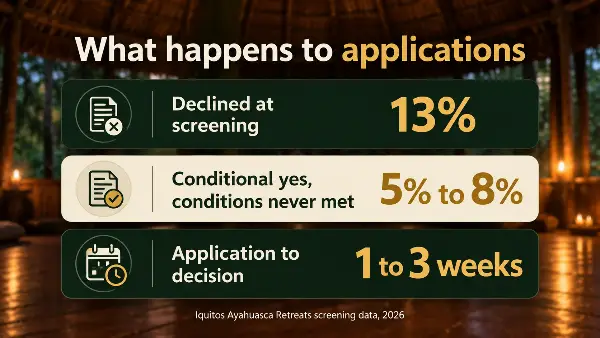
We turn down 13% of applicants at the screening stage, and another 5% to 8% get a conditional yes, usually tied to a medication taper, that they never complete. Our automatic no’s include any history of psychosis, and schizophrenia or psychosis in a parent or sibling if you’ve never taken a psychedelic before. Screening takes 1 to 3 weeks, and we lay out our full screening process step by step.
A same-day acceptance is the clearest fail on this list. It leaves no time for a physician to look at your medications.
4. Guests per healer on a ceremony night
Find out how many guests will be in the ceremony, and how many healers and facilitators will sit in the room with them. A staff-to-guest ratio that counts cooks and gardeners says nothing about who reaches you at 2 a.m.
My first ceremony, in November 2013, was at a large center on the road to Nauta, outside Iquitos. There were 25 guests in the maloca and 2 healers I was never introduced to. I purged within 40 minutes and then spent about 4 hours with nobody checking on me. Hold that night up against the numbers below.
We seat no more than 10 guests, with 3 healers and 2 facilitators in the room every night. That works out to 2 guests for every person on staff in the room, or about 3 guests per healer. At least 2 of those 5 are women, a maestra and our head facilitator, which is how we keep our promise of 2 women in every ceremony.
“Small, intimate groups” with no number attached isn’t an answer. Neither is a ratio built from the whole payroll.
5. How far is the hospital, and who is awake at 2 a.m.?
The answer you want names the hospital, gives a travel time the center has timed itself, and names the medical person who stays awake on the property during ceremony.
Most hard nights never need a hospital. In the Global Ayahuasca Survey, 132 of the 5,775 people who answered the question, about 2.3%, reported physical effects that needed medical attention. Rare still means somebody, eventually, and on a river the plan has to exist before that night.
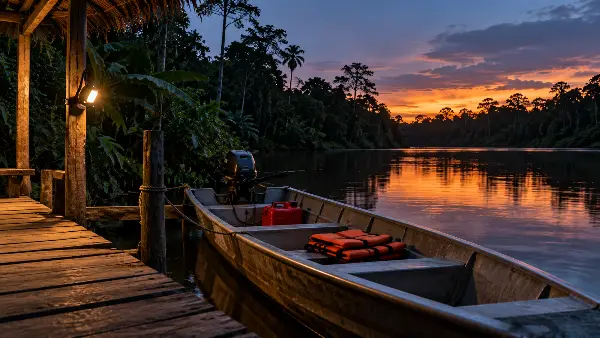
Ours runs to Hospital Regional de Loreto in Iquitos, about 45 minutes by fast launch. The boat operator sleeps at the dock during every ceremony block. Dra. Ríos stays on the property, awake, through every ceremony night, with a walkie-talkie linking her to the maloca and the dock, and a satellite phone to alert the hospital.
We’ve made that run twice in 9 years. The first, in early 2018, was a cardiac event that happened before we had hired a physician. The second, in 2022, was an acute psychotic episode. Both guests recovered fully. Because a river evacuation is expensive, we require insurance that covers evacuation.
“We have first aid” is a fail, and a doctor “on call” an hour away isn’t much better.
6. What’s in the cup, and who cooked it
A passing answer gives 2 plant names and the name of the cook. “Traditional Amazonian medicine” doesn’t.
We use 2 plants: the Banisteriopsis caapi vine and the leaf of Psychotria viridis, called chacruna. Don Enrique and his son cook every batch together over 2 days. If Don Enrique can’t cook, the ceremony waits. We’ve logged every batch since 2020, more than 130 of them, and we harvest no wild vine: it comes from our own land or from 2 families nearby who grow it.
Some centers add toé (Brugmansia) to make the visions stronger. The adulteration problem is why this question made the list.
7. How are the healers paid?
Ask for the structure and a figure: a monthly salary, a share of the business, or a fee per ceremony. If a center won’t say how it pays the people who hold its ceremonies, it has told you how it treats the tradition.
For scale, Peru’s legal minimum wage is S/ 1,130 a month under Decreto Supremo N° 006-2024-TR, and the government has announced a rise to S/ 1,230 from October 1, 2026.
His son and his cousin each earn S/ 3,500 a month, plus health insurance and bonuses tied to occupancy. Don Enrique co-owns 35% of the company, draws a S/ 4,500 monthly stipend and takes 35% of the net profit. We also put 5% of gross revenue, about $14,000 in 2025, into a fund run by a committee of 2 elected community leaders and me.
We publish these numbers because we think every center should. If a center won’t tell you what it pays its healers, ask yourself why.
8. The calls after you fly home
Look for a schedule with dates and a named person on the other end. “Lifetime integration support” with no calendar attached is a slogan.
The weeks after a retreat are when people need it. In the Global Ayahuasca Survey, 55.9% of respondents reported adverse mental health effects during the weeks or months after they drank. Most of them, 87.6%, saw those effects as part of a positive process, and around 12% sought professional support for them.
Our follow-up program, Raíces, is run by Lucia Fernández, who practiced for 7 years as a licensed clinical social worker in California before joining us. Every guest gets this schedule:
| When | What | Format |
|---|---|---|
| Week 1 | Check-in call, which about 82% of guests take | 30-minute video call |
| Week 3 | Follow-up call | 20-minute call |
| Weeks 6 to 8 | Check-in | Email, with a call if you want one |
| Month 3 | Depression and PTSD questionnaires | |
| Months 6 and 12 | Check-ins | |
| Any time | A hard week or a crisis | Emergency WhatsApp line, answered within 4 hours during waking hours |
Lucia also keeps a list of 25+ vetted therapists across the US, Canada, the UK, Australia, Germany and the Netherlands. Our 3-month scores are public too, including the guests who don’t improve.
Can you trust ayahuasca retreat reviews?
For comfort, yes. Reviews are good for judging the food, the rooms and the boat ride. They’re weak on what you can’t see from a good week: who was turned away, what the evacuation plan is, and what changed after something went wrong.
Our own reviews average about 4.8 across 202 reviews on 4 review sites, and we don’t pay or offer anything for them. I spent years building a digital marketing agency before this center, and I still wouldn’t pick a retreat by its stars. Reviews come from people who finished the week, and they describe the week they had. A declined applicant never had one.
Fake reviews are a big enough problem that the U.S. Federal Trade Commission banned buying and faking them in a federal rule that took effect October 21, 2024. The FTC also says a business that posts testimonials on its own website can be liable if they’re fake. Use reviews to judge comfort. Use the 8 answers to judge safety.
What a reputable retreat costs in 2026
Price doesn’t prove safety in either direction. What matters is whether screening, an on-site physician and follow-up calls sit inside the price or are missing from it. Our services page lists what each week includes.
| Our retreats | Details |
|---|---|
| 10-day retreat, private tambo | $2,600 |
| 10-day retreat, shared tambo | $2,100 per person |
| 3-week plant dieta retreat | $5,200 |
| Included | Airport pickup in Iquitos, boat transfers, all meals, 4 ceremonies, 2 to 4 plant baths, integration circles, at least 2 healer consultations, the Raíces follow-up program |
| Not included | International flights, the Lima to Iquitos flight, required travel insurance with evacuation cover, a hotel night in Iquitos, tips |
| Payment | 50% deposit to reserve, balance due 30 days before arrival |
Ask every center the same thing: what does the price leave out? A cheap retreat that drops the physician and an expensive one that spends your money on a pool tell you the same thing, which is where their priorities sit. Iquitos has no road link to the rest of Peru, so budget for the flight from Lima. Our guide to getting to Iquitos covers each part of the trip.
Check that the answers match
Put each center’s email next to its website and its directory listings. The healer names, the founding year, the group size and the price should agree everywhere.
A mismatch isn’t always a lie. Centers change healers, prices and buildings. But when the email and the website disagree, you’re owed an explanation before you send a deposit.
Reputable ayahuasca retreats answer all 8 questions with names and numbers, and the answers match what’s on their website. Send us the same email you send everyone else. If our answers don’t hold up next to someone else’s, go with theirs. When you’re ready, start your application.
FAQs
How can you tell if an ayahuasca retreat is reputable?
Email it 8 questions and judge the replies by how specific they are: who leads the ceremonies and who trained the healers, who reads your medical file, how often it says no, guests per healer, the hospital and travel time, what’s in the brew, how healers are paid, and who calls after you leave. Names, numbers and times pass, and adjectives fail. We decline 13% of applicants and seat up to 10 guests with 5 staff in the room, and we answer all 8 in writing.
Are reviews enough to find a reputable ayahuasca retreat?
No. Reviews show you the food, the rooms and the boat ride, but not who was turned away or how a center handles an emergency. Fake and bought reviews were a big enough problem that the U.S. Federal Trade Commission banned them in a rule that took effect October 21, 2024.
How many people should be in an ayahuasca ceremony?
Ask for the number of guests and the number of healers and facilitators in the room during ceremony, not the retreat’s total staff. We cap ceremonies at 10 guests, with 5 people on staff in the room: 3 healers and 2 facilitators. My first ceremony elsewhere, in 2013, had 25 guests and 2 healers, and nobody checked on me for about 4 hours.
How long should ayahuasca retreat screening take?
Expect days to weeks, not hours. Ours takes 1 to 3 weeks: a physician reviews your application within 72 hours, then you have a video interview of 30 to 45 minutes before a decision. A same-day acceptance leaves no time to review medications, and our physician requires 6 to 8 weeks off some antidepressants before ceremony.
Should a reputable ayahuasca retreat have a doctor on site?
That’s the standard we’d look for: a physician on the property and awake during ceremony, not a number to call in the city. Ours stays on site through every ceremony night, and the nearest hospital is about 45 minutes away by fast launch. The Global Ayahuasca Survey found that about 2.3% of respondents who answered the question reported physical effects that needed medical attention.
How long should integration support last after an ayahuasca retreat?
Plan on months. Ours runs 12 months: a 30-minute video call in week 1, a 20-minute call in week 3, then check-ins through month 12, with a WhatsApp line answered within 4 hours during waking hours. The Global Ayahuasca Survey found that 55.9% of respondents reported adverse mental health effects during the weeks or months after they drank, and around 12% sought professional support.