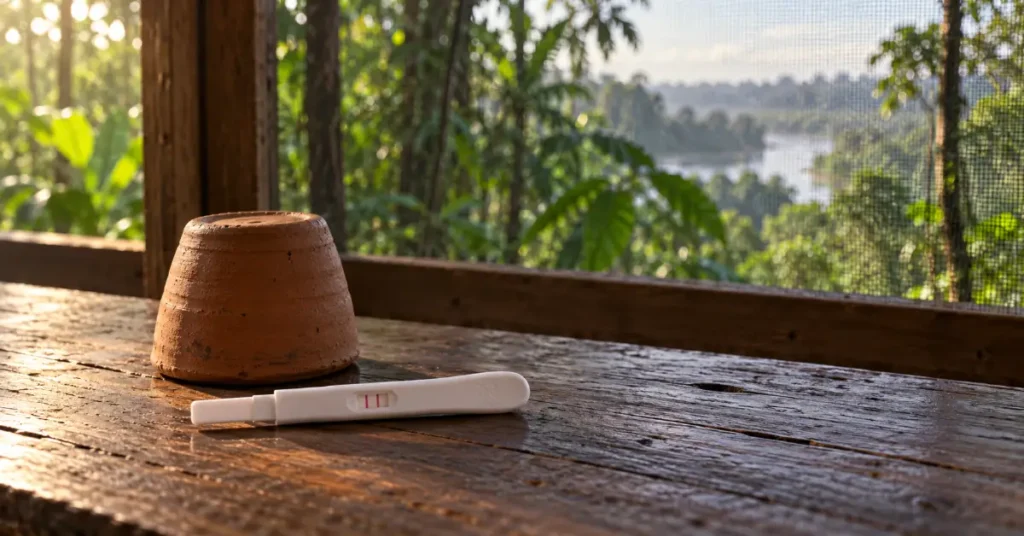
Don’t drink ayahuasca while you’re pregnant, or while you might be. At our center, both are a full stop. The research on ayahuasca and pregnancy is thin, and what there is calls for caution. A 2026 review searched the medical literature through March 2025. It found no eligible human study of pregnancy outcomes after ayahuasca. In a 2018 study, pregnant rats got the brew every day. At 2 times a typical ritual dose, their litters were smaller. At 4 times, 11 of 25 mothers died.
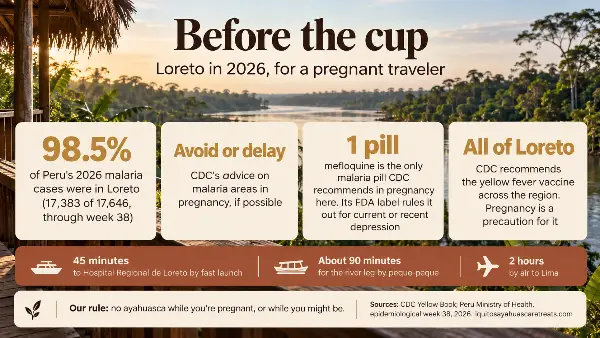
The trip adds risks before anyone pours a cup. CDC tells pregnant women to avoid or delay trips to malaria areas if they can. Through late September 2026, Loreto, the region around Iquitos, had 98.5% of Peru’s malaria cases.
Can you drink ayahuasca while pregnant?
No. Nobody has published a study showing it’s safe in pregnancy. In a 2018 rat study, clear harm showed up at 2 times a ritual dose. Even the ritual dose brought small changes in the fetuses.
Ayahuasca and pregnancy is a safety question about what the brew can do to a pregnancy. The brew is made from chacruna leaves and the Banisteriopsis caapi vine. The vine’s alkaloids block the enzyme MAO-A, so DMT from the leaves can work. A 2026 review found no eligible study of pregnancy outcomes in women who drank it.
A 2026 scoping review in Therapeutic Advances in Drug Safety searched 5 medical databases through March 2025 for pregnancy outcomes after psychedelic use. It found 23 sources that fit, from 1968 to 2020, on MDMA, LSD and peyote. None covered ayahuasca or DMT. The authors warn that a lack of data isn’t proof of safety.
ICEERS, a nonprofit focused on ayahuasca, wrote a 2019 guide for the health department of Catalonia, in Spain. The guide lists pregnancy, or thinking you might be pregnant, as a reason not to take ayahuasca.
At our retreat center, a licensed doctor checks each application before we offer a place. Pregnancy is on the full-stop list for every service on our services page. If there’s any chance you’re pregnant, do a pregnancy test before you book flights.
Breastfeeding is a stop too. Our guide for women covers it, along with periods and birth control.
What did the rat studies find?
All 3 found effects on the mothers or their young. In the 2018 study, daily doses at 2 times a ritual dose meant smaller litters. At 4 and 8 times, about half the mothers died.
| Study | What the pregnant rats got | What happened |
|---|---|---|
| Reproductive Toxicology, 2018 | 1, 2, 4 or 8 times a ritual dose, every day from day 6 to day 20 of pregnancy | Ritual dose: the authors’ no-adverse-effect level, with small rises in minor skeleton and organ variations. 2 times: litters averaged 6.5 live fetuses, against 9.2 in rats given water, and the mothers lost neurons in the hippocampus. 4 times: 11 of 25 mothers died. 8 times: 13 of 25 died, and 3 lost every embryo. Malformations didn’t rise at any dose |
| Birth Defects Research, 2010 | 1, 5 or 10 times a typical human dose, from day 6 to day 20 of pregnancy | At 10 times, mothers ate less and gained less weight, and their fetuses weighed less. Fetal organ findings showed up at every dose, and skeleton findings at 5 and 10 times |
| Revista Brasileira de Farmacognosia, 2011 | About a typical human dose, every day from day 6 of pregnancy to day 10 of nursing | Pups developed on schedule. As adults they were less anxious and less social, and a drug that triggers seizures worked at a lower dose |
The 2018 study based its doses on 150 mL of brew for a 70 kg adult. That’s a typical dose at a ritual of Brazil’s UDV church. The authors concluded that daily use in pregnancy, at more than 1 ritual dose, may pose risks to the embryo.
Read it both ways. The authors note that most Brazilian ayahuasca churches hold rituals about every 15 days. Pregnant members are told to drink less. The authors also say it’s unclear whether a single dose, or doses days apart, would cause the same losses. But the margin is thin. The study’s no-adverse-effect level was the ritual dose itself. The next step up, 2 times that dose, already meant smaller litters.
Rats aren’t people. But no one can ethically test ayahuasca on pregnant women in a trial, so animal data sit at the center of the evidence. That’s also why our answer doesn’t change by trimester.
Can ayahuasca cause a miscarriage?
Nobody knows in people. In rats, embryo losses rose with daily dosing, and they were highest at 8 times a ritual dose.
In the 2018 study, mothers on 8 times the ritual dose lost 3.9 embryos per litter on average. Mothers given water lost 0.6. At that dose, 3 mothers lost every embryo. Early losses were already higher at 2 times the ritual dose. At the ritual dose, losses were 1.4 per litter against 0.6, but the gap didn’t pass the study’s statistical test.
A 2024 International Journal of Toxicology review sums up the animal work. Higher doses of ayahuasca, it says, have caused abortion and birth defects in animals. The 2018 study, though, found no rise in malformations. The review also cites a rat study in which high injected doses of harmine and harmaline, 2 of the vine’s alkaloids, caused abortions. A mouse study of harmaline alone found little or no harm. The review adds that high-dose animal studies of single alkaloids may not carry over to people drinking the plant brew.
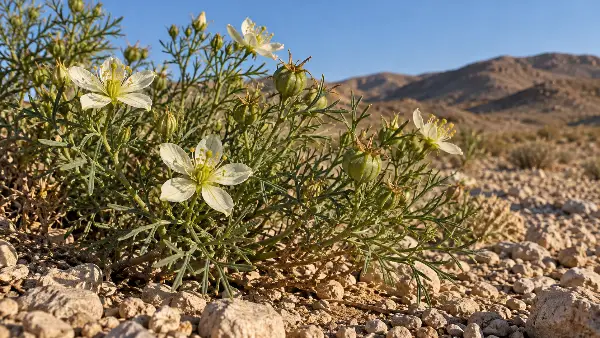
Syrian rue (Peganum harmala) is a desert plant whose seeds carry similar alkaloids. The only human abortion case report we found involved those seeds, not the vine.
That report came out in 2014. A woman 22 weeks pregnant was believed to have taken a large amount of the seeds to end the pregnancy. The report calls this a traditional Moroccan remedy. She was 24. Her kidneys failed, her liver was injured, and she needed dialysis and a breathing machine. The fetus died 2 days after she reached the hospital. When she went home 2 months later, she still had damage to her balance and her nerves.
A 2021 paper in Molecules notes that Syrian rue seeds are used in place of the vine in ayahuasca-like brews. The brew at our ayahuasca retreat is 2 plants, the vine and chacruna leaves, cooked on site. Ask any center what goes in its cup, and don’t drink if it can’t tell you.
Ayahuasca and pregnancy in 2026: the risk starts before the cup
For a pregnant woman, the first risks of a retreat here come from the region itself. Loreto has malaria and yellow fever, and CDC advises pregnant women to stay out of both kinds of area if they can.
Most pages on ayahuasca and pregnancy stop at the cup. That skips the first hazard: to reach a ceremony here, you fly into the Amazon. CDC’s page for pregnant travelers says to avoid or delay travel to malaria areas if possible. CDC’s yellow fever chapter says to avoid risk areas if possible. It counts all of Loreto as one.
| Risk | What CDC says for pregnant travelers | Latest figures for Peru and Loreto |
|---|---|---|
| Malaria | Avoid or delay travel if possible. No prevention drug works every time | 17,383 of Peru’s 17,646 cases in 2026 were in Loreto, through week 38 (98.5%) |
| Yellow fever | Avoid travel to risk areas if possible. Pregnancy is a precaution for the vaccine | Peru confirmed 49 cases and 19 deaths in 2025, including 3 cases and 1 death in Loreto. 2 more were confirmed by mid-February 2026, both in Madre de Dios |
| Zika | Talk to your provider first, prevent bites, and prevent sexual spread if you’re concerned | 3 suspected cases in Peru in 2026 through week 38, none listed in Loreto |
| Oropouche | Talk to your provider first. CDC links infection in pregnancy to stillbirth and birth defects | Peru is on CDC’s Level 1 notice for Oropouche in the Americas, dated September 2025 |
| Dengue | It can pass to the fetus and can cause fetal death, low birth weight and premature birth | 3,021 cases in Loreto in 2026 through week 38 |
CDC’s word is “if possible.” Some women have no choice about travel while pregnant. A retreat isn’t one of those trips, and it can wait until after the birth and after breastfeeding ends. Our guide to getting to Iquitos covers vaccines and malaria pills for everyone else.
The malaria pill problem
CDC treats malaria in Loreto as resistant to chloroquine, an older drug, so it advises pills that still work. In pregnancy, it names 1 for these areas: mefloquine. It rules out doxycycline, primaquine and tafenoquine. It also advises against atovaquone-proguanil, since the safety data are thin, unless nothing else will do.
Mefloquine has a catch. Its FDA label warns against prescribing it for prevention to anyone with a major psychiatric disorder. The label lists current or recent depression, psychosis, schizophrenia and generalized anxiety disorder. So for a pregnant woman with depression, the 1 pill CDC recommends is ruled out by mefloquine’s own FDA label. What’s left is a trade-off to weigh with her doctor, or skipping the trip.
On our land we rely on nets, screened rooms and repellent. CDC says EPA-registered repellents, DEET among them, are safe for pregnant women when used as directed. No guest has reported catching malaria on a retreat with us in 9 years. Pregnant women aren’t part of that record, because we don’t accept them. None of that changes CDC’s advice. No prevention drug works every time, it says. So avoiding malaria areas is the best choice in pregnancy, when possible.

45 to 90 minutes from a hospital
There’s no road to our land, so an emergency goes by river to Iquitos and Hospital Regional de Loreto. During ceremony blocks, a fast launch and its driver stay at our dock. Our medical director rides along and calls ahead by satellite phone. By fast launch, the hospital is about 45 minutes away. By peque-peque, the slower local boat, the river leg alone takes about 90.
The hospital handles emergencies, surgery and intensive care. For anything it can’t treat, Lima is 2 hours away by air.
Before you go, CDC says, find a hospital there that can handle problems in pregnancy. Problems are most likely in the 1st and 3rd trimesters. CDC also tells doctors to advise against trips to places where care for mothers and newborns might not meet a woman’s needs.
The same CDC page advises insurance that pays for pregnancy problems and the newborn’s care. It should cover medical evacuation, too. CDC says one from far-off, remote places can cost over USD 250,000. Before you buy, ask if the policy covers pregnancy problems and newborn intensive care. Our travel insurance guide covers evacuation and what to ask an insurer.
Santo Daime mothers, and why tradition isn’t a safety record
Some women in Brazil’s ayahuasca churches keep drinking while pregnant, at smaller doses. No formal study of how those pregnancies turned out has been published, only mothers’ own reports.
A 2011 Journal of Psychoactive Drugs paper describes the practice in Santo Daime. A doula in the church told the author that pregnant members usually drink half the usual dose, and less if they want. The paper adds that drinking during labor is common in the church.
The same paper covers the União do Vegetal, or UDV. Its medical department ran a pilot study in the city of Fortaleza, looking back at members’ pregnancies for problems. The author couldn’t get any more on it, and the notice about it was later taken off the UDV’s website. She found no medical research at all on ayahuasca in pregnant women.
In 2010, CONAD, Brazil’s drug policy council, left the choice to the women. Its resolution says a pregnant woman decides how far to take part, while protecting the unborn child’s development. Those rules were written for religious use in Brazil.
The closest things to human data are mothers’ own reports and studies of UDV teenagers. Some of the teens had been exposed before birth, and they tested normal on mental health and brain-function tests. A 2013 review in the same journal says this suggests ayahuasca doesn’t appear toxic to pregnant women or their children. It also says more data are needed before anyone gives a firm answer.
Tradition isn’t a safety record, and mothers’ reports aren’t a controlled study. In these churches, pregnant women drink smaller doses, about 2 weeks apart, inside groups that have done this for decades. A retreat for travelers has none of that history.
In the sources we checked, the best record of use in pregnancy comes from these churches, not from Indigenous practice in the Amazon. The customs of Shipibo and mestizo lineages don’t stand in for a study either.
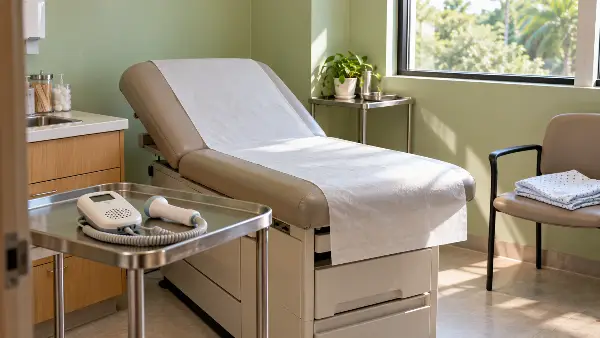
What if you drank ayahuasca before you knew you were pregnant?
Stop drinking, and tell your prenatal care provider what you took and when. The data can’t promise you a good outcome or a bad one.
Bring notes to your next prenatal visit:
- The date of each ceremony, and the number of cups you drank.
- What the brew contained, if the center told you. Add anything else you took that week, such as tobacco snuff or other plant medicines.
- Any drug you stopped or started for the trip, like an antidepressant taper, a malaria pill or a yellow fever shot.
Most of the evidence comes from rats. In the 2018 study, malformations didn’t rise at any dose. Early losses rose with daily doses at 2 and 8 times a ritual dose. A 2010 rat study saw fetal organ findings at every dose it tested. The 2018 authors say it’s unclear whether a single dose would cause the same embryo losses. That doesn’t prove you’re fine, and it doesn’t mean something went wrong.
In the US, MotherToBaby answers questions about exposures in pregnancy for free. Call 866-626-6847 on weekdays, or reach it by text, email or chat. If you find out while you’re with us, stop drinking and tell our doctor, who stays on site on ceremony nights.
Pregnant and depressed: what to weigh ayahuasca against
Weigh it against treatments with pregnancy data. ACOG, the main US group of pregnancy doctors, says SSRIs are the first medicine to try for depression in pregnancy.
ACOG also advises against stopping mental health medicines only because you’re pregnant. Its 2023 guideline calls talk therapy a first-line treatment for mild to moderate depression in pregnancy. SSRIs are linked to a rare newborn lung problem, at about 1 to 2 extra cases per 1,000 babies. Most studies find short-lived newborn symptoms in 10% to 30% of exposed babies. They usually clear within 2 weeks.
Ayahuasca would mean stopping first. The vine blocks MAO-A, the enzyme that breaks down both DMT and serotonin. That’s how the brew works at all. It’s also why mixing it with an SSRI, which raises serotonin too, can push levels too high.
The mix has rarely been reported, and rare isn’t safe. A 2024 drug-interaction review in the Journal of Psychopharmacology found 1 case report of an SSRI with ayahuasca. It still advises caution with the mix. In that 1998 report, a man who’d taken fluoxetine for months drank about 100 mL of ayahuasca. An hour later he had tremors, sweating, shivering and confusion. He staggered out of the ceremony and collapsed, with severe nausea and vomiting. His symptoms lasted about 4 hours without treatment, with no apparent lasting harm.
That’s why, under our taper rule, coming off most antidepressants takes 6 to 8 weeks, with a doctor’s help. ACOG says stopping a medicine that works during pregnancy raises the risk that depression comes back. So a pregnant woman would trade a treatment studied in pregnant women for a brew studied mostly in rats. Don’t stop or taper an antidepressant in pregnancy to qualify for a retreat, ours or anyone’s.
| Option | What the evidence says in pregnancy |
|---|---|
| An SSRI, managed by your prescriber | ACOG’s first-line medicine. About 1 to 2 extra cases of a rare newborn lung problem per 1,000 babies, and short-lived newborn symptoms in 10% to 30% of exposed babies in most studies |
| Talk therapy | ACOG’s first-line treatment for mild to moderate depression |
| Stopping your antidepressant | ACOG says stopping a medicine that works raises the risk that depression comes back, and it advises against stopping only because you’re pregnant |
| Ayahuasca | A 2026 review found no eligible human study of pregnancy outcomes. Smaller litters in rats at 2 times a ritual dose. For most antidepressants, a 6 to 8 week taper comes first |
If you’re pregnant and struggling now, don’t wait for a retreat or a reply from us. In the US, the free National Maternal Mental Health Hotline takes calls and texts at 1-833-TLC-MAMA (1-833-852-6262). It’s open 24 hours a day, in English and Spanish. If you’re thinking about suicide, call or text 988. If you’re in danger right now, call 911. Outside the US, call your local emergency number or your prenatal care provider.
Trying to conceive, or your partner is pregnant
If you could be pregnant by your first ceremony, wait. Suspected pregnancy is a full stop here, the same as a positive test.
Plan backward from your flight. CDC’s Yellow Book says a woman should wait 4 weeks after a yellow fever shot before getting pregnant.
Zika can add a wait too. If you’re concerned about Zika after a trip to Peru, CDC suggests couples consider holding off on pregnancy. That means at least 2 months after a woman gets home, or 3 months after a man does. Use condoms or skip sex until then.
Do a pregnancy test in the days before your flight. If your period is late once you’re here, tell our doctor and sit that ceremony out. Any guest can skip a night.
If your partner is pregnant and you travel without her, CDC’s Zika advice still applies to you. It says to talk with a provider before the trip and to prevent mosquito bites. If you’re worried about Zika, it also says to prevent sexual spread during and after travel. Our guide for parents covers the time away and the first week back home.
So our answer on ayahuasca and pregnancy stays no, from the day you might be pregnant until the birth. To plan a retreat for after the birth and after breastfeeding, write to us. We’ll start with your screening.
FAQs
What do studies show about ayahuasca and pregnancy?
A 2026 review searched studies through March 2025. It found no eligible study of pregnancy outcomes in people who drank ayahuasca. In a separate 2018 study, pregnant rats dosed every day had smaller litters at 2 times a ritual dose. At 4 times the ritual dose, 11 of 25 mothers died.
Can ayahuasca cause a miscarriage?
Nobody knows in people. In a 2018 study, rats given water lost 0.6 embryos per litter, and rats on 8 times the ritual dose lost 3.9. A 2024 review cites a rat study in which big injected doses of 2 vine alkaloids caused abortions. The only human abortion case we found involved Syrian rue seeds, which carry similar alkaloids.
What should I do if I drank ayahuasca before I knew I was pregnant?
Stop drinking, and tell your doctor or midwife the dates, the number of cups and anything else you took. In the US, MotherToBaby answers questions about exposures in pregnancy for free. In 2 rat studies, harm showed up with doses given across most of pregnancy. Neither can tell you whether a single night was safe or harmful.
Is it safe to travel to Iquitos while pregnant?
CDC says pregnant women should avoid or delay trips to malaria areas if they can. Loreto, the region around Iquitos, is one. Through late September 2026, it had 98.5% of Peru’s malaria cases, per Peru’s Health Ministry. CDC also says to skip yellow fever areas if you can, and pregnancy is a reason for care with that shot.
Do Santo Daime women drink ayahuasca while pregnant?
Some do. In a 2011 paper, a doula in the church told the author that pregnant members usually take half the usual dose, or less. Brazil’s 2010 rules leave the choice to the pregnant woman. Nobody has published a formal study of how those pregnancies turned out, only mothers’ own reports.
What is your rule on ayahuasca and pregnancy?
We don’t serve ayahuasca to anyone pregnant, at any stage, and a suspected pregnancy counts the same. A licensed doctor checks each guest’s file before we offer a place.
Can I drink ayahuasca while trying to get pregnant?
Not if you could be pregnant by ceremony night. Here, a suspected pregnancy counts as a pregnancy. CDC’s Yellow Book says a woman should wait 4 weeks after a yellow fever shot before getting pregnant. If Zika worries you, CDC suggests waiting at least 2 months after a woman gets home, or 3 months after a man does.