Ayahuasca ceremony etiquette is a short list of rules for sharing a dark room with strangers who are all on the same medicine. Here they are: stay on your mat, keep quiet, keep lights and phones out, don’t touch other guests, purge into your bucket, let the healer set your dose, and never leave the maloca alone mid-ceremony. Every rule has a reason, and the reasons are more useful than the rules.
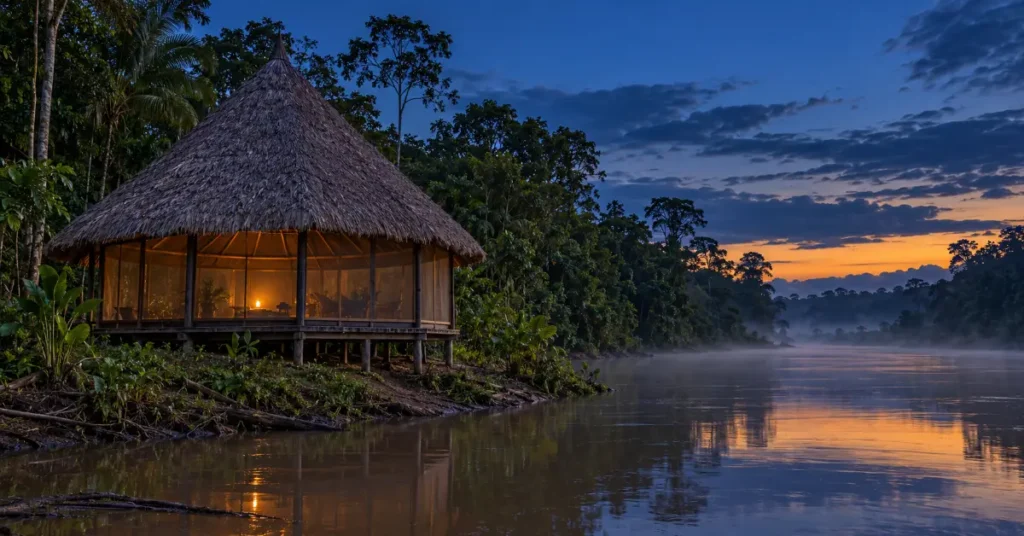
Our lead healer and I opened our center in 2017, a 90-minute boat ride up the Río Momón from Iquitos. Before I ever drank, I’d spent the better part of a decade building a marketing agency in Denver, so I learned these rules the way you will: as a guest. Since then we’ve run more than 650 ceremonies, for about 1,900 guests in all, never with more than 10 in the maloca.
The reasons start with the body. Of the 8,216 people who answered the physical-effects questions in the Global Ayahuasca Survey, 62.0% had vomiting or nausea and 4.1% had fainted, at least once, during or soon after drinking. That’s why each mat has its own bucket, and why nobody walks to the toilet alone.
What is ayahuasca ceremony etiquette?
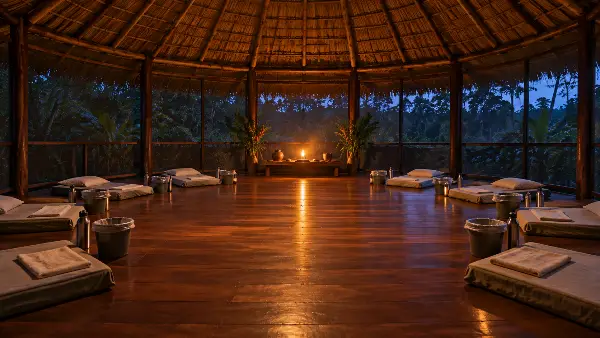
Ayahuasca ceremony etiquette is the set of rules guests and staff follow inside the maloca, the ceremony house, from the first cup until the healer closes the night. The rules keep people in altered states safe in the dark: no wandering, no talking, no light, no touching without consent, and nobody left alone.
The wording changes from center to center. Ours comes from the Loreto mestizo tradition our lead healer has practiced for 54 years, and from 9 years of watching what happens at 2 AM. He opens every ceremony by blowing mapacho smoke to the 4 directions and singing protection icaros. There’s no chakra work, and nothing from outside the Amazon.
The ayahuasca ceremony rules in 2026, and the reason for each
Our maloca runs on 7 rules for guests and 1 for staff. Here’s each one, why it exists, and what to do when you need to break it.
| Rule | Why it exists | When you need to break it |
|---|---|---|
| Stay on your mat | The room is dark and full of people in altered states. Moving around causes falls and confusion | Raise your hand and a facilitator comes to you |
| Keep quiet | The healers work with their voices. A conversation breaks the icaros for everyone | Whisper to a facilitator |
| No light, no phones | The dark is part of how the healers work, and a screen pulls you back to the clock | Staff carry red-light headlamps. Your phone stays in the locked box |
| Don’t touch other guests | What feels comforting to you can feel like an intrusion to someone else | Tell a facilitator if someone near you needs help |
| Purge into your bucket | Vomiting is the most common physical effect | Raise your hand, and staff swap a full bucket |
| The healer sets your dose | It depends on your weight, your experience and how you reacted at your last ceremony | Ask for a second cup around 10 PM. The answer may be no |
| Never leave the maloca alone mid-ceremony | The paths are dark and confusing, and there are snakes | A facilitator walks you out with a red light |
| Staff ask before any touch, every time (the staff rule) | Boundaries shift in an altered state, so a yes at 9 PM doesn’t cover a touch at midnight | Say no out loud. The healer carries on with song and smoke instead |
Our lead healer gives every guest a mat on the first night. He places people by how he reads their energy, and you keep the same mat for all 4 ceremonies.
What should you wear and bring to an ayahuasca ceremony?
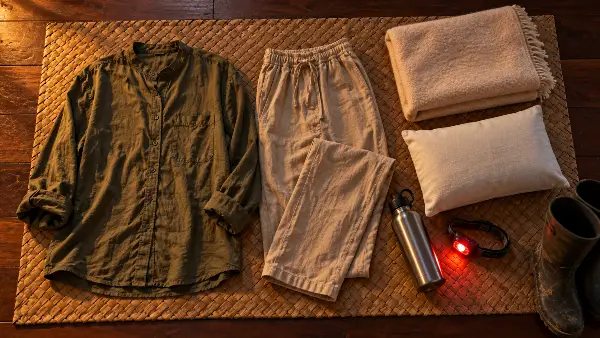
Wear loose, long clothes you can lie in for 7 hours, and carry only 4 things into the maloca. Here’s the list, with the reason for each item.
| What | Why |
|---|---|
| Loose long sleeves and long trousers | You’ll lie on a mat from 8 PM to about 3 AM, and mosquitoes come out at dusk |
| A light layer, or the blanket we give you | The maloca sits at 23 to 29°C (73 to 84°F) at night, but the medicine can bring on chills |
| Bare feet | Shoes come off at the maloca entrance |
| A pillow, a blanket, a water bottle and your lined bucket | These 4 things are all you carry to the mat |
| Nothing else | Watches and jewelry stay in your tambo, and your phone has been in our locked box since arrival day |
| A red-light headlamp | For the paths after dark. It tops our list of things guests never think to pack |
| Rubber boots | The walk over can be muddy, especially in the rainy season |
The food and medication rules for the weeks before you arrive are in our dieta guide.
Can you leave an ayahuasca ceremony?
Yes, as long as a facilitator goes with you. The standard advice is to stay until the end no matter what. That turns a safety rule into an endurance test. The real rule is shorter: never alone.
You can step out for the toilet at any point. If you need more care, there’s a medical room beside the maloca. A facilitator walks with you every time, carrying a red-light headlamp. In 2020 a guest tripped on a root walking back from ceremony, and we put red-filtered solar lights along every path.
Skipping a whole ceremony is allowed too, for any reason, with no pressure. About 5 to 8% of ceremony places go unused, mostly in the second half of the retreat. A facilitator looks in on you once during the ceremony and again at the close.
Sometimes the healer makes the call. Our lead healer has asked guests to sit a night out when he felt they weren’t in a state to drink safely.
What you can’t do is walk off alone, and the data points the same way. The Global Ayahuasca Survey authors list drinking without supervision among the factors tied to physical adverse effects. And with 4.1% of respondents having fainted at least once during or soon after drinking, a dark jungle path at 1 AM is the worst place to be on your own.
Surrender and asking for help can happen in the same minute. When you raise your hand, a facilitator sits down at your mat, keeps talking, and doesn’t leave.
Why the maloca stays silent and dark
The healers work with sound, and the dark is part of the work. Talk and light pull everyone else out of their night.
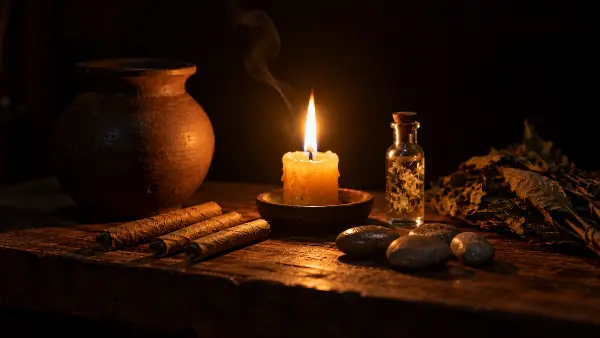
At 8:30 PM our lead healer puts out the one candle on the altar, and the maloca goes fully dark. On a new moon you can’t see your hand in front of your face. From then until the close at 3 AM, what you hear is the icaros, the healers’ songs, and the jungle outside: frogs, insects, the river.
If you need something, whisper to a facilitator. Our 2 facilitators move around the room all night.
Some nights our lead healer and our second healer sing 2 different icaros at the same time. He calls it cruzar los cantos, crossing the songs, and guests describe the sound as three-dimensional. A voice from a mat cuts straight through it.
Your phone stays locked away all retreat, apart from half an hour on Day 5.
How to purge, and why it isn’t a detox
Purge into your bucket, breathe, and let it pass. Vomiting is the brew’s most common physical effect, and I haven’t seen a study showing it pulls toxins out of your body.
The etiquette part is easy. Stay on your mat and aim for the bucket. Don’t apologize, and don’t worry about the noise, because everyone else is busy with their own night. Facilitators move around with water and tissues and change a full bucket for you. What purging involves, hour by hour, has its own page.
At least 2 of the top 10 ceremony guides call the purge a detox or a cleaning. The Global Ayahuasca Survey authors describe vomiting as a normal effect that experienced drinkers seek out, and they call its spiritual cleansing benefits “perceived.” One retreat blog goes further and says science shows vomiting expels cortisol. The 2018 study it cites, published in Frontiers in Psychiatry, measured cortisol in blood and saliva, never vomit. Its 28 patients with treatment-resistant depression started with low cortisol, and in the half given ayahuasca, salivary cortisol went up.
Call a facilitator over if you feel faint, your heart is racing, or the vomiting won’t settle. Purging is also part of why we screen for eating disorders.
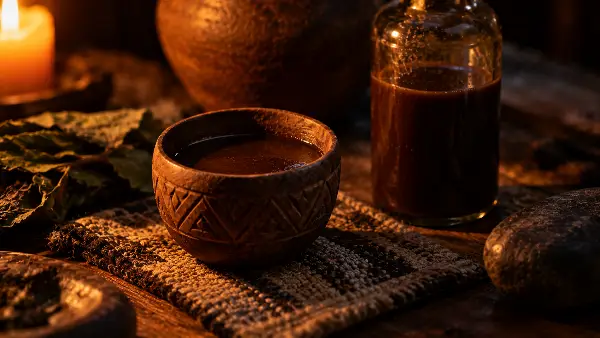
Should you ask for a second cup?
Ask if you want one, then let the healer decide. A common rule of thumb says that if you keep wondering whether you need more, you do. We leave that call to the person who has watched you all night.
The offer comes around 10 PM, roughly 90 minutes after the first serving, and anyone who wants more walks up to the altar. That timing sits close to the first cup’s peak. In a 2003 controlled study of 18 volunteers, published in the Journal of Pharmacology and Experimental Therapeutics, effects peaked 1.5 to 2 hours after dosing.
In the same study, on the stronger of 2 doses, diastolic pressure was up a statistically significant 9 mm Hg at the 75-minute mark.
Expect to hear no sometimes. About 1 request in 5 gets a no, usually because the medicine is already doing its work. First nights start low, at 40 to 60 ml, and if yours felt mild, the pour goes up at your next ceremony.
What the staff owe you: consent before any touch
Etiquette runs both ways here. No healer or facilitator touches you without asking first, each time, and a no from you stands until the ceremony ends.
A healer comes to your mat, says who they are, and asks something like “Can I put my hand on your head?” Touch usually stays on the head and shoulders, and never goes below the waist or onto the chest. If you say no, the healing carries on through song and mapacho smoke.
We hold staff to this because the risk is documented. In 2020 the Journal of Psychedelic Studies published a paper that calls sexual abuse and misconduct toward women in ayahuasca circles “quite prevalent,” and argues that consent in an altered state is an ongoing process rather than a one-time yes. It also notes that healing work such as sopladas never requires you to undress. If anyone asks you to, say no and tell our head facilitator or me.
A woman healer and our head facilitator, also a woman, sit in every ceremony, so there are always 2 women in the room. Our retreat safety page sets out the rest of our consent policy: the 90-day ban on romantic or sexual contact, and who to tell if something goes wrong.
Who comes when you raise your hand, and how fast
Raise your hand. A facilitator reaches you first, a healer follows, and our medical director, a physician, is on the radio and 2 to 3 minutes away.
| What’s happening | What you do | What staff do | Timing |
|---|---|---|---|
| Fear or terror, but you can talk | Raise your hand and keep breathing | A facilitator sits with you and talks you through it. A healer brings an icaro to your mat | Most pass within 10 to 20 minutes of direct singing |
| You need the toilet | Raise your hand | A facilitator walks you there and back with a red light | Any time |
| Faint, racing heart, or you can’t catch your breath | Raise your hand and stay lying down | The facilitator radios our medical director, who checks your vital signs | 2 to 3 minutes |
| Someone touches you, or you want a healer to stop | Say no, out loud | Touch stops, and the healing continues through song and smoke | Immediately |
| The person next to you is struggling | Stay on your mat | Staff go to them, and the ceremony carries on for everyone else | Immediately |
| You feel nothing | Lie still. Ask at the second-cup offer if you want more | The healer decides whether to pour, and adjusts your dose at the next ceremony | Around 10 PM |
A hospital trip means the river. The fast launch at our dock reaches the regional hospital in Iquitos in 45 minutes, and its driver spends ceremony nights there. We’ve needed it 2 times since 2017, and both people went home well.
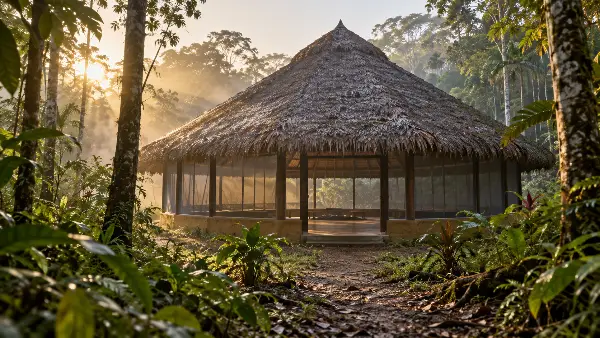
After the ceremony: what stays in the maloca
What people say and do in ceremony stays there. You share your own night, never someone else’s.
Our lead healer closes the ceremony around 3 AM with tobacco smoke. Rest on your mat as long as you need, and a facilitator will walk you back to your tambo if you want company.
Late the next morning, at 11, our head facilitator leads the group circle, and it can run up to 2 hours. Share as much or as little as you like. Nobody comments while you’re speaking.
Photos need written consent, and with phones locked away, nobody’s hardest night ends up online.
That’s our ayahuasca ceremony etiquette: 7 rules for you, 1 for our staff, and a reason behind every one. To see how 4 ceremonies fit into 10 days, read about our 10-day retreat or browse everything we offer. If a rule here raises a question about your own situation, send it to us before you apply.
FAQs
What is the most important rule of ayahuasca ceremony etiquette?
Never leave the maloca alone during a ceremony. The paths are dark, and 4.1% of the people who answered the Global Ayahuasca Survey’s physical-effects questions had fainted at least once during or soon after drinking. At our center a facilitator walks you to the toilet or the medical room with a red-light headlamp, every time.
What should I wear to an ayahuasca ceremony?
Wear loose, long clothes you can lie in for about 7 hours, and plan for chills. Our maloca runs 23 to 29°C (73 to 84°F) at night, we hand out light blankets, and long sleeves help with mosquitoes at dusk. Leave watches, jewelry and your phone behind, and take your shoes off at the door.
Can you go to the bathroom during an ayahuasca ceremony?
Yes, at any point, but not on your own. Raise your hand and a facilitator walks you to the toilet and back with a red-light headlamp. Our paths have had red-filtered solar lights since 2020, when a guest tripped on a root walking back from ceremony.
Can you talk during an ayahuasca ceremony?
Only in a whisper, and only to a facilitator. The healers work with their voices, and a conversation breaks the icaros for everyone else in the room. If you need help, raise your hand and a facilitator comes to your mat.
Can you skip an ayahuasca ceremony?
Yes. At our center you can sit out any ceremony, for any reason, with no pressure. Across our retreats, 5 to 8% of seats in ceremony stay empty, mostly in the second half of the retreat.
Is ayahuasca ceremony etiquette the same at every retreat?
No. Etiquette changes with the tradition and the center, so get each center’s rules, consent policy included, in writing before you book. Ours follow the Loreto mestizo tradition our lead healer has practiced for 54 years, with 7 rules for guests and 1 for staff.
Can you ask for a second cup of ayahuasca?
Yes, and the healer decides. At our center the offer comes at about 10 PM, roughly 90 minutes after the first serving, and about 1 request in 5 gets a no. First nights start at 40 to 60 ml.