Yes, ayahuasca can change your sense of direction. But the real relationship between ayahuasca and life purpose is narrower than the marketing: it works less often than the survey numbers suggest, it rarely works the way people picture, and the part everyone flies down here for is the part the evidence supports least.
In the largest study of ayahuasca drinkers ever published, 89.2% reported at least one life change afterward and 32.1% reported a career change. In a nationally representative US sample published this year, 18.4% of people who had ever taken a psychedelic reported any major life change at all, and 2.8% quit a job. Both figures are real. Neither one is your odds.
I have watched about 1,900 people drink at our center on the Río Momón since 2017. Purpose is the reason 1 in 5 of them came.
Can ayahuasca show you your life purpose?
Not directly, and not on schedule.
Ayahuasca does not hand anyone a purpose. It lowers the psychological defenses that stop a person from noticing what they already want, and the direction tends to show up in the weeks after ceremony as a change in behavior rather than as a vision during it. That is the honest shape of the relationship between ayahuasca and life purpose.
What people expect is a scene. A voice, a picture, a sentence they can write down. Some get that. Most get something duller and more useful: they stop being able to tolerate a situation they had tolerated for years.
Maestro Don Enrique Huayta Peña, who co-founded this center with me and has worked with these plants for 54 years, puts it as an instruction rather than a promise. The vine addresses what it decides needs addressing. If you arrive asking for career clarity and you are carrying an unburied grief, you get the grief. People find that disappointing on night 2 and correct on month 6.
How often does anyone actually change their life after ayahuasca?
The answer depends on who you ask, and the gap between the studies is the most useful thing on this page.
Daniel Perkins and colleagues surveyed 8,907 ayahuasca drinkers across more than 50 countries, mean age 40.65. Their findings: 98.1% reported at least one insight, averaging 9.07 insights each. 89.2% reported at least one life change, averaging 3.10 changes. Career change came in at 32.1%, a change in religious or spiritual status at 56.5%, and healing a personal conflict at 42.7%. The most common insight was into “own personality,” at 81.8%.
Then a 2026 replication in a different sample landed almost on top of it. Joshua Aday and colleagues surveyed 581 naturalistic psychedelic users and found 83.0% reporting at least one major life change, with 32.4% reporting a change of occupation or line of work. Two independent samples, 8 years apart in recruitment, agreeing to within a percentage point on career change.
And then Nicholas Carlisle and colleagues asked a nationally representative sample of 613 US adults who had ever used a psychedelic, and got 18.4%.
| Study | Who was surveyed | Reported 1 or more major life change | Reported a career or job change |
|---|---|---|---|
| Perkins and colleagues, 2023 | 8,907 ayahuasca drinkers, recruited through ayahuasca research networks | 89.2% | 32.1% |
| Aday and colleagues, 2026 | 581 naturalistic psychedelic users, recruited online and at an advocacy event | 83.0% | 32.4% |
| Carlisle and colleagues, 2026 | 613 US adults who had ever used a psychedelic, nationally representative | 18.4% | 2.8% |
89.2% against 18.4%. 32.1% against 2.8%.
Here is what separates them, and it is not that one team got it wrong. Perkins surveyed people who sought out ceremony and then volunteered to fill in a long questionnaire about it. Carlisle surveyed everyone in America who has ever taken a psychedelic, which mostly means people who took mushrooms at a festival in 2009 and never sat in a maloca. Part of that gap is a real difference in setting and intent. Part of it is that anyone who completes an ayahuasca survey is not a random draw from people who drink ayahuasca.
So if you are asking whether ceremony changes lives: it clearly does, for a lot of people, in a structured setting, with intent. If you are asking whether it will change yours because 89% is a number you read somewhere, the 18.4% is the correction you needed.
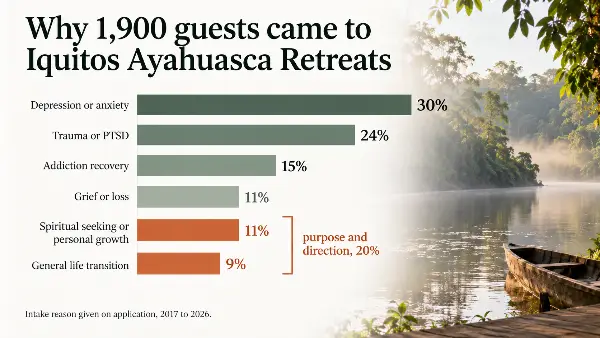
Purpose is why 1 in 5 of our guests come, not 4 in 5
Across roughly 1,900 guests, purpose and direction are a minority reason for booking. Here is our actual intake breakdown, taken from the reason each person gave on their application:
| Reason for attending | Share of guests |
|---|---|
| Depression or anxiety | 30% |
| Trauma or PTSD | 24% |
| Addiction recovery | 15% |
| Grief or loss | 11% |
| Spiritual seeking or personal growth | 11% |
| General life transition | 9% |
Spiritual seeking plus life transition is 20%. The other 69% arrive with a clinical reason, and most of them are here because something conventional did not reach it.
I publish this because it reframes the question you came in with. You are not asking about the main use of this medicine. You are asking about a real but secondary one, at a center built by someone whose brother died of an overdose in a motel room in Colorado Springs. That founding story is why our roster skews the way it does, and it is worth knowing before you weigh a purpose-seeking retreat against the other things you could do with 10 days.
None of which means purpose work is illegitimate here. It means the honest version of it looks different from the marketing.
Does a stronger vision mean a better outcome?
No. The intensity of your experience does not predict your outcome, and drinking more does not either.
Simon Ruffell and colleagues ran a 6-month prospective study at a retreat in the Peruvian Amazon near Iquitos, 63 participants before and 57 at 6-month follow-up. Depression scores on the BDI-II went from 13.9 to 6.1 immediately after and 4.0 at 6 months. Trait anxiety went from 44.4 to 33.7. Self-compassion rose from 3.1 to 3.8. All at p<0.001. Real, durable movement.
Two findings inside that study get almost no attention, and both of them matter more to a purpose-seeker than the headline numbers.
First, they measured mystical experience with the Mystical Experience Questionnaire and it did not predict outcome in the overall sample. Only in the depressed subgroup did the mystical subscale correlate with improvement, at r = -0.357, p = 0.049, and that correlation was gone by 6 months. The big scene is not the mechanism.
Second, on ceremony count, the paper is blunt: “Our study did not show direct correlation between the number of ayahuasca ceremonies and outcome measures, ostensibly indicating no potential benefit of engaging in greater numbers of ceremonies.” They tested it against 4 separate measures at a conservative alpha of 0.01 and found nothing.
That is a null result rather than proof that fewer is better, and I will not overstate it. The authors also name their own limits: no control group, self-selection, no access to medical records, dose not standardized. But it is the only 6-month prospective study run at an Iquitos-area retreat, and it says the two things this industry sells hardest, the intensity of the vision and the number of nights, are the two things it could not tie to results.
We run 4 ceremonies across a 10-day retreat, on nights 2, 4, 7 and 9, against a regional norm of 5 to 7 in a single week. Don Enrique’s reason is not a study, it is 54 years of watching: leave silence between ceremonies and the canyon answers. The research does not contradict him.
If you want the mechanics of what a single night actually does to you, we published an hour-by-hour breakdown of an ayahuasca ceremony and a separate piece on how the brew acts on the brain.
Is there a plant for working on direction instead of healing?
Yes, and this is the part of the tradition almost nobody writes about in English.
In Loreto mestizo vegetalismo, ayahuasca is not the only teacher. The deeper work happens in a dieta: extended isolation with a single master plant, restricted food, no media, no physical contact, and daily doses of that plant under a healer’s supervision. Different plants are understood to work on different territory, and 2 of ours are specifically about direction.
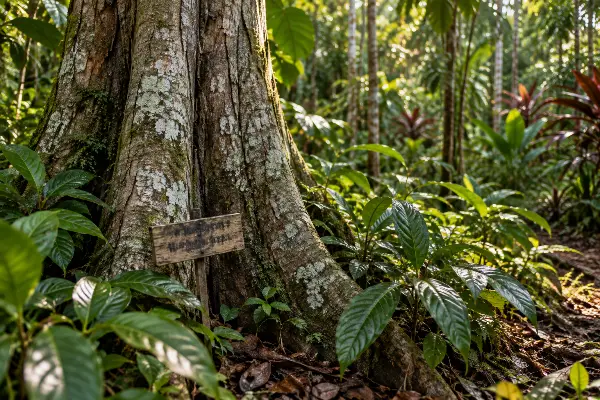
Chullachaqui caspi
A 15 to 30 day dieta. It works with identity, direction and spiritual grounding, and it is considered one of the most significant plants in Loreto vegetalismo. This is the plant Don Enrique reaches for when someone’s problem is who they are rather than what happened to them.
Ajo sacha
An 8 to 15 day dieta. A grounding plant that works with mental clarity, decision-making and protection. Shorter, and better suited to someone facing a specific decision rather than an open question about their whole life.
Both are supervised directly by Don Enrique and his son Maestro Wilber Huayta Cruz. The dieting guest stays in an isolated tambo and eats boiled plantains, rice and bland fish with no salt, sugar or spice. No conversation beyond what is necessary. Anyone who has read our guide to the ayahuasca dieta knows the pre-retreat version is mild by comparison.
I am not going to tell you a dieta is the answer to your career question. Don Enrique reserves renaquilla and the longer chullachaqui caspi dietas for people with prior ceremony experience, and most first-time guests are not candidates. But if you have read 6 pages about ayahuasca and purpose and not one of them named a single plant, that tells you something about how those pages were written.
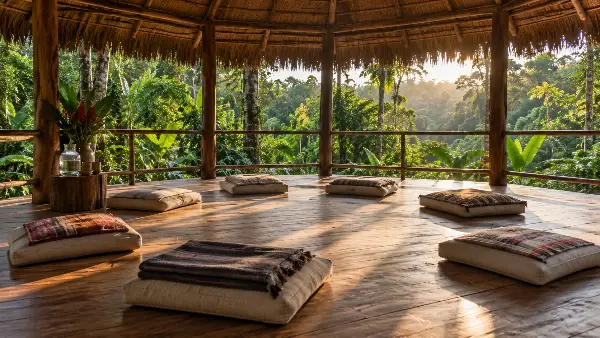
The 3-month rule we use to tell integration from afterglow
After 9 years and about 1,900 guests, the clearest predictor of whether someone kept what they found is not what happened in the maloca. It is whether they changed something outside it inside 3 months.
Not “I feel different.” An actual change. A conversation they had been avoiding. A job they left or a job they finally committed to. A relationship they ended or repaired. A practice they kept for 90 days.
The people who struggle share a pattern too, and it is just as consistent. They expect the medicine to do the work. They go home to the identical environment and change nothing. They isolate, and the experience turns into a private story that gets more abstract every month. Or they chase it, booking the next retreat instead of doing anything with the last one. Serial attendance without integration is one of the more destructive habits in this industry.
This is why our follow-up is scheduled rather than optional: a call at week 1, another at week 3, then check-ins at month 2, month 6 and month 12. Our head facilitator Lucia Fernández built that program, called Raíces, after we spent the early years hugging people goodbye at the dock and hoping.
It also explains the survey gap from earlier in a way the studies cannot. When 32.1% of ayahuasca drinkers report a career change, some of that is purpose arriving. Some of it is a person acting on an insight they had no support to test. The difference between those 2 things is integration, and it does not happen on the boat ride out.
When purpose-seeking is the wrong reason to sit in 2026
Sometimes it is, and we screen for it.
We turn away 13% of applicants outright. Everyone who submits an enquiry does a 30 to 45 minute video call with David Park, our senior facilitator, who holds an MSW and spent 6 years in trauma-informed care before this. One of his questions is the one I would want asked of me: what will you do if the medicine shows you something you are not ready to see?
There is no right answer. The response tells him whether the person has considered that ceremony might not be pleasant, and whether they have the resources for that.
The profiles we decline or discourage, in plain terms:
- People who want a psychedelic experience. This is not recreation.
- People running from something without any willingness to face it.
- People seeking a guru. Don Enrique is a healer, not a teacher of life direction.
- People in active crisis who need stabilization rather than exploration.
- People in love with the idea of ayahuasca from podcasts and Instagram.
That last one is the purpose-seeker’s specific risk. A person who feels adrift is easy to sell a story to, and the ayahuasca internet is mostly story.
There is also a version of this that happens after you arrive. Don Enrique performs a soplada diagnóstica on each guest before serving, blowing mapacho smoke over them and reading what he calls their aire. Three times in 9 years he has finished that reading, shaken his head, and declined to serve someone that night. They had flown thousands of miles. They watched everyone else drink. All 3 drank on a later night and had strong experiences.
What surprised me most across 1,900 guests is that willingness beats diagnosis every time. The people who struggle hardest are not the ones with the worst histories. They are the most rigid: tight control over emotion, strong defenses, everything intellectualized. A person who arrives demanding an answer about their purpose is, more often than not, arriving rigid.
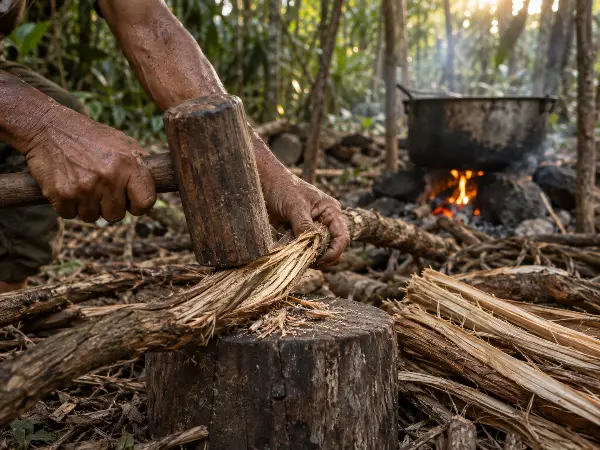
“Maybe I should do this for a living”
This thought arrives on about night 3 and it deserves a real answer instead of encouragement.
The setting is designed to move you. Total darkness, no electricity in the maloca, a jungle soundscape, 3 healers singing icaros for 7 hours. The people holding that space appear to be living with total conviction. If you are lost, the arithmetic is obvious: they have what I want, so I should do what they do.
Sometimes that is true. More often it is admiration wearing a calling’s clothes.
So here is the actual bar, since nobody publishes it. A new facilitator at our center trains for a minimum of 6 months across 3 phases. Phase 1 is personal: attend a full retreat as a guest, then complete at least one extended plant dieta. Don Enrique is inflexible on that one, on the grounds that you cannot hold space in the medicine for someone if you have not been in it yourself. Phase 2 is 2 months as a silent observer in ceremony, debriefing after each one. Phase 3 is 2 months of supervised practice. Then a final assessment by Lucia, me and Don Enrique, where his vote decides. He has vetoed a candidate who completed all 3 phases because he did not trust their presence in the ceremony space.
Add first aid certification and crisis-intervention training on top. Many operators in this region consider our pipeline excessive. I consider it barely adequate.
And that is only the medicine side. Anyone who tries to build something in this field ends up learning a second trade on top of the first: land rights, permits, insurance, medical cover, and how people find you online. I spent a decade in that second trade before I ever came to Peru, and it is the reason this place survived its first 14 months, when retreats ran at 25 to 40% capacity.
If the calling is real, that path is open to you and it is longer than you think. If it is an echo of a good night, 6 months of dieta and observation will show you that early. Give it 90 days at home before you tell anyone it is your purpose.
What a purpose page owes you about the risks
The weeks after a purpose-seeking retreat are frequently harder than the retreat.
The Global Ayahuasca Survey, which collected responses from 10,836 people, reported that 55.9% experienced mental health adverse effects in the weeks or months following ayahuasca use. Around 88% of that group regarded those effects as part of a positive process of growth or integration. On the physical side, 69.9% reported acute adverse effects, 62.0% reported vomiting or nausea, and 2.3% required subsequent medical care.
Read that 55.9% carefully. More than half of people have a rough patch afterward, and most of them come to see it as the work rather than the damage. Both halves of that sentence are true and a page that gives you only one of them is selling something.
One more thing worth stating, because it is a gap in the science rather than in the marketing: no ayahuasca study has ever used a validated measure of meaning in life or purpose in life. Ruffell’s team measured depression, anxiety, self-compassion, general distress, childhood trauma and mystical experience. No purpose scale. Perkins measured self-reported life changes, not purpose. Anyone who tells you the research shows ayahuasca increases purpose is extrapolating, and now you know from what.
The practical version, from 9 years of watching: 22% of our guests come back at least once, and 7% have come 3 or more times. The ones who return with the clearest sense of direction are almost never the ones who found it in a vision. They are the ones who came home, changed one concrete thing, and let the rest follow. That is what ayahuasca and life purpose look like together in practice: not a revelation you receive, but a direction you can put a date on. If you want the aggregate picture, we broke down the benefits of ayahuasca with the outcome data we collect, and the practicalities of reaching us are covered in our guide to getting to Iquitos and our explainer on ayahuasca’s legal status in Peru.
FAQs
Can ayahuasca and life purpose work be done in a single ceremony?
Rarely. In our experience the direction shows up in the weeks after ceremony, not during it, and the strongest predictor of whether it lasts is whether you change something concrete within 3 months. Ruffell and colleagues also found no correlation between the number of ceremonies attended and improvement across 4 outcome measures, so more nights is not a shortcut.
What percentage of people change their career after ayahuasca?
It depends on who is counted. Perkins and colleagues found 32.1% of 8,907 ayahuasca drinkers reported a career change, and a 2026 replication found 32.4% reporting a change of occupation. A nationally representative US sample of 613 lifetime psychedelic users found 2.8% who quit a job. The self-selected samples agree with each other; the representative sample is the correction.
Is wanting to find my purpose a good reason to book an ayahuasca retreat?
It is a legitimate reason and a minority one. Spiritual seeking and general life transition together account for 20% of our intake across roughly 1,900 guests, against 69% who come for depression, trauma, addiction or grief. What matters more than your reason is your flexibility about it. Willingness beats intention every time.
What if I have a ceremony and get no answer about my direction?
That is common and it is not a failed retreat. The vine addresses what it determines needs addressing, which is often something older than the question you brought. Guests who report nothing on nights 2 and 4 and then have an overwhelming night 7 are one of the most familiar patterns we see.
Should I quit my job after an ayahuasca retreat?
Not on the strength of the experience alone. Wait 90 days, keep the follow-up calls, and see whether the impulse survives contact with your ordinary life. A decision that still looks right at month 3 is a different thing from one that looked right at 3am in a maloca.
Is there a specific ayahuasca dieta for finding direction?
Yes. Chullachaqui caspi, a 15 to 30 day dieta, works with identity, direction and spiritual grounding and is regarded as one of the most significant plants in Loreto vegetalismo. Ajo sacha, an 8 to 15 day dieta, works with mental clarity and decision-making. Both are supervised directly by Don Enrique and Maestro Wilber, and the longer dietas are generally reserved for guests with prior ceremony experience.
Can ayahuasca make me feel worse about my direction?
For a period, yes. In the Global Ayahuasca Survey of 10,836 people, 55.9% reported mental health adverse effects in the weeks or months afterward, though around 88% of that group came to regard those effects as part of a positive process of growth. Structured follow-up is what separates a difficult integration from a bad outcome.