Ayahuasca ceremony consent means no one touches you in a ceremony unless you’ve said yes, and you’re asked again each time. A yes you give after drinking can only narrow what you agreed to before. It can’t widen it. In our maloca, a healer’s hands usually go on your head or shoulders, never your chest or anywhere below the waist. The healer asks you out loud before each touch. If you don’t answer, the answer is no.
The risk is on the record. On September 4, 2026, the US State Department issued a travel advisory for Peru. It says US citizens on ayahuasca or kambo have been robbed, injured and sexually assaulted. It names Iquitos among the places these centers operate, and it tells US travelers not to take either one.
We know of no reliable count of abuse at retreats. The nearest data we’ve found is a 2022 survey of 1,221 psychedelic users outside clinics. About 8% said they, or someone they know, had experienced inappropriate sexual contact from a sitter, guide or practitioner. Most of those cases involved underground guides or friends rather than retreats, and the survey mixed first-hand and second-hand reports.
Since 2017, our retreat center has hosted over 650 ceremonies. Today a ceremony here never goes above 10 guests. Through the night, 5 staff stay with them, including 2 women.
What is ayahuasca ceremony consent?
It’s the agreement that decides what anyone may do near your body during the night, and who hears you if they break it.
Ayahuasca ceremony consent is a guest’s agreement, made before drinking, about which touches and healing practices may happen near their body during a ceremony. It also means a fresh yes or no each time someone wants to act on it. On the medicine, that yes can narrow the earlier agreement but never widen it. A refusal stands all night.
It covers the cup too: knowing what’s in it, who decides how much you drink, and that you can skip a night.
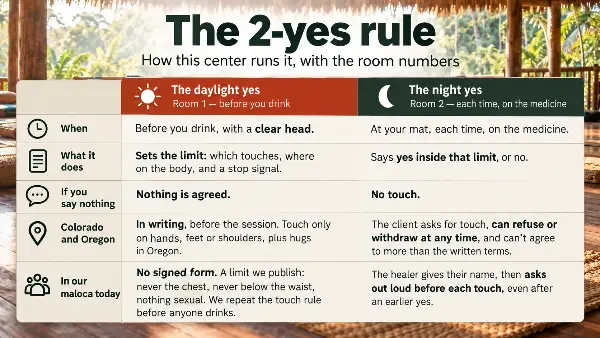
The 2-yes rule: a yes on ayahuasca can take touch away, never add it
The first yes comes in daylight, with a clear head, and sets the limit. The second comes at your mat, on the medicine, and can only stay inside that limit or cancel it.
That’s how the licensing rules for psychedelic sessions in Colorado and Oregon handle touch. Colorado’s rules for natural medicine facilitators require a written touch contract, signed in a preparation session. They also require a stop word or hand signal agreed in advance. During the session, the participant can refuse or take back consent at any time. What they can’t do is agree to anything the contract doesn’t already cover.
Oregon’s consent form for psilocybin clients works the same way. A facilitator may touch a client only when the client asks and has agreed in writing beforehand. The touch is limited to hugs or hands on the client’s hands, feet or shoulders. The client can change their mind at any moment of the session.
Neither rule applies to ayahuasca in Peru, where nobody licenses retreats. The logic still holds wherever people drink: the clearest yes is the one you give before the cup.
| The daylight yes | The night yes | |
|---|---|---|
| When | Before you drink, with a clear head | At your mat, each time, on the medicine |
| What it does | Sets the limit: which touches, where on the body, and a stop signal | Says yes inside that limit, or no |
| If you say nothing | Nothing is agreed | No touch |
| In Colorado and Oregon | In writing, before the session. Touch only on hands, feet or shoulders, plus hugs in Oregon | The client asks for touch, can refuse or withdraw at any time, and can’t agree to more than the written terms |
| In our maloca today | No signed form. A limit we publish: never the chest, never below the waist, nothing sexual. We repeat the touch rule before anyone drinks | The healer gives their name, then asks out loud before each touch, even after an earlier yes |
Our nights match those rules on 2 points: you can refuse at any time, and a yes on the medicine can’t add anything. The rest differs. In both states, the client asks for touch and agrees to it in writing first. Touch stays on the hands, feet and shoulders, and Oregon also allows hugs. Colorado adds a stop word or hand signal agreed in advance. Here, the healer offers and you answer, there’s no signed form, the limit is ours rather than yours, and it includes your head, which neither state allows.
If you’d rather not be touched at all, say no the first time a healer asks to touch you. That no holds until the ceremony closes, and the healer works with songs and smoke instead.
Can you consent while you’re on ayahuasca?
You can say no, and your no counts. A yes given on the medicine is weaker, because your judgment isn’t working the way it does by day. So it shouldn’t open up anything new.
The lab offers a hint, no more. In a 2015 study published in Psychopharmacology, 10 healthy volunteers scored higher on a suggestibility test after LSD than after a placebo. That’s LSD, not ayahuasca, in a small group, and the test measured suggestibility, not consent. Still, it’s part of why we don’t let a yes given on the medicine count for more than a yes given by day.
2 nonprofits that work on ayahuasca safety go further. ICEERS studies ayahuasca and supports people in legal cases over it. It says the power gap between practitioner and participant means consent can’t be assumed, even when the participant makes the first move. The Chacruna Institute’s community guide says a ceremony leader who seeks sex with a participant during or soon after a ceremony is committing a transgression, which all traditions consider inappropriate.
So our healers ask every time, and silence counts as no. A guest who’s frightened at 1 AM may not manage to say no out loud, so not answering has to be enough. It’s the same reason consent gets harder to give as the self dissolves.
What our healers do near your body, and what they ask first
Song is a healer’s main tool here, along with tobacco smoke and a leaf rattle, and none of them involves touching you. Once the candle is out, the healer asks before working with you alone, and again before each touch.
The exception is an emergency. If your health or safety, or someone else’s, is at risk, our physician and staff step in without waiting for a yes.
| Practice | When | What happens | Your say |
|---|---|---|---|
| Soplada diagnóstica | About 8:15 PM, before your cup | The lead healer blows tobacco smoke over your head and body for about 45 seconds to read you | Done for every guest who drinks, because it guides the dose. Ask about it before your first ceremony |
| A healer’s work at your mat | 9 PM to about 2 AM | Songs for you alone, usually 5 to 20 minutes and sometimes 30 or more, with tobacco smoke and, mostly after midnight, a leaf-bundle rattle | Asked before it starts |
| Hands on your head or shoulders | During that work | A healer’s hands rest there | Asked first, every time. No answer means no |
| A facilitator beside you | If you raise a hand or seem frightened | They speak first and touch only if you say yes | Your yes or no |
| Plant bath | By day, 2 to 4 times in a retreat | A bath of plants prepared for you, in a private tub in our bath house | Sober and in daylight, so you can ask what’s involved first |
| Never | Any time | Your chest, anywhere below the waist, anything sexual | Not open to a yes |
Hold any center to the floor that Chacruna’s guide sets for every tradition. Healing work like sopladas, limpiezas and plant baths never involves touching your private parts, and you never need to be naked for it. For plant baths, the guide says swimwear, underwear or whatever you’re comfortable in is fine. Our never row goes further than that floor.
Guests have rules of their own too, including never touching another guest. Our hour-by-hour ceremony guide shows where the soplada and the healers’ rounds fall in the night.
Consent in a language you understand at 1 AM
A yes only counts if you understood the question. Our healers work in Spanish, so the rule that silence means no carries more weight here.
Chacruna’s guide makes the point about sex: consent has to happen in a language both people understand. The same goes for a hand on your head. If a question comes at you in words you don’t follow, don’t answer. That’s a no, and the healer carries on without touching you.
Both of our facilitators speak English and Spanish, and one is always moving between the mats. Raise your hand and one comes to you. Outside ceremony, your talks with a healer, including at least 2 one-to-one consultations, are translated by a member of staff. So you aren’t alone with a healer in those talks. That matters, because Chacruna’s guide names drinking or healing alone with a healer as a common setting for abuse.

What do licensed psychedelic programs require in 2026?
Written touch consent before the session, and a short list of places hands can go. Colorado adds a 2-year ban on romance with clients after the work ends. The table puts the main written standards next to ours.
| Standard | Who it binds | Touch | Romance or sex after the work |
|---|---|---|---|
| Oregon’s psilocybin program (touch form 2025, client rights 2026) | Licensed facilitators | Written consent beforehand; hugs or hands on hands, feet or shoulders; can be withdrawn in the session | Clients’ rights include freedom from sexual abuse before, during and after services |
| Colorado’s natural medicine rules (4 CCR 755-1) | Licensed facilitators | Written touch contract and a stop signal agreed in advance; hands, feet and shoulders only; nothing beyond the contract in the session | Banned for 2 years after services end |
| ICEERS criteria for practitioners (November 2024) | Ayahuasca practitioners seeking its legal support | Informed, voluntary consent that can’t be assumed | Wait at least 6 months |
| American Psychological Association code | US psychologists | Not covered | At least 2 years, and almost never after |
| American Counseling Association code | US counselors | Not covered | 5 years |
| National Association of Social Workers code | US social workers | No touch that risks psychological harm; the social worker sets clear limits | No end date |
| Our rules | All staff, kitchen and boat crew included | Asked out loud every time; usually head or shoulders; never the chest, below the waist or anything sexual | Banned for 2 years after your retreat |
None of the outside standards binds an ayahuasca healer in Peru. The state rules cover licensed facilitators, the professional codes cover those professions, and ICEERS’s criteria apply to practitioners who want its legal support. Our 2 years matches Colorado’s rule. It’s also the psychologists’ minimum, though their code rules out sex with former clients even after 2 years “except in the most unusual circumstances.”
How long should staff keep away from you after a retreat?
At least 2 years for anything romantic or sexual, by our rule and Colorado’s. No study we’ve found measures how long the pull toward a healer or facilitator lasts, so every number in that table is a judgment.
The pull is common. Guests often leave feeling close to the people who stayed beside them through their hardest night. That feeling is real. It isn’t consent to a relationship, because the gap in power doesn’t end when you fly home.
Our rule covers healers, facilitators, kitchen staff and boat crew alike, during your retreat and for 2 years after it ends. It covers messages as well as meetings. Staff sign a written conduct agreement when hired, the team reviews the policy before every retreat season, and breaking it means dismissal. It doesn’t stop the follow-up calls our integration team makes in the weeks after you leave.
What happens if someone crosses a line here
Tell any of 3 people. The person you name stops working with guests at once, and 1 of the 3 is an independent contact.
You can go to our head facilitator, to the director, or straight to the medical director. She’s a physician, and your welcome packet lists her as that independent contact, so keep it after you fly home. Our safety guide explains who the 3 are and why the third matters.
After a report, the director and the medical director look into it together. If it’s confirmed, the staff member is dismissed. You’re offered help to leave early if you want to, a full refund and referrals for professional support. On your first day, we tell every guest out loud that a report will be believed and taken seriously.
We’ve acted on risk alone. During the observation stage of training, we let a facilitator candidate go for seeking personal relationships with guests outside ceremony. There had been no misconduct. The risk was enough. Since 2020, new facilitators have also had to pass a criminal background check in their home country. And 2 women sit in every ceremony: our head facilitator and a maestra.
No guest has reported sexual misconduct by our staff since we opened in 2017, across about 1,900 guests. We say “reported” on purpose. Chacruna’s guide notes that most cases never come to light, which is why the route to report matters more than any record.
Where to report in Peru if it happened somewhere else
Call Línea 100. It’s Peru’s free, 24-hour line for family violence and sexual violence.
Línea 100 is run by Peru’s Ministry of Women. If your Spanish is limited, ask a Spanish speaker to help with the call. The ministry also runs walk-in centers called Centros Emergencia Mujer, including 1 in Iquitos.
iPerú, the state’s tourist assistance service, answers 24 hours a day on (01) 574 8000 and on WhatsApp at +51 944 492 314. It can point you to the right place to file a complaint.
If you want the police to investigate, report it before you leave Peru. The UK government’s guide for victims of sexual assault in Peru says the report has to be made in Peru, in the city where it happened. It adds that medicine to prevent HIV must be taken within 72 hours. The World Health Organization says emergency contraception works up to 5 days after, and works better the sooner it’s taken. Tell your embassy as well.
If it happened to you, it isn’t your fault. Chacruna’s guide says women commonly freeze during a violation, and that you have the right to report abuse afterward, even if you couldn’t speak up at the time.
Consent to the medicine: what’s in the cup, who pours it, and your right to sit out
You can’t agree to a drink nobody describes. Ours has 2 ingredients, ayahuasca vine and chacruna leaves, with nothing else added, and our services page names both. You’re free to miss any ceremony without giving a reason, and nobody will press you to drink.
Every dose is set by our lead healer, who pours each cup himself. When guests want a second cup, he refuses about a fifth of them, usually because the guest is already deep enough in the experience. Guests sit out roughly 5 to 8 in every 100 ceremony places across our retreats, most often after an intense second or third night. The healer can also ask you to skip a night if he doesn’t think it’s safe for you to drink.
Before any of that, a physician reads your medical form, and some medicines have to stop weeks before you come. Agreeing to drink means knowing all of this first.
Ayahuasca ceremony consent comes down to 2 yeses, a short list of nevers and someone to tell. If you’re comparing centers, ask each one to describe all 3 in writing, along with the questions we’d ask. To see how a retreat runs, start with our ayahuasca retreat page.
FAQs
Can you give consent while on ayahuasca?
You can say no, and your no should always stand. A yes on the medicine shouldn’t open up anything you didn’t agree to first. Colorado’s rules for licensed facilitators work this way. Touch is agreed in writing before the session, and nothing more can be agreed during it.
Is it normal for a shaman to touch you during an ayahuasca ceremony?
Some touch is part of Amazonian healing. Here, it’s usually a healer’s hands on your head or shoulders, and the healer asks out loud each time. Our rule bars touch on the chest, below the waist and anything sexual. In any tradition, the Chacruna Institute’s guide says sopladas, limpiezas and plant baths never involve touching private parts.
Does ayahuasca ceremony consent carry over to the next touch?
No, a yes covers 1 touch. In our maloca, the healer asks again before the next one, even later the same night. A no works the other way: outside an emergency, it holds until the ceremony closes at about 3 AM, and nobody questions it.
How does ayahuasca ceremony consent work if you don’t speak the healer’s language?
A yes only counts if you understood the question. In our maloca, not answering counts as no, so the healer goes on without touching you. Our 2 facilitators speak English and Spanish, and one is always moving between the mats if you raise your hand.
How long should a facilitator wait before dating a former participant?
Written standards range from 6 months to no limit at all. ICEERS asks ayahuasca practitioners to wait at least 6 months. Colorado’s rules for licensed facilitators set 2 years, and the US social workers’ code sets no end date for sexual contact. Our staff rule runs 2 years from the end of your retreat.
What should I do if I was sexually assaulted at an ayahuasca retreat in Peru?
Call Línea 100, Peru’s free 24-hour line for family and sexual violence, and know it isn’t your fault. For a police case, the UK government’s guide for victims says you must report it in Peru, in the city where it happened. It adds that medicine to prevent HIV must be taken within 72 hours. iPerú’s 24-hour tourist line and your embassy can help too.
Do you have to undress for a soplada or a plant bath?
No. The Chacruna Institute’s guide says you never need to be naked for healing work like a soplada, a limpieza or a plant bath. For plant baths, it says swimwear, underwear or whatever you’re comfortable in is fine. Some Colombian yagé traditions ask people to remove a shirt, but the guide says keeping on a bra or camisole is normal.