
If you have an active eating disorder, we won’t serve you ayahuasca. That isn’t a soft discouragement. Severe eating disorders with medical instability sit on our list of 15 automatic disqualifications, next to schizophrenia, lithium use and uncontrolled cardiac conditions. I’m writing this because ayahuasca and eating disorders comes up on our screening calls more often than you’d expect, and because almost everything published on the subject is either a research summary or a center selling you a recovery story. Neither one tells you whether you’d be accepted here, or why the ceremony itself is the problem.
Ayahuasca and eating disorders is a contraindication question before it’s a treatment question. Ceremony involves induced vomiting and a fasted evening, which are two of the behaviors an eating disorder already runs on. Most centers screen for cardiac and psychiatric history and skip this one entirely. No clinical trial has tested ayahuasca in this population.

Can you do ayahuasca if you have an eating disorder?
Not with us, if it’s active. Not with any center that screens properly.
The line we draw is medical instability. Someone who is purging regularly, restricting to the point of weight loss, or who has electrolyte or cardiac findings on recent bloodwork is not a candidate for a night of induced vomiting on an empty stomach in a building 45 minutes by fast launch from the nearest hospital. Our medical director, a licensed physician with 18 years in emergency and tropical medicine, reads every intake form we receive, and this is one of the conditions she flags before anyone gets a call.
A history is a different question from an active disorder. That one gets assessed person by person rather than by a rule, and I’ve set out below what the assessment actually looks at.
What the research on ayahuasca and eating disorders actually shows
Less than the headlines suggest. Two small qualitative studies, no controlled trial, and nobody has measured safety in this group.
| The study | Who took part | What it found | What it doesn’t establish |
|---|---|---|---|
| Lafrance and colleagues, 2017, Journal of Psychoactive Drugs | 16 people who had already sought out ayahuasca on their own | 11 reported reductions in eating disorder thoughts or symptoms | Whether ayahuasca caused the change, or whether it’s safe |
| Williams and colleagues, 2022, Journal of Psychoactive Drugs | 15 ceremony leaders, 9 with a personal history of disordered eating | What experienced leaders believe is happening in ceremony | Anything at all about outcomes in people who drink |
| Controlled trials | Nobody. None exist | Nothing | Everything |
| Safety studies in this population | Nobody. None exist | Nothing | Everything |
The study people cite is Adele Lafrance and colleagues. It interviewed 16 people who went looking for ayahuasca themselves, which is the weakest design in research, and the authors say so. The 2022 follow-up asked 15 ayahuasca ceremony leaders what they thought was happening. When you see “two-thirds of ceremony leaders believe” in an article about this, that phrase means 10 people were interviewed and agreed. It’s interesting. It isn’t evidence that anything works.
Here’s what nobody quotes. A 2025 review in Brain Sciences by Bilenker and Avena put the safety problem in one sentence: because traditional use involves both dietary restriction and purging, behaviors that are themselves part of eating disorder pathology, there are open questions about whether ayahuasca is safe in these conditions. The same review confirms no systematic safety data answers those questions. The 2017 study sidestepped it by recruiting people who had already drunk, rather than giving anyone the medicine and watching what happened.
So the honest summary is this. A handful of people say it helped. Nobody has checked whether it hurts anyone. Those are different claims and the field keeps collapsing them into one.
Why does a purging history change the risk?
Because your body has already been through it, and because your mind has already learned something from it.
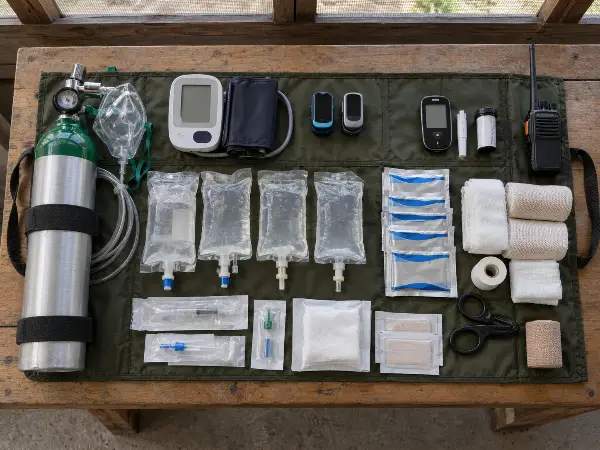
Start with the physical. Purging behaviors disturb electrolytes, and low potassium in particular lengthens the QT interval on an ECG. A 2023 review in the Journal of Eating Disorders by Friars, Walsh and McNicholas is direct about where that leads: cardiac arrhythmias are the highest-risk cardiovascular complication related to purging, and the review cites reported cases of sudden cardiac death in people with severe self-induced vomiting. Now add a substance that reliably produces vomiting, a fasted stomach, tropical heat and humidity, 4 nights across 10 days, and a clinic that is a boat ride away. Our medical kit carries electrolyte replacement and an ECG isn’t part of it. We require ECG documentation only for guests over 50, and that rule exists because of a cardiac event we had in 2018.
Then the part that doesn’t show up on bloodwork. In ceremony, purging gets described as cleansing. People talk about what came out of them. Some of them feel lighter, and they say so in the integration circle the next morning. If you’ve spent years using vomiting as a way to feel clean or back in control, sitting in a dark room where 9 other people are doing it and calling it healing is not a neutral environment. We describe what purging actually involves elsewhere on this site, and the description is accurate for most guests. It isn’t written for you.
The retreat asks you to fast before every ceremony
Every ceremony day ends with a 4 PM meal of plain rice, boiled plantains and vegetables, no salt and no oil. There’s no dinner. You walk into the maloca at 7:15 PM on an empty stomach, and you do that 4 times across a 10-day retreat.
For most guests that’s a manageable inconvenience. For someone whose disorder is built on restriction, it’s a prescribed fast with a spiritual justification attached, repeated on a schedule, in a setting where everyone around you is doing the same thing and treating it as meaningful. Add the full dieta rules that start 2 weeks before you fly, which tell you what you may and may not eat, and you have a structure that looks a great deal like the disorder wearing better clothes.
I want to be precise here, because this is where people accuse us of scaremongering. The dieta exists for pharmacological reasons and most of it is not negotiable. The problem isn’t that the rules are wrong. It’s that a food-rule system administered by an authority figure is exactly the thing a restriction disorder attaches itself to, and we have no way to tell from the outside whether that’s happening to you.

What we turn people away for, and where eating disorders sit on it
We reject 13% of applicants outright. Another 5 to 8% are accepted on conditions they never meet, so roughly 18 to 21% of people who apply never come. The full list of what disqualifies you runs to 15 items and is published.
Eating disorders are on that list, phrased as severe eating disorders with medical instability. Most of the other 14 are conditions where the risk comes from the medicine interacting with something in your body or your psychiatric history. This one is different, and it’s the reason this page exists: the risk comes from the ceremony resembling the illness.
We publish that rejection rate because nobody else in this field does. The number that should matter to you isn’t ours, though. It’s whether the center you’re writing to has ever turned someone down for this, and whether they’ll tell you when you ask.
What if your eating disorder is in remission?
Then it’s a conversation, not an automatic no, and it happens before anything is confirmed.
Every applicant does a 30 to 45 minute video call with our senior facilitator, who holds an MSW and spent 6 years in trauma-informed care before he joined us. He’s turned people down whose written applications read clean. The questions that matter here aren’t about diagnosis. They’re about what your relationship with the rules would be: how you’d handle a fasted evening, whether you’d want a second cup for reasons that have nothing to do with the medicine, what you’d do if purging started to feel like an achievement.
One thing I’ll say without qualification. If you’re in treatment, your treating clinician gets to weigh in before we do, and if they say no, we say no. We don’t override the person who has been watching your case for a year on the strength of a video call.
Why a fast yes should worry you
If a center reads your application, sees an eating disorder history, and books you anyway without a call, you’ve learned something about that center’s screening rather than about your own readiness.
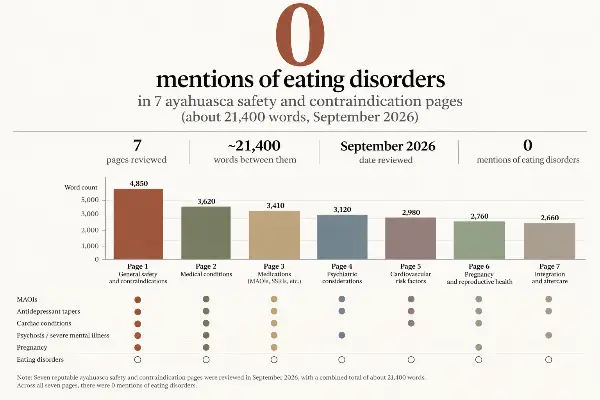
Some Iquitos centers report rejection rates of 2 to 3%. Ours, at a 10-guest center on the Río Momón, is 13%. That gap isn’t because our applicants are sicker. In September 2026 we read the 7 pages that rank on Google for ayahuasca contraindications and safety screening, about 21,400 words between them, from centers in Peru, Colombia and Costa Rica. Every one of them covers MAOI interactions, antidepressant tapers, cardiac disease, psychosis and pregnancy. Not one of them mentions eating disorders. Not once.
That isn’t a coincidence and it isn’t ignorance. Naming this condition forces a center to write down that its own ceremony involves vomiting and fasting, and no business selling ceremonies wants that sentence on its website. There’s no regulator setting a screening floor either, which we’ve covered in our piece on how Peru actually regulates this. The floor is whatever each center decides it is.
What we’d tell you to do instead
Treat the eating disorder with people who treat eating disorders, and come back to this question later if you still want to.
That sounds like a brush-off. It isn’t. Eating disorders carry one of the highest death rates in psychiatry. Arcelus and colleagues, in a meta-analysis of 36 studies published in 2011, found people with anorexia nervosa died at nearly 6 times the expected rate, and about 1 in 5 of those deaths was suicide. Udo and Grilo, writing in BMC Medicine in 2019, found roughly 31% of people with anorexia and 23% of people with bulimia had attempted suicide. This is not a condition to experiment on yourself with.
In the US, the National Alliance for Eating Disorders runs a clinician-staffed helpline and a treatment-provider directory, both free. Outside the US, start with your GP or a specialist eating disorder service. If you’re already working with someone, tell them you were considering this. Their reaction will tell you more than this page can.
If you get well and the question is still there in a year, write to us. We’ll do the same screening call we’d do for anyone, and the answer might be yes. Ayahuasca and eating disorders is a question we’d rather answer honestly now than manage badly in a dark room at 2 AM. If you want to talk it through before you’re sure, reach us here, and if you want to see what we publish about outcomes rather than promises, our piece on what ayahuasca actually does for people has the numbers, including the ones that don’t flatter us.
FAQs
Can you do ayahuasca with an eating disorder?
Not at a center that screens properly. Severe eating disorders with medical instability are 1 of 15 automatic disqualifications on our intake criteria. The concern is that ceremony involves induced vomiting and a fasted evening, which overlap directly with eating disorder behaviors, and no controlled trial has tested safety in this group.
Does ayahuasca treat eating disorders?
There’s no evidence that it does. The main study, published in the Journal of Psychoactive Drugs in 2017, interviewed 16 people who had already taken ayahuasca on their own and found 11 reported symptom reductions. That’s a starting point for research, not a treatment finding, and the authors describe it as exploratory.
Why is purging in ceremony a risk if I have a history of purging?
Two reasons. Purging behaviors disturb electrolytes, and a 2023 review in the Journal of Eating Disorders identifies cardiac arrhythmia as the highest-risk complication linked to purging. Separately, a ceremony where vomiting is described as cleansing can reinforce the behavior psychologically.
Will an ayahuasca retreat turn me away for an eating disorder?
A properly screened one will, if it’s active. We reject 13% of applicants outright and another 5 to 8% never meet their conditions. Be aware that some centers in the Iquitos area report rejection rates of 2 to 3%, and that of the 7 highest-ranking ayahuasca safety pages we reviewed in September 2026, none mentioned eating disorders at all.
What if my eating disorder is in remission?
It’s assessed case by case on a 30 to 45 minute video call, and your treating clinician’s view carries more weight than ours. A written history alone isn’t an automatic no, but active medical instability is.
Is the ayahuasca dieta a problem if I have a restriction history?
It can be. The dieta sets food rules for 2 weeks before arrival, and every ceremony day ends with a 4 PM meal and no dinner. The rules exist for pharmacological reasons, but a scheduled fast with a spiritual justification is the kind of structure a restriction disorder attaches to.
What should I do instead?
Work with clinicians who treat eating disorders. In the US, the National Alliance for Eating Disorders operates a free clinician-staffed helpline and provider directory. If you recover and still want to sit with this medicine, the conversation is open.