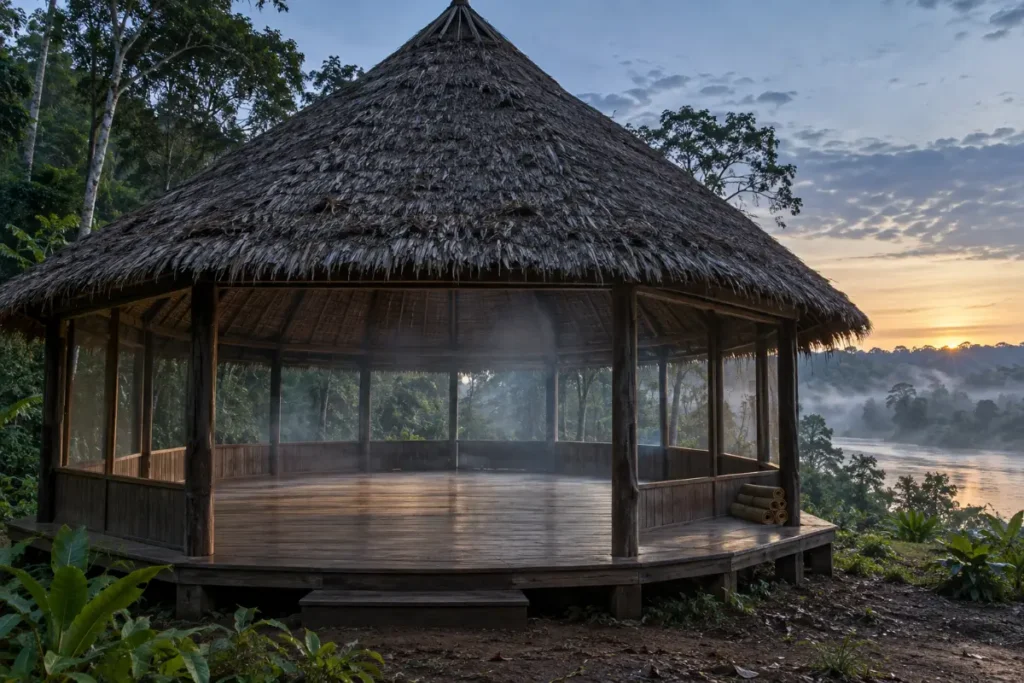
Is an ayahuasca retreat safe? Mostly, if the center is run properly, and ayahuasca retreat safety turns on 3 things almost nobody writes about.
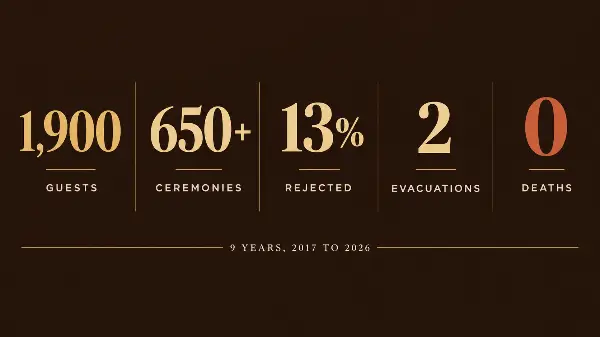
Our record first, so you know what a real one looks like. Across 9 years at an Amazon retreat an hour upriver from Iquitos we’ve served roughly 1,900 guests and more than 650 ceremonies. Zero deaths. Two medical evacuations, both ending in full recovery. Both are described below with dates and causes.
Read 10 safety guides and you’ll get 10 versions of the same medication list. That list matters, and what real screening looks like is covered properly elsewhere on this site. It is also the easy part. Any center with an intake form catches it.
The 3 risks that actually reach guests are a facilitator who crosses a line in the dark, a brew with something in it you weren’t told about, and a ceremony sold as a single night. None of the 3 appear in the guides. All 3 are checkable before you pay.
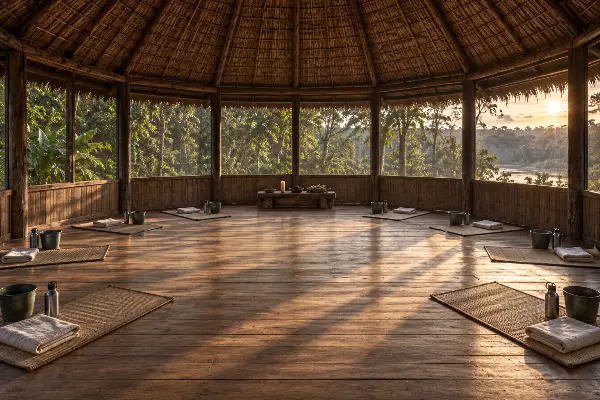
What ayahuasca retreat safety actually means
Ayahuasca retreat safety is the combination of screening that can reject you, a brew whose 2 ingredients the center will name, a written consent policy with a reporting channel outside the management chain, enough staff that nobody is alone in the dark, medical cover with a stated evacuation time, and a retreat long enough for any of that to matter.
Comfort, price, scenery and review scores predict none of it. Four of those 6 things can be confirmed by email before you send a deposit.
The risk the industry does not talk about
Sexual assault by facilitators and healers is this field’s worst-documented, least-discussed harm, and it is the one your safety guide skipped.
The conditions are obvious once stated. Guests are in the dark, in the most vulnerable state a person can be in, frequently unable to tell a hand on the shoulder from something the medicine produced. The power gap is total. The romantic story of the wise Amazonian shaman leaves no room for the fact that some practitioners are predators, so the field mostly declines to discuss it.
We discuss it because structure is the only thing that prevents it, and structure is publishable.
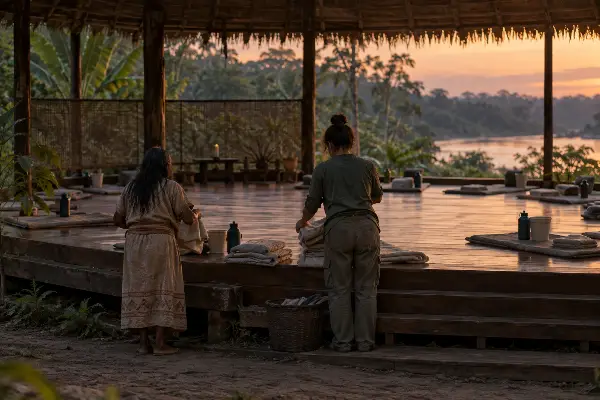
What does a real consent policy look like?
It is specific, it is written down, and it constrains staff rather than reassuring guests. Here is the difference between a policy and a sentiment.
| What a real policy states | What most sites say instead |
|---|---|
| No touch without verbal consent asked in the moment, every time, even if you agreed an hour earlier | “We hold a safe and sacred space” |
| Named body areas that are never touched: nothing below the waist, nothing on the chest | Nothing |
| No staff-guest romantic or sexual contact during the retreat or for 90 days after, covering healers, facilitators, kitchen and grounds staff | Nothing |
| Signed by every staff member on hire, with termination as the stated consequence | “Our team is carefully chosen” |
| Criminal background checks through each person’s country of origin | “All our facilitators are experienced” |
| At least 1 woman healer and 1 woman facilitator present at every ceremony | “We have a mixed team” |
That is our policy, and every line of it is enforced. Altered states change where a person’s boundaries sit, which is why consent gets asked again rather than assumed. A healer who is told no works without touch for the rest of that night, and the no is never revisited or queried.
Who you report to, and why it should not be the director
A reporting channel that ends at the person who runs the business is not a reporting channel.
You can raise something with our head facilitator. If the complaint involves her, you go to the director. If it involves the director, you contact Dra. Carmen Ríos Medina directly, and her details are in your welcome packet for exactly that reason. She is the medical director, she is not in the management line, and she can act without anyone’s permission. Guests are told this out loud on arrival day rather than left to find it in a document.
When you’re comparing centers, ask who the third name is. If there isn’t one, every complaint route ends with the owner.
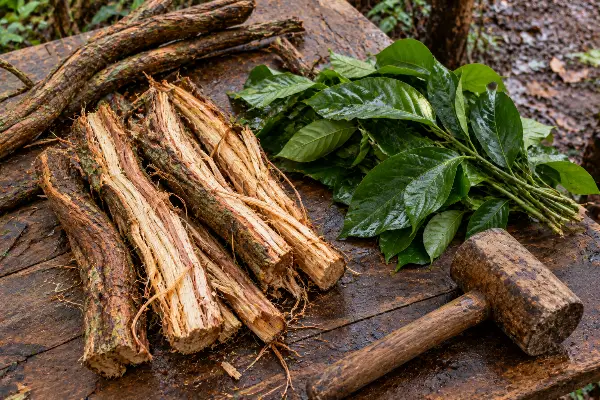
What is in the cup that nobody mentioned
Some centers add toé, the common name for Brugmansia, to make visions more dramatic. Toé is a deliriant rather than a psychedelic, and adding it is the most documented adulteration problem in Peruvian ayahuasca tourism.
The reason this belongs in a safety article rather than a pharmacology one is that it is a consent failure before it is anything else. A guest who drinks an adulterated brew cannot agree to what they are taking, because they were not told what it is.
Ours is Banisteriopsis caapi vine and Psychotria viridis leaf. Nothing else. Our lead healer’s position is that the vine is the doctor and the leaf opens the door, and that you do not need more doctors in the room. The full account of how it is cooked and logged sits with what each medicine involves.
Ask any center to name what is in the brew. Two plants is a real answer. “Traditional Amazonian medicine” is not.
Is a 1-day or 2-day ayahuasca ceremony safe?
Structurally, no, and it has nothing to do with the strength of the brew.
A single-night booking cannot contain a physician reviewing your medical history, a 30 to 45 minute screening interview, a supervised medication taper that runs 6 to 8 weeks for most antidepressants, a healer who has watched you across more than one night, or any integration support at all. Those are 5 of the things that make ayahuasca safer, and a 1-day ceremony removes all 5 while keeping the part that carries the risk.
The preparation window is the giveaway. If your antidepressant taper needs our timelines by drug, a center that can fit you in tomorrow night has either not asked what you take or does not care about the answer.
We run 4 ceremonies across 10 days, on nights 2, 4, 7 and 9. Much of this region runs 5 to 7 inside a single week. A center that will sell you one night has told you what its screening is worth.
What our safety record actually looks like
Two guests have needed a hospital in 9 years. Both recovered fully.
2018. A guest developed cardiovascular symptoms during ceremony: racing heart, chest pressure, difficulty breathing. They had a cardiac condition that was not on their intake form. We ran them downriver by fast launch in the dark and they were treated at Hospital Regional de Loreto, then recovered completely. What changed afterwards: cardiac screening questions were added, and ECG documentation became mandatory for every guest over 50.
2022. A guest had an acute psychotic episode that did not settle with on-site management. Dra. Ríos gave diazepam, stabilised them, and evacuated at dawn. They recovered completely, and later disclosed a family history of schizophrenia that had been left off the application. What changed: first-degree family psychiatric history became a required disclosure and the crisis protocols were rebuilt around it.
Beyond those 2, Dra. Ríos has been called into the maloca 6 to 8 times over 9 years to assess a guest for a racing heart, extreme panic or prolonged dissociation. All were handled on site.
Zero deaths. Zero sexual misconduct incidents. Zero lawsuits.
We publish this because a center advertising a spotless record across many years is either very new or editing. Two evacuations in 1,900 guests is what an honest record looks like, and both of them trace back to the same thing.
When someone lies on the intake form
It has happened 3 times in 9 years, and every time it made the outcome worse for the person who did it.
One guest concealed active benzodiazepine use and was asked to leave before drinking anything. One concealed SSRI use in 2023, having stopped 2 weeks before instead of the required 6, which meant reassessment, a reduced dose and close monitoring. The 2022 psychotic episode was the third.
Nobody gets shamed for it. The reason is almost always fear of rejection or of losing a deposit. But both of our evacuations happened because of something a guest chose not to tell us, and that is the whole argument for honesty on the form.
How common are bad reactions to ayahuasca?
Common, mostly physical, and mostly not dangerous. The largest dataset is the Global Ayahuasca Survey, published in PLOS Global Public Health in 2022 with 10,836 respondents. It found 69.9% reported acute adverse physical effects, and 2.3% of those needed medical attention afterwards.
On the psychological side, 55.9% reported adverse mental health effects in the weeks or months after drinking. That figure gets quoted without its other half, so here it is: 87.6% of those people considered the effects part of a positive process of growth or integration, and 11.9% sought professional support. The survey also found adverse mental health effects were less likely among people drinking in ceremonial and religious settings than outside them, which is an argument for the container rather than against the medicine.
What the data does not do is tell you whether a particular center is safe. It describes the medicine. The 3 risks above describe the operator.
Does resurfacing trauma mean something went wrong?
Usually not, and there is now data rather than folklore on this.
A 2023 study in Scientific Reports by Weiss and colleagues surveyed 339 ceremony participants. Among non-veterans with a prior adverse life event, 42% reexperienced it during ceremony. Women reexperienced at 57% against 32% for men. Among non-veteran women with a sexual assault history, 33% reexperienced it. Among veterans, 59% reexperienced some adverse life event.
The finding that matters here: reexperiencing tracked with greater improvement, not harm. Participants who reexperienced showed an additional 0.21 and 0.19 unit fall in neuroticism. The authors are careful and so are we. This was self-selected retreat attendees with self-reported diagnoses, not a controlled trial.
What it supports is that hard material surfacing is not a sign the night has gone wrong. What it does not support is drinking somewhere with nobody trained to sit with you when it does. Our own outcome tracking, and what the numbers show at 3 months including the guests who do not improve, is published separately.
How to check a center before you book
Everything above is verifiable by email, and the replies tell you more than the website does.
Ask what is in the brew and count the plants in the answer. Ask for the consent policy in writing and see whether it names body areas and a time window, or whether it describes an atmosphere. Ask who you report a facilitator to and listen for a third name outside the management chain. Ask how many nights the retreat runs and how long before arrival they need you off your medication. Ask what has gone wrong, and treat “nothing” as the answer it is.
A center with real answers replies in specifics. A center without them replies in adjectives, and you have learned what you needed to know either way.
If you want to check ours, the rest of the team are named with their training and their years, how to check a lineage explains what those credentials mean, our 10-day retreat sets out the structure, and kambo carries its own separate screening list. Getting here is a 90-minute boat ride from Iquitos, and the 2008 ruling covers where the law sits. When you’re ready, you can start the application.
FAQs
Is an ayahuasca retreat safe?
Mostly, when the center is run properly, and the things that decide it are checkable before you book. A safe retreat will name the 2 plants in its brew, hand you a written consent policy, give you a reporting route that does not end with the owner, and tell you what has gone wrong in its history. Across 9 years and roughly 1,900 guests we have had 2 medical evacuations, both ending in full recovery, and zero deaths.
What are the biggest ayahuasca retreat safety red flags?
A ceremony you can book for tomorrow night, a center that will not name what is in the brew, no written consent policy, no reporting channel outside the management chain, and a claim of a perfect record over many years. The last one matters most, because a center with real volume and nothing to describe is either very new or not telling you everything.
What should an ayahuasca consent policy include?
It should say that no staff member touches a guest without verbal consent asked in the moment, name the body areas that are never touched, set a no-contact window that extends past the retreat itself, and apply to every member of staff rather than only to healers. Ours runs for 90 days after departure and covers kitchen and grounds staff as well as the ceremony team.
Is a 1-day or 2-day ayahuasca ceremony safe?
Structurally no, whatever the brew is like. A single night cannot include a physician reviewing your history, a screening interview, a medication taper that runs 6 to 8 weeks for most antidepressants, or any integration afterwards. It removes the 5 things that make ayahuasca safer and keeps the part that carries the risk.
Can a retreat add other plants to the ayahuasca brew?
Some do. Toé, the common name for Brugmansia, gets added to intensify visions and is the most documented adulteration problem in Peruvian ayahuasca tourism. It is a consent problem before it is a pharmacological one, because a guest cannot agree to something they were never told about. Ours is caapi vine and chacruna leaf, and nothing else.
How often do people have bad reactions to ayahuasca?
Often, and mostly not dangerously. The Global Ayahuasca Survey, with 10,836 respondents, found 69.9% reported acute adverse physical effects and 2.3% of those needed medical attention. Adverse mental health effects were reported by 55.9%, and 87.6% of those people considered them part of a positive process rather than a harm.
Does ayahuasca bring back traumatic memories?
For many people, yes. In a 2023 study of 339 ceremony participants, 42% of non-veterans with a prior adverse life event reexperienced it during ceremony, rising to 59% among veterans. Reexperiencing was associated with more improvement rather than less, though the study was observational. It is not a sign the night has gone wrong, but it is a reason to drink somewhere with trained people in the room.