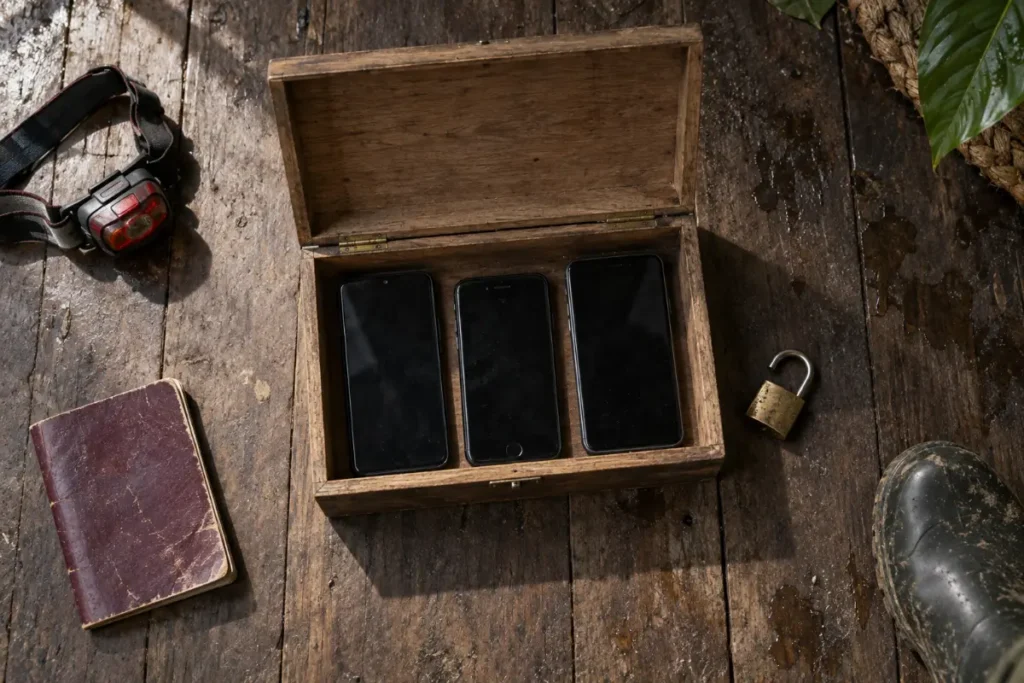
Your phone goes into a locked box when you arrive. You get it back for 30 minutes on Day 5. And at any hour of those 10 days, someone at home can reach you through our satellite phone. That is the shape of an ayahuasca retreat as a parent, and it is the part almost nobody in this field publishes.
We held phones for the full 10 days when we started. Parents of young children told us that was too much, and they were right. The Day 5 window exists because they said so.
This is written from a 10-guest center on the Río Momón, 90 minutes upriver from Iquitos, running since 2017 with roughly 1,900 guests through it. Our average guest is 39. Plenty of them are somebody’s parent. Here is what the 10 days ask of you, and what happens when you fly home.
What an ayahuasca retreat as a parent involves
Doing an ayahuasca retreat as a parent means 10 days away from daily contact with your children, a locked phone with a single 30-minute window on Day 5, a medication taper that starts weeks before you travel, and 8 weeks of structured follow-up afterward. Most people are gone 12 to 14 days door to door. Emergency contact runs through the center, not your phone.
Everything below is the detail behind that paragraph.
Can your family reach you during the 10 days?
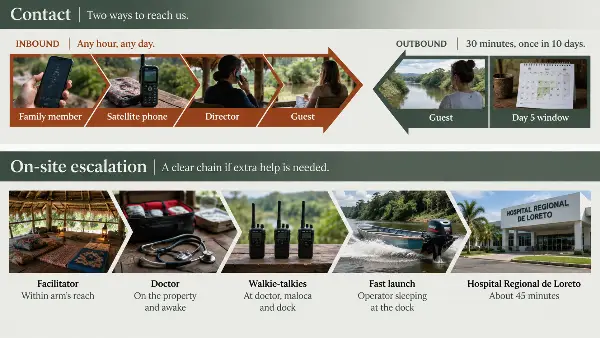
Yes, through us, at any hour. Not through your phone.
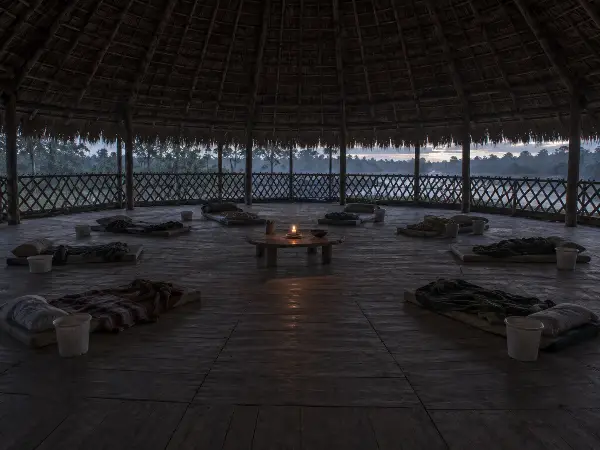
Phones are collected on arrival and stored in a locked box until departure. There’s no wifi anywhere on the property, and that isn’t a bandwidth problem. It’s a decision. Solar panels run the common areas from 6 AM to 10 PM, each guest tambo has a single low-watt lamp, and the maloca where ceremonies happen has no electricity at all, ever.
The exception is the satellite phone. It’s our primary emergency line, it sits with the director, and a family member who needs you can call it. We also keep 3 walkie-talkies on the property, held by the doctor, the maloca and the dock.
| If this happens | How it reaches you | How fast |
|---|---|---|
| Ordinary news from home | Day 5 phone window, 30 minutes | Once, mid-retreat |
| A real emergency at home | Your family calls the center’s satellite phone | Any hour, any day |
| You want to check in | The Day 5 window, or ask staff | Same day |
| Something goes wrong with you here | A doctor is on the property every ceremony night, awake | Minutes |
| You need a hospital | Fast launch on standby, operator sleeps at the dock | Roughly 45 minutes to Iquitos |
Give your emergency contact our number before you fly. Tell them what it’s for and tell them not to use it for a scheduling question. That conversation takes 2 minutes and it’s the one that lets most parents sleep.
What happens if there is an emergency at home
We come and get you, and we help you leave.
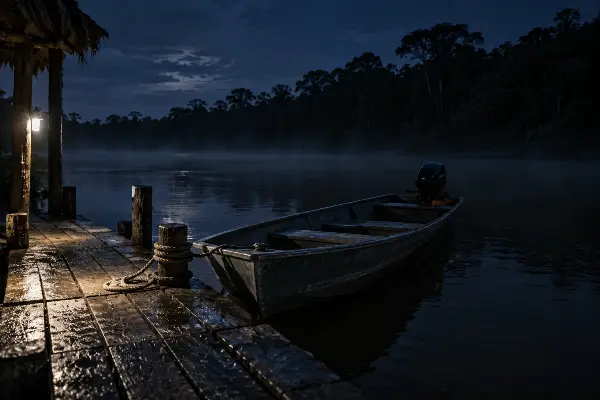
The launch that sits at the dock for medical evacuation is the same launch that takes a guest to the airport when a call comes in from home. It has happened. A guest leaving mid-retreat forfeits the remaining ceremonies, and we don’t pretend that’s a small thing after you’ve travelled this far, but nobody has ever had to argue with us about it.
The refund side is worth knowing before you book, because a parent’s plans break more often than anyone else’s. Cancel 60 or more days out and you get everything back except a $200 administrative fee. Between 30 and 59 days, half. Inside 30 days there’s no refund, though we’ll usually credit it toward a future retreat. We’re reasonable about real emergencies and we’d rather you asked than assumed.
What happens if the emergency is here instead
A doctor is on site, awake, every ceremony night, and the plan above her runs 3 tiers deep.
Our medical director reviews every application before anyone is accepted, and she’s physically on the property during ceremonies with her own kit: oxygen, IV fluids, an automated blood pressure monitor, 2 pulse oximeters, injectable diazepam, epinephrine. In 9 years she’s been called to assess a guest during ceremony 6 to 8 times, for a racing heart, extreme panic or prolonged dissociation. All of those were handled where they happened.
Twice in 9 years we’ve run a full evacuation. A cardiac event in 2018 and an acute psychotic episode in 2022, both in guests who had left something off their application form. Both recovered. Across roughly 1,900 guests and more than 650 ceremonies, there have been no deaths.
Travel insurance with medical evacuation cover is a requirement here, not a suggestion. There is no road out of this stretch of river, so an evacuation is a boat and then a flight, and a family with no cover absorbs the whole of it. If you have children at home, that is the argument for reading the policy properly rather than buying the cheapest one.
Your own government’s position is worth reading too. The U.S. State Department’s Peru page carries a Level 2 advisory and says plainly that “facilities or groups offering ayahuasca/kambo are not regulated by the Peruvian government and may not follow health and safety laws or practices.” That’s accurate. We wrote about what the law covers in its own piece, including the 2025 embassy alert in full.
Does being a parent change whether you are accepted?
No. Being a parent isn’t a factor in screening, and having children won’t get you turned down or waved through.
What does decide it is a 15-item list of automatic disqualifications, a medical review of your form by our doctor within 72 hours, and a 30 to 45 minute video call that every single applicant does. We reject 13% outright. Another 5 to 8% are accepted on conditions and never meet them, usually a medication taper they can’t or won’t finish. So 18 to 21% of people who apply never come.
Pregnancy or suspected pregnancy is on the automatic list. So are schizophrenia and schizoaffective disorder, any history of psychosis, bipolar I, current lithium, current pharmaceutical MAOIs, uncontrolled cardiac conditions, uncontrolled hypertension, and active suicidal ideation with a plan. The full list and how each one gets assessed is in our piece on what actually decides your risk.
Peru’s own health ministry landed in the same place. In August 2024 the Instituto Nacional de Salud published guidance on safer ayahuasca use telling participants to disclose existing conditions, current medications and mental health history first, because those “podrían generar complicaciones severas o incluso mortales.” Nobody enforces that guidance. Ask any center whether they’ve read it.
One more rule that surprises people: our minimum age is 25, which is higher than the law requires. The founders’ position is that most people under 25 don’t yet have the settled life to integrate this well. If you’re a parent reading that as a comment about maturity, it is one.
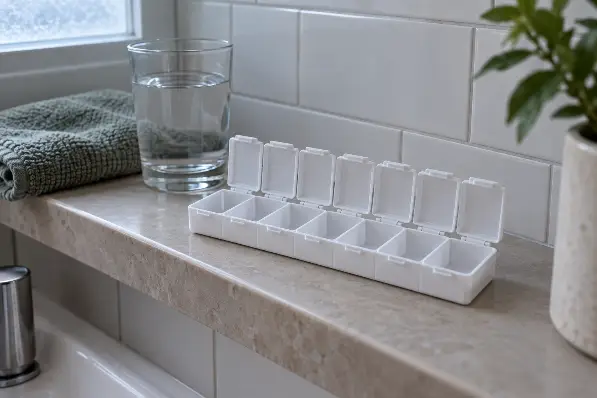
Do you have to stop your antidepressant, and what is that like at home?
Yes, and the timeline depends on the drug rather than on how you feel. This is the hardest part of the trip for most parents, and it happens before you leave the house.
| Medication | Minimum time off before ceremony |
|---|---|
| SSRIs (sertraline, escitalopram and similar) | 6 weeks |
| Fluoxetine | 8 weeks |
| SNRIs (venlafaxine, duloxetine) | 6 weeks, often longer |
| ADHD medication | 2 weeks |
| Tramadol | 2 weeks |
| St John’s wort | 2 weeks |
| 5-HTP | 1 week |
| Benzodiazepines | Case by case, physician-supervised |
Read the top row again with a school run attached to it. You will be 6 weeks into coming off an antidepressant while doing the ordinary work of a parent, and the evidence says that’s a real event rather than a formality. Henssler and colleagues pooled 79 studies and 21,002 patients for The Lancet Psychiatry in 2024 and found that 31% of people stopping an antidepressant reported at least 1 discontinuation symptom, against 17% coming off placebo. The share caused by stopping the drug was about 15%, roughly 1 in 6 to 7 people. Around 3% had severe symptoms.
So plan the taper around your family, not around your flights. Start it in a quiet stretch. Tell your partner or whoever helps you what weeks 2 through 4 might look like. Our doctor works directly with your own prescriber and signs off before your place is confirmed, and if your physician says the taper isn’t safe for you, you don’t come that cycle. The mechanism behind all of this is in our piece on the medication list.
How long you are actually away in 2026, door to door
Plan for 12 to 14 days, not 10.
The retreat is 10 days on a fixed schedule, 2 per month, dates published a year ahead. Around that you need the travel. Fly to Lima, then Lima to Iquitos, about 2 hours with daily flights. Someone meets you at the Iquitos airport and drives 20 minutes to the river dock. Then it’s 90 minutes upriver by peque-peque, or 45 minutes by fast launch.
From Lima the whole chain is 4 to 5 hours. From the US east coast, 10 to 14 hours with connections. From Europe, 14 to 20. We ask people to arrive in Iquitos a full day early rather than sprint a connection, which adds a night. Getting to Iquitos covers the routing and which airlines still fly it.
Peak season runs June to September and those retreats often sell out 5 to 7 months ahead. If you’re working around a school calendar, that lead time is on your side.
What state will you be in during those 10 days
Tired, often physically unwell for 3 or 4 hours at a stretch, and not reachable for casual conversation.
Ceremonies run on nights 2, 4, 7 and 9. They end between 3 and 4 AM and most people sleep until 9 or 11. There’s no alarm and no wake-up call. The morning after each ceremony there’s a 90-minute to 2-hour integration circle at 11 AM, and afternoons are deliberately unstructured.
The physical side is not a secret and shouldn’t be sold as one. In the Global Ayahuasca Survey, published in PLOS Global Public Health in 2022, 69.9% of respondents reported acute physical adverse effects and 62.0%, which was 5,097 people, reported vomiting or nausea. Only 2.3% needed medical attention. In the only randomized placebo-controlled trial of ayahuasca for treatment-resistant depression, 57% of the ayahuasca group vomited against 0% on placebo. That trial had 29 patients in it, so treat it as promising rather than settled.
None of that is dangerous in a screened person with a doctor 40 feet away. It does mean the version of you inside those 10 days is not the version who can take a call about a permission slip. Our account of what 650 ceremonies show, hour by hour, has the rest.
What the first week back at home looks like
Loud, bright and faster than you remember, which is why the follow-up starts inside week 1 rather than at month 3.
Every guest gets a 30-minute video call with one of our integration facilitators in the first week, a 20-minute call at week 3, an email check-in around month 2, then month 6 and month 12. About 82% of people take the week 1 call. By month 6, roughly 35% still respond, and we don’t chase the rest. Someone doing well without us is the point.
The program has a name, Raíces, and it’s built into what you already paid rather than sold separately. There’s also an emergency WhatsApp line with a 4-hour response commitment during waking hours, a referral network of more than 25 integration-aware therapists across the US, Canada, the UK, Australia and Europe, and an alumni group of about 320 former guests.
What we tell parents specifically: do not fly home into the busiest week of your family’s year. Ask for 2 or 3 quiet days on the other side of the flight before you’re back on full duty. Almost nobody plans this and almost everybody wishes they had.
What if you come home worse than you left?
You call the emergency line and someone answers within 4 hours. In 9 years, 12 to 15 people have used it for a serious post-retreat crisis and none needed psychiatric hospitalization.
That number is small. It isn’t zero, and a parent deserves its real shape rather than reassurance. Difficulty in the weeks after is common enough to be normal: in the same PLOS survey, 55.9% reported mental health effects in the following weeks or months, and about 88% of that group described those effects as part of a process of growth rather than as harm.
When someone is struggling badly, our integration team moves to weekly calls for as long as it takes, and we’ve run 4 to 6 week stretches of that at no extra charge. If it’s beyond what calls can hold, we connect you to a therapist from the referral list.
The part most parents get wrong about the timing
The ceremonies are not the variable that decides whether you come back a better parent. The 8 weeks afterward are, and most people book the wrong 8 weeks.
Our own data says so. We’ve collected PHQ-9 and PCL-5 scores from every guest since 2021, and across 290 complete datasets the average depression score came in at 13.1, dropped to 6.8 by Day 10, then sat at 7.3 at 3 months. Read that shape carefully. Some of the Day 10 lift doesn’t hold. About 70% of people show sustained improvement at 3 months, which means 30% don’t, and we publish that 30% on purpose.
The industry sells the 4 nights. The 4 nights are the cheap part. What separates the people who keep it from the people who lose it is what the following 2 months looked like, and a parent has more control over that than anyone: you choose the return date, you choose whether there’s help in the house for the first week, and you choose whether month 2 is a house move and a new job or a quiet stretch.
So here’s the practical version. Don’t come the month before a school year starts. Don’t come between 2 work deadlines. Don’t fly home on a Sunday night for a Monday morning. If the only window you have is a bad one, wait for a better one. We run 22 retreats a year and the dates go up 12 months ahead for exactly this reason.
What we would tell you to ask any center
Ask the questions whose answers can be checked, and ask them before you ask about the shaman.
Nobody licenses ayahuasca retreats in Peru. No ministry inspects a maloca, no registry lists practitioners, and the only standards that exist anywhere in this field are the ones a center sets for itself and writes down. That cuts both ways, and it means the burden of vetting is on you. 6 questions worth asking, ours included:
- If my family has an emergency, what number do they call and who answers it?
- Is there a doctor on the property during ceremony, and what is their name?
- How far is the nearest hospital and how do you get someone there?
- What percentage of applicants do you turn away, and for what?
- What follow-up happens after I leave, and is it included?
- Do you collect outcome data, and will you show me the bad half?
A center that can’t answer 1 through 3 in specifics isn’t ready for a parent. A center that won’t answer 6 is telling you something.
If you want the full screening process and the 10-day schedule before you commit, they’re both on our 10-day retreat page, and the family behind this center goes back 5 named generations on this river. If you’d rather ask a question first, that’s usually the better move. Tell us on the call that you have kids at home. An ayahuasca retreat as a parent is a different calculation, and it changes what we tell you.
This article is for education and is not medical advice. Ayahuasca interacts dangerously with a range of prescription and over-the-counter medicines. Never stop or change a prescribed medication without your prescribing physician, and talk to a qualified doctor before attending any ceremony.
FAQs
Can you do an ayahuasca retreat as a parent?
Yes, and parenting is not a factor in whether you are accepted. What matters is the 15-item disqualification list, a medical review of your application and a video call every applicant completes. Roughly 18 to 21% of people who apply never attend, either rejected outright or unable to meet a condition such as a medication taper. The practical constraints for a parent are the 10 days away, the locked phone and the taper timeline before you travel.
Can your family reach you during an ayahuasca retreat?
At this center, yes, through the center rather than through your phone. Phones are collected on arrival and stored in a locked box, with a single 30-minute window on Day 5. A family member with a real emergency can call the center’s satellite phone at any hour of any day. Ask any center you are considering what that number is and who answers it.
Does having children affect ayahuasca retreat screening?
No, but pregnancy does. Pregnancy or suspected pregnancy is 1 of 15 automatic disqualifications, alongside schizophrenia, any history of psychosis, bipolar I, current lithium, uncontrolled cardiac conditions and active suicidal ideation with a plan. Every application here is reviewed by a physician within 72 hours and 13% of applicants are rejected outright.
How long are you away for an ayahuasca retreat as a parent?
Plan for 12 to 14 days rather than 10. The retreat itself runs 10 days on a fixed schedule. Around it you need the flights, a 2-hour hop from Lima to Iquitos, a 20-minute drive to the river and then 90 minutes upriver by boat, or 45 minutes by fast launch. Guests are asked to arrive in Iquitos a full day early rather than sprint a connection.
Do you have to stop antidepressants before an ayahuasca retreat?
Yes, and the timeline depends on the drug. SSRIs need a minimum 6 weeks off, fluoxetine needs 8 because it clears slowly, SNRIs need 6 or longer, ADHD medication and tramadol need 2 weeks. Benzodiazepines are handled case by case under physician supervision. The taper is supervised jointly by the center’s medical director and your own prescriber, and it happens while you are still at home running your normal week.
What happens if you struggle after you get home?
Every guest gets a 30-minute video call in the first week, a 20-minute call at week 3, then check-ins at month 2, month 6 and month 12. About 82% take the week 1 call. There is also an emergency line with a 4-hour response commitment, and in 9 years 12 to 15 people have used it for a serious post-retreat crisis, none of whom required psychiatric hospitalization.
What is the minimum age for an ayahuasca retreat?
Here it is 25, which is higher than Peruvian law requires. The stated reason is that most people under 25 do not yet have the settled circumstances to integrate the experience well. Guest ages run from 25 to 70 with an average of 39.