01
Maestro Rono Meni
From Paoyhan, a Shipibo community on the Ucayali, with 31 years singing ceremonies. He leads nights 2 and 7, the first and last ceremonies, and sets the pace for the other singers.
Km 14, Iquitos-Nauta highway · San Juan Bautista, Loreto · About 120 m
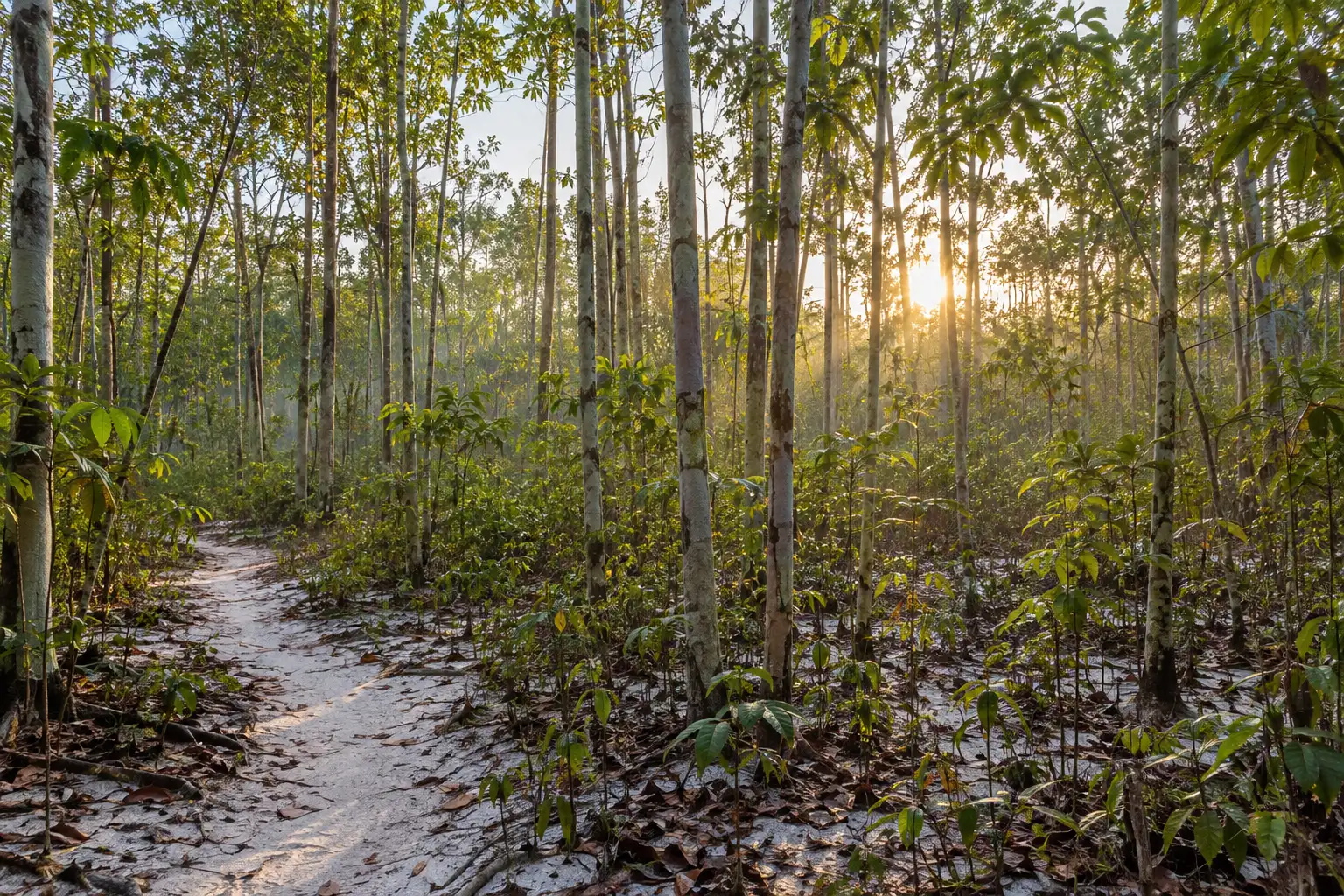
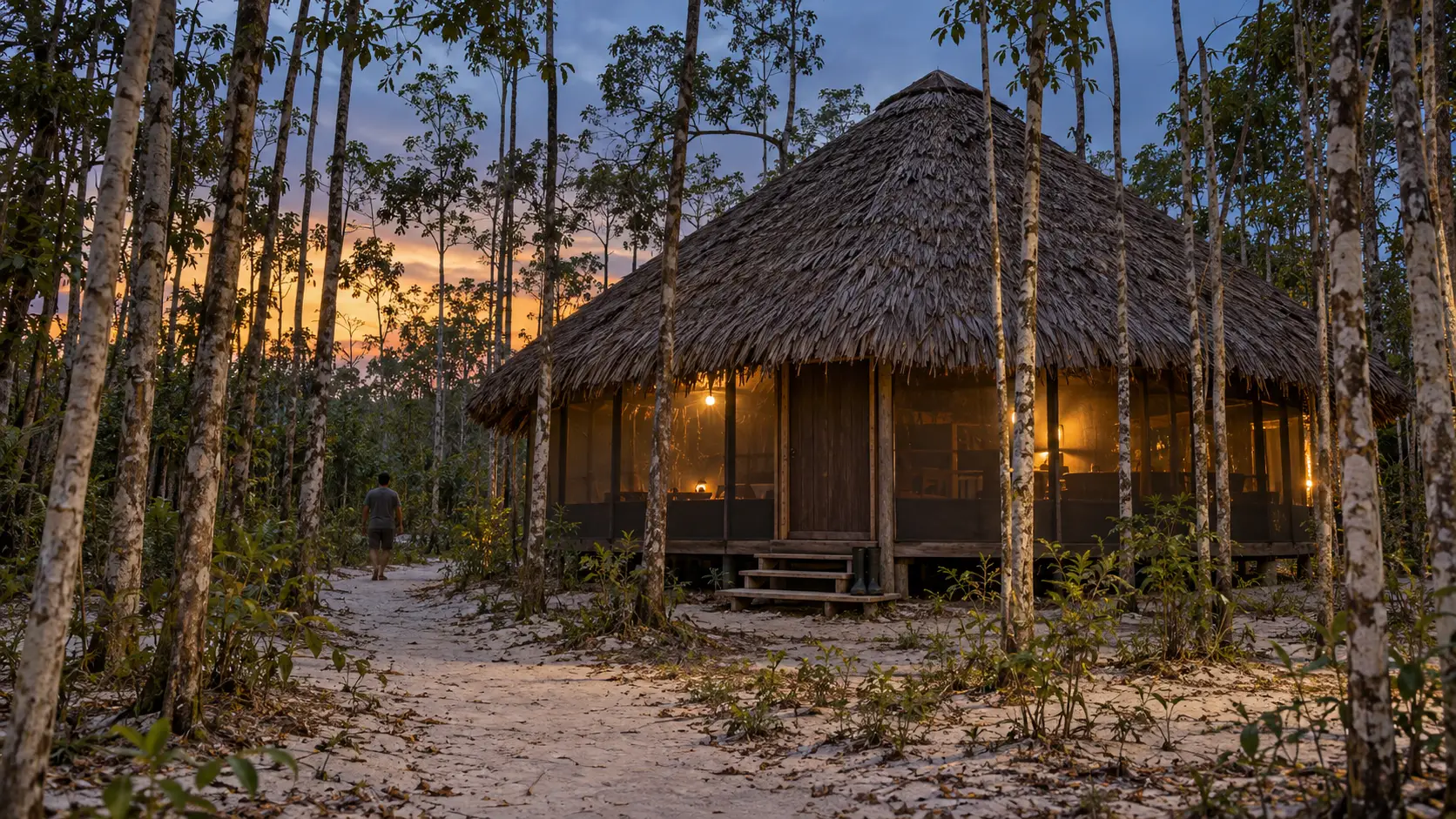
Varillal is a village at km 14 of the Iquitos-Nauta highway, the only road out of Iquitos, and it gave its name to a forest type. Behind the houses the clay gives out and the ground turns to white quartz sand, where the trees grow thin and straight like rods, which is what varilla means. Our ayahuasca retreat center in Varillal sits on a sand track west of the village. 12 guests a week, 4 ceremonies sung by Shipibo maestros, and a physician awake in the maloca on each of those nights. About 25 minutes from Iquitos airport, with no boat.
Terminal to gate by car, with no boat and no second flight.
On the Iquitos-Nauta highway, the only road out of the city, with the sand starting behind the village.
Gate to an Iquitos hospital by car, in every month of the year.
Guests at most, each in a room of their own.
Varillal is a highway village in the San Juan Bautista district, about 14 km south of Iquitos airport. West of the houses the red clay gives out and the ground turns to white quartz sand that holds almost nothing a tree can eat. The trees that manage grow thin and straight, like rods, and the canopy stays low enough for light to reach the ground. People here called it a varillal, a stand of varillas, and botanists kept the word for the whole forest type. The village carries the name of the forest.
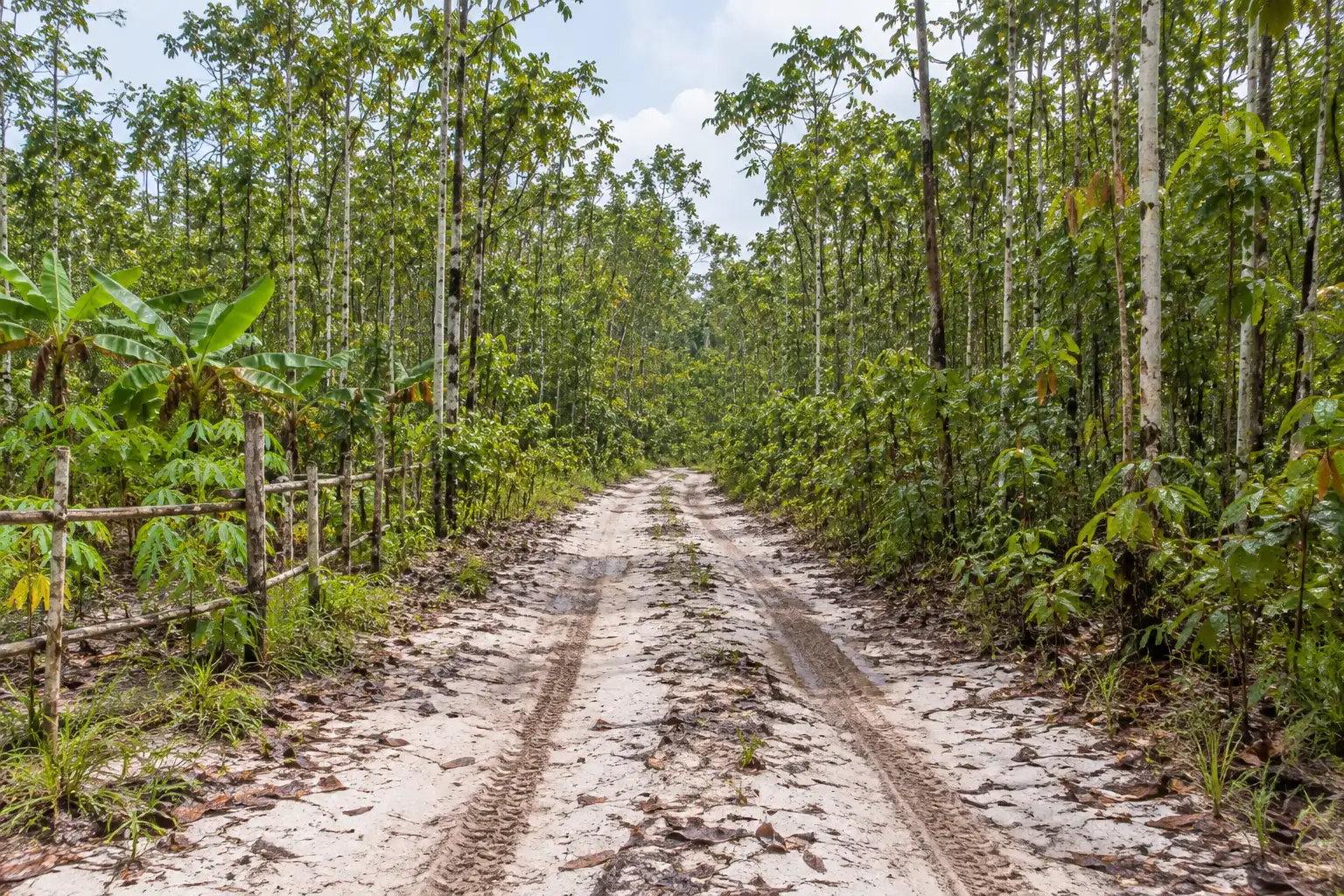
That ground is why we are here. Our property sits about 2 km west of the highway on a sand track, where the small farms stop and the white sand begins. 10 minutes further down the same road, at km 23, the Allpahuayo-Mishana National Reserve begins. It protects 58,069 hectares of varillal and blackwater forest, home to 21 bird species that live in no other forest type. IIAP runs a 2,750 hectare research station inside it at km 26.8. The reserve is not ours and the week does not go into it. It is the reason the forest behind our maloca is worth a page of its own.
Varillal sits at about km 14 of the Iquitos-Nauta road, in the San Juan Bautista district. The school and the houses are on the asphalt. The sand begins behind them, and our track runs west into it.
Even inside Allpahuayo-Mishana, white-sand forest covers about 9% of the area. The rest is flooded forest and upland clay forest. Outside the reserve, IIAP counts more than 8,000 hectares of varillal damaged by sand quarrying.
The Iquitos gnatcatcher, the Allpahuayo antbird and the Mishana tyrannulet are 3 of them. The gnatcatcher’s whole population is thought to be under 100 birds, all within a short drive of our gate.
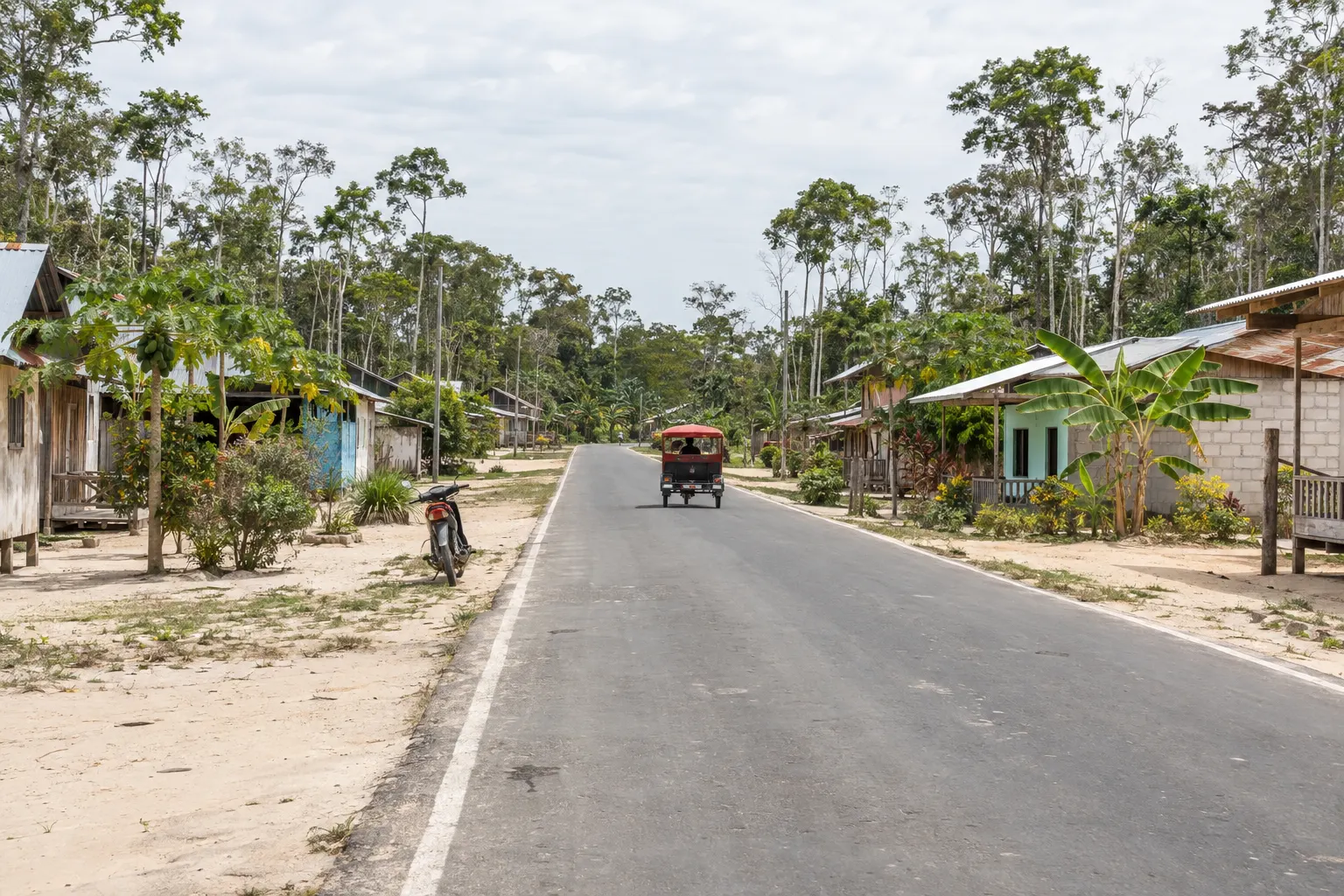
We will not call the varillal sacred. We will not tell you the vine grows on it, because it does not. We will not run the week as a birding tour with ceremonies attached. And we will not hide the highway, the sand quarries or the small farms you pass on the way in. Varillal is a working village on the road, not an Indigenous community, and there is no local ceremonial tradition here for us to borrow. Our maestros are Shipibo, from the Ucayali, and we say so.
02 · Getting here
Iquitos has no road to the rest of Peru, so you arrive by air. It does have 1 road out of itself: about 100 km south to Nauta, paved by the mid 2000s. The airport sits at the city end of it and Varillal is at km 14. From the terminal to our gate is 1 road, 1 village and about 5 minutes of sand.
Connect in Lima. Most international arrivals make a same day connection to Iquitos. If yours lands after the last flight, sleep near Lima airport and fly up in the morning. Your week starts when you land in Iquitos.
The flight. Direct departures run through the day. For the last 30 minutes there is nothing under the wing but forest and brown water.
Collected at arrivals. The terminal is on the southern edge of the city, on the same road that runs south to Nauta. You never cross downtown Iquitos unless you ask to.
Past the lake. The turn for Quistococha, where we run another house, goes by at km 6.5. From here the forest on both sides thins and pales as sand takes over from clay, with farm plots and quarry cuts between the trees.
Through the village, then the sand. Our driver turns west off the asphalt and follows the sand track for about 5 minutes to the gate, about 2 km from the highway. There is no boat, no canoe and no crossing at any point.
Intake. The physician takes your blood pressure and goes through your medications against your file, and you meet your integration lead over a dieta dinner. Nothing else is asked of you until night 2.
A car and driver stay on site every ceremony night, and the physician in the maloca decides when they move. From our gate to a city hospital in Iquitos is about 40 minutes by road. That is 5 minutes longer than Quistococha and 10 shorter than Nueva Esperanza, our other 2 houses on this highway. The sand track adds nothing in the rain, because quartz sand drains almost as fast as the rain falls. No boat is in the chain at any point.
Varillal, in the San Juan Bautista district of Maynas, Loreto, at about km 14 of the Iquitos-Nauta highway and about 120 m above sea level. The white-sand forest lies west of the road, around 3°52′48″ S, 73°21′43″ W. Open in Google Maps
The Iquitos area gets 2,500 to 3,000 mm of rain a year and averages about 26°C, with March usually the wettest month and August the driest. On clay, that means mud for half the year. On the quartz sand behind Varillal, the water is gone within about an hour of the rain stopping, in every month. What changes with the season is the heat, the light and how the paths feel underfoot. The ceremony calendar does not.
| Drier months, June to September | Wetter months, November to April | |
|---|---|---|
| The sand | Pale, dry and hot underfoot by 10 am | Damp for about an hour after rain, then pale again |
| Rain | The lighter months, with August usually the driest of the year | The heavier months, with March usually the wettest |
| Heat | The open canopy reflects the sun back at you. Walks end by 9 am | Cloudier afternoons, still above 30°C most days |
| The dawn walk | Dust-dry paths and the clearest first light of the year | Fresh animal tracks on damp sand, the forest at its greenest |
| Ceremonies | Nights 2, 4, 6 and 7 | Nights 2, 4, 6 and 7 |
04 · In the maloca
Every accepted guest sits all 4 ayahuasca ceremonies. Kambo and Bufo are available to some guests after a separate clearance for each, at no extra cost, so nobody here earns anything by suggesting them.
Dusk to first light, 2 maestros singing, 12 guests at most.
The brew is Banisteriopsis caapi vine with chacruna leaves (Psychotria viridis). Both grow on our chacra, but not on the sand. Neither plant will take root in white quartz, so the chacra sits on the clay terrace at the eastern edge of the property. The maestros cut it within an hour of the maloca and cook it on site. Ceremonies fall on nights 2, 4, 6 and 7.
A 20 to 40 minute purge, fully awake, at least 24 hours from any cup.
The dried secretion of Phyllomedusa bicolor, the giant monkey frog, goes onto small burns on the upper arm. Heat, nausea and a fast pulse for about half an hour, then it passes, with nothing visionary about it. We measure your water instead of loading it. A separate assessment decides whether you can take it.
15 to 20 minutes with 1 facilitator beside you, and hard to describe afterwards.
Synthetic 5-MeO-DMT, never toad venom. Offered on the morning after the last ceremony and only with 2 separate yeses, 1 from the physician and 1 from your integration lead. Anyone who takes it stays 1 more night. First time guests are usually asked to wait for a return visit.
There is no altitude to adjust to and the gate is 25 minutes from the terminal, so none of the first 24 hours goes to recovering from the trip. The rest days stay in the plan anyway. The day after a ceremony is usually when it starts to make sense.
Pickup at arrivals, 25 minutes down the highway, through the village and onto the sand. Intake with the physician before dinner, then an early night.
A walk on the sand paths before the day warms, a plant bath in the afternoon, blood pressure at dusk. The maloca opens at about 9 pm and the maestros close it at first light.
No phone, 1 meal, as much sleep as you need. Your integration lead is around if you want to talk and leaves you alone if you do not.
The maestros have watched you for 2 nights and adjust the dose and the songs to each guest. This is often the night guests describe afterwards.
The 1 walk of the week into the white-sand forest, at the hour the birders come for: cool sand, pale trunks, low sun. Back before 9 am, when the open canopy makes this the hottest forest we run. Guests cleared for Kambo take it later that morning. No ceremony that night.
The room knows itself by now. Most weeks this is the quietest of the 4.
The last night, back to back with the third. The maestros close the week at dawn.
A slow breakfast and an afternoon drive to the terminal, 25 minutes door to door. Guests approved for Bufo take it this morning and leave on day 9.
Book the afternoon flight out on day 8, not the morning one. If your connection into Iquitos is tight, arrive the day before and the driver collects you from your Iquitos hotel. If you want the reserve and its birds, book a guide for the day before you come to us, not the day after. Keep your first 48 hours at home free of plans.
4 people carry the responsibility for your nights at Varillal, and you get all 4 names in writing before any payment. None of them is from Varillal. The maestros travel from Shipibo communities on the Ucayali and are paid their full fee whether the week is full or not.
From Paoyhan, a Shipibo community on the Ucayali, with 31 years singing ceremonies. He leads nights 2 and 7, the first and last ceremonies, and sets the pace for the other singers.
From Nueva Betania, also on the Ucayali, with 26 years of practice. She runs the plant baths and the dieta, and sings on all 4 nights.
From Paoyhan, with 19 years of practice. Second maestro at most ceremonies, and the person guests find on the sand path at sunrise when they need to talk the night through.
Internal medicine, based in Iquitos. Reads every application, runs intake and the checks before each ceremony, and stays awake until the maloca closes. Named to you in writing before you are asked for anything.
07 · Read this first
Nothing on this page is a medical claim. Ayahuasca does not cure depression, PTSD or addiction, and guests who arrive expecting a cure are the ones most likely to leave let down.
Caapi and chacruna want clay. Our chacra is on the terrace at the edge of the property, not in the varillal. Any house on this highway telling you its vine grows in white sand is telling you something about itself.
You pass small farms and sand quarries on the way in, and the highway runs through the village about 2 km from the maloca. Our varillal is intact for an unflattering reason: sand farms nothing. We will not photograph the property as if the road were not there.
When the wind is from the east you can hear a bus or a mototaxi on the highway. At night, when ceremonies run, the road is close to empty. If silence is the whole point, our houses across the Nanay at Padre Cocha and Manacamiri are reached by boat and have no highway within earshot.
A low, open canopy over white sand reflects the sun back up at you. Walks are before 9 am or not at all. Expect afternoons around 31°C and humidity around 80% in every month. If heat is your limit, start with our Sacred Valley house.
About 2 weeks of physician screening and 3 weeks of dieta come before you fly, so your place is rarely less than 5 weeks away. The 7 nights sit inside about 4 months of work, most of it at home.
3 of our Iquitos houses sit on the same road, on 1 protocol, with the same 12 guest cap and the same team. They differ in what grows outside the gate, how long the drive is and what you can hear.
| Varillal · this page | Quistococha | Nueva Esperanza | |
|---|---|---|---|
| From the airport | About 25 minutes, to km 14 | About 15 minutes, to km 6.5 | About 45 minutes, to km 22 and a 5 km track |
| To a hospital | About 40 minutes by road | About 35 minutes by road | About 50 minutes by road |
| The ground | White quartz sand and varillal forest | Forest beside a blackwater lake | High ground between the highway and the Nanay |
| Next door | A highway village, with the reserve 10 minutes further on | The lakeside park with its beach and zoo | A working village beside the Allpahuayo-Mishana reserve |
| Choose it for | The white-sand forest itself, reached by road | The shortest drive and the gentlest logistics | A week inside ordinary village life |
If you are open to water in the trip, Rumococha is a lake house with a short canoe crossing. Padre Cocha and Manacamiri are villages across the Nanay, reached by boat from the port at Bellavista-Nanay. On the Nanay side of the city, Santa Clara de Nanay, Zungarococha and Puerto Almendra are all reached by road. There a river or a lake sits in front of the maloca instead of sand.
09 · What the week includes
The Varillal week is 1 inclusive booking. Your room, the 4 ceremonies, the dieta kitchen, plant baths, physician care, Kambo or Bufo where cleared, both transfers and 12 months of integration calls are all in it. Nothing is for sale on site, and being declined for an optional medicine changes nothing about what you paid.
Nothing is charged until the physician has confirmed your place. After that you pay at once or across 3 or 6 months. Flights, travel insurance and any night in Lima are yours to arrange. Choose a policy that refunds a cancellation on medical grounds, because sometimes the medical grounds are ours. Ask for the current rate and the open weeks when you write.
10 · Questions
Free to apply · a reply within 48 hours
The physician reads your application first. If Varillal is wrong for your health, your dates or your tolerance for heat, the reply says so and names the house or the week that suits you better.