01
Maestro Rono Meni
From Paoyhan on the Ucayali, 31 years in the work. Opens the week with the first ceremony and closes it with the fourth, and sets the pace the other 2 follow.
San Juan Bautista district, Loreto · Lake Zungarococha, Nanay basin · About 100 m
Zungarococha is a blackwater lake on the right bank of the Nanay, 20 minutes by road from Iquitos airport, with a village of about 800 people on its shore and the national university’s campus on the road behind it. Our ayahuasca retreat center in Zungarococha sits on the lake beyond the last houses: 12 guests, 4 ceremonies in 7 nights, Shipibo maestros, a physician awake through every ceremony, and a road rather than a river between you and a hospital.
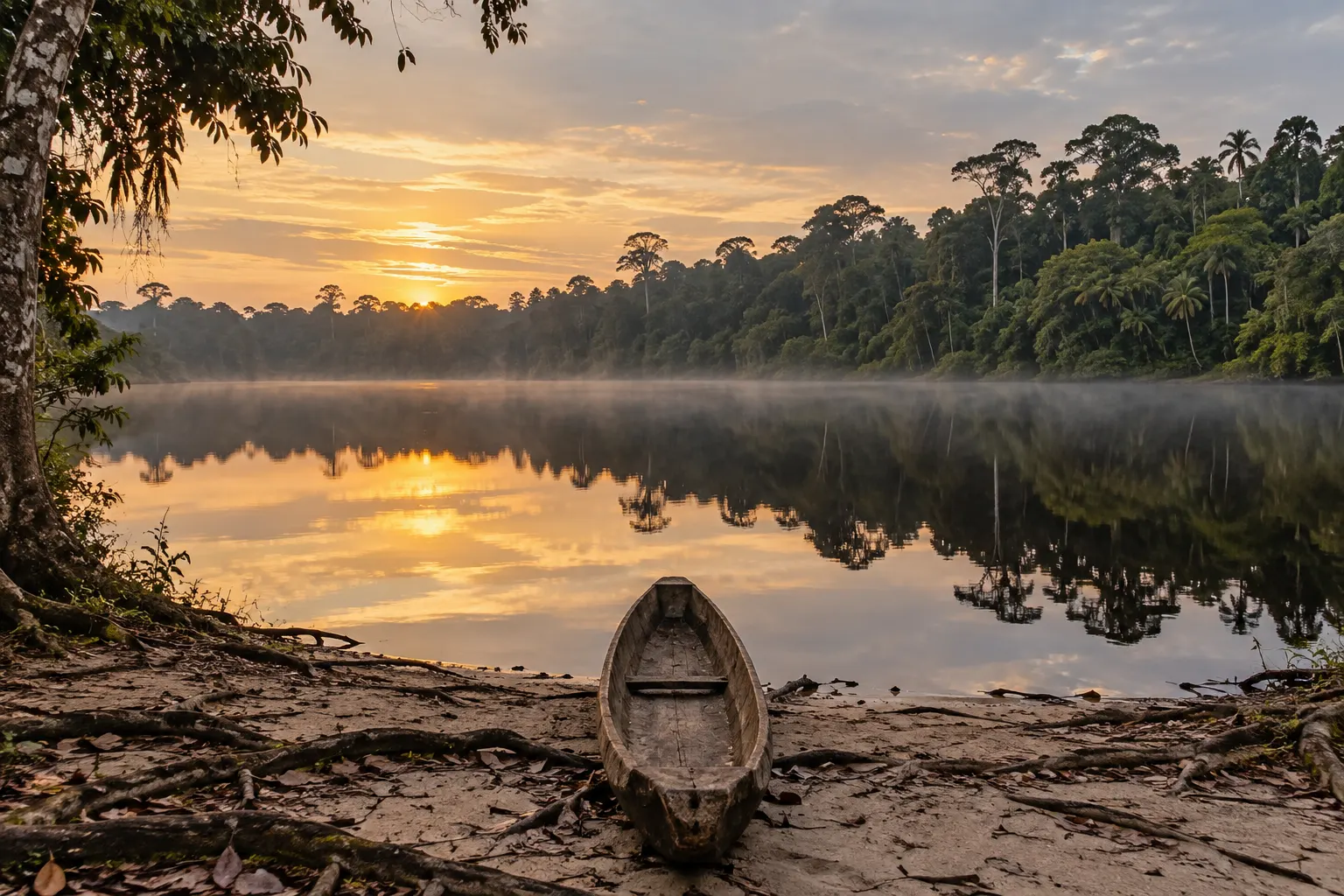
From the arrivals hall to the lake, by road, no boat.
People in the village of Zungarococha, founded in 1965.
Guests per week, with 2 maestros in the maloca every ceremony night.
Of university teaching forest 5 km further along the same road.
Lake Zungarococha lies southwest of Iquitos in the San Juan Bautista district of Maynas province, on the right bank of the Nanay, the blackwater river that meets the Amazon at the north edge of the city. The water is dark with tannin and still, and the name records what used to fill it: zungaro, the big river catfish, and cocha, the Quechua word for a lake. The village on the shore was founded in 1965 and has about 800 people. The lake rises and falls with the Nanay, so its edge moves by metres across the year.
What makes it unusual for a retreat is who else is on the road. The Zungarococha road leaves km 5.5 of the Iquitos-Nauta highway and runs 11.5 km southwest over sand, under tall trees, to Llanchama, where it ends at the Nanay. Along it sit the university city of the Universidad Nacional de la Amazonía Peruana, the village, the cold creek at Corrientillo, and at Puerto Almendra the university’s forest research and teaching center: 1,300 hectares of natural forest and plantations with the El Huayo arboretum inside it. The forest here is studied rather than cleared, and the road is shaded for most of its length.
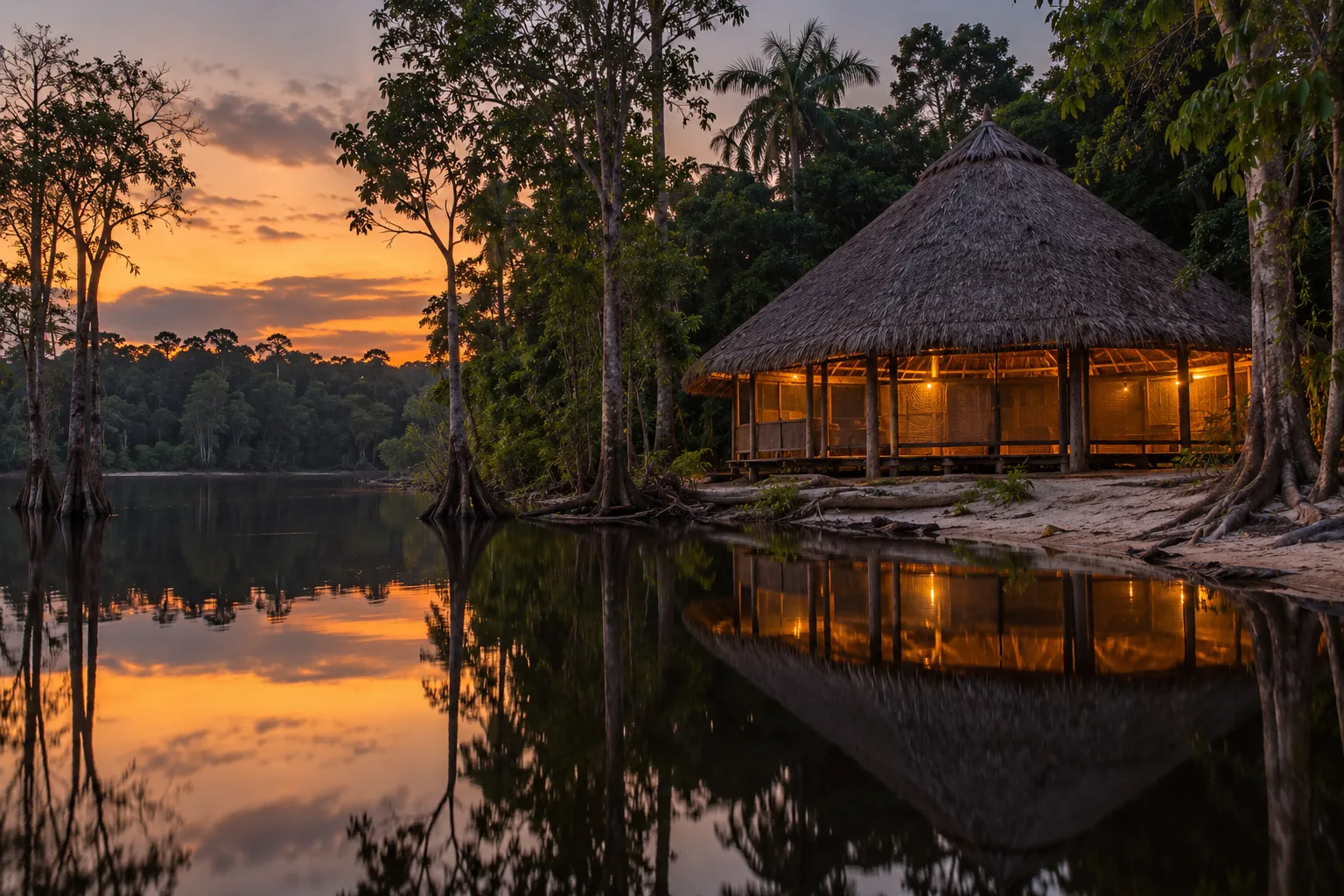
Our ayahuasca retreat center in Zungarococha is on the lake beyond the last houses of the village, reached by the same road and then a short track down to the water. The maloca and the guest rooms face the lake. Nobody arrives by boat and nobody leaves by one. The village, the campus and the weekend swimmers are all back along the road from us, which matters on a Saturday afternoon and not at all at 2 in the morning on a ceremony night.
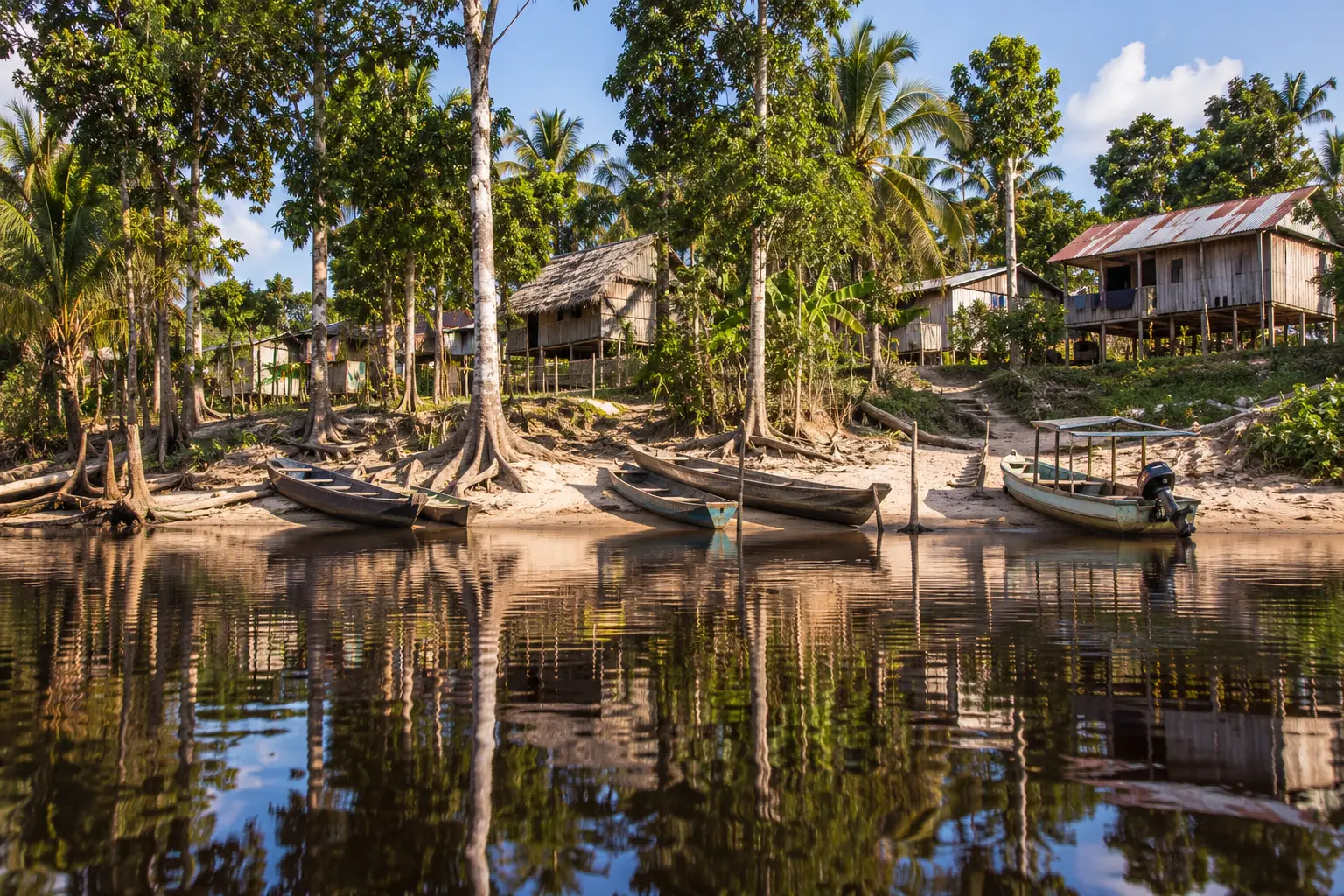
The university is a neighbour, not a partner. We do not take guests into its buildings or its forest, and no student has anything to do with the week. It shapes the place in 2 ways you will notice: the road carries vans and motocarros on weekday mornings and afternoons, more than a village road would, and the forest along it is older than most land this close to Iquitos because it has been kept for research and teaching rather than cleared for plots. If you want a river between you and every other person, our houses at Padre Cocha and Manacamiri give you that, and we will book you there.
02 · The road in
Iquitos has no road to the rest of Peru, so every guest arrives by air. From the terminal, the way to our ayahuasca retreat center in Zungarococha is 1 highway and 1 forest road, and all of it can be driven at 3 in the morning in any month of the year.
Direct flights leave Lima through the day, and most guests connect from an international arrival the same afternoon. If your inbound lands late, sleep in Lima. The week does not need to start tired, and the first ceremony is not until night 2.
Our driver meets you at arrivals with your name and your file. The car turns south onto the Iquitos-Nauta highway and leaves it at km 5.5, at the large sign for the Zungarococha road, with the only golf course in the Peruvian Amazon 500 m further on at km 6.
The road is a sandy carriageway with tall trees on both sides, which is why the heat drops the moment you leave the highway. The university city is on this stretch. The village and the lake come up within the first kilometres, and our track leaves the road past the last houses.
Blood pressure and medications checked against your file by the physician, an introduction to your integration lead, a meal from the dieta kitchen, and an early night with the lake outside the screen. Nothing on day 1 is rushed.
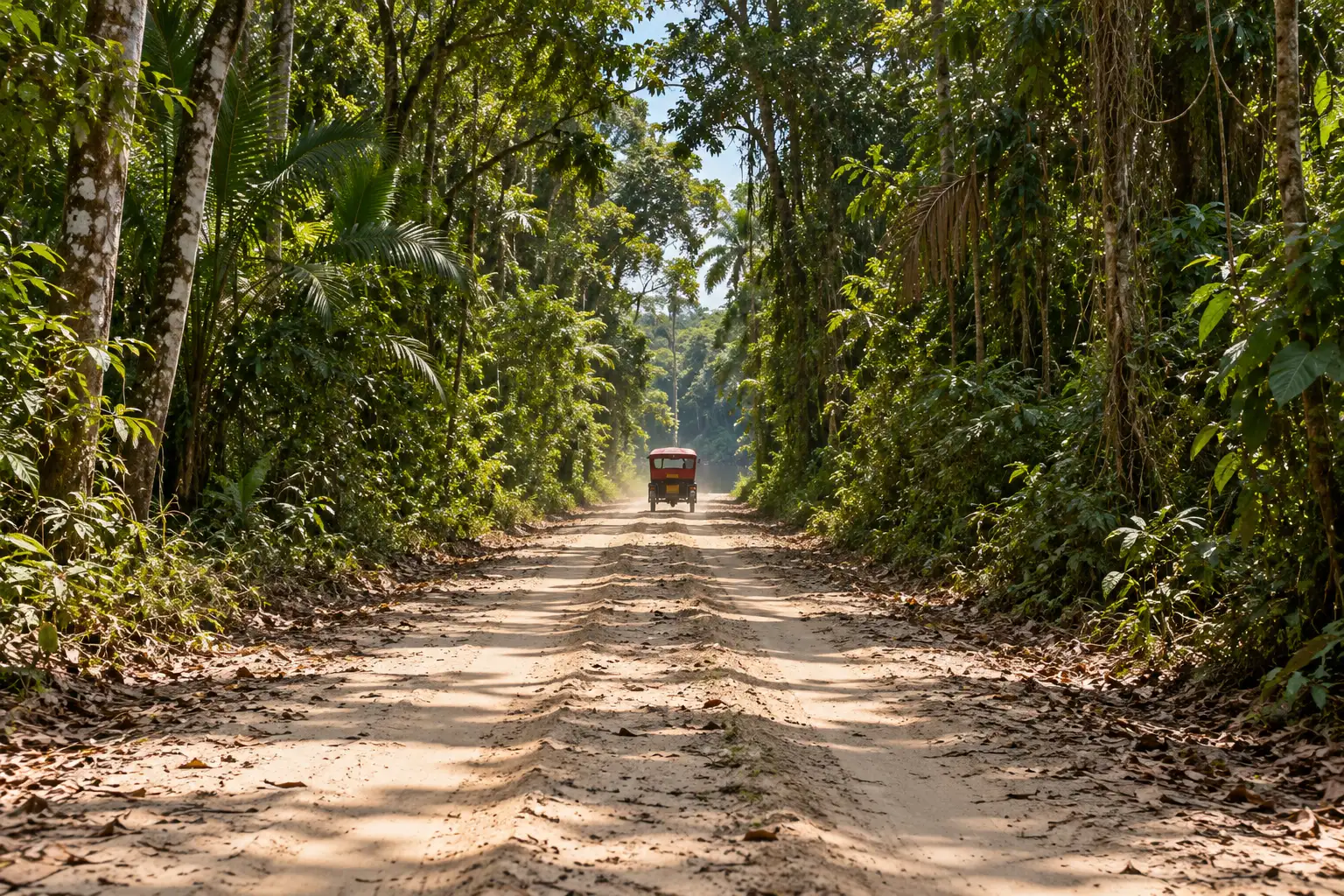
About 40 minutes by road from our gate to a city hospital in Iquitos, in any weather and at any water level. A vehicle and a driver stay at the property on every ceremony night. There is no launch, no boatman to wake and no river to read in the dark. Rumococha, our other lake house, has a shorter number on paper, about 35 minutes, with a canoe crossing inside it. Santa Clara de Nanay is the same 40 minutes with a beach village next door. We publish the number for every house because it is the one a family asks about.
Lake Zungarococha, San Juan Bautista district, Maynas province, Loreto, at about 3°49′ S, 73°22′ W: on the right bank of the Nanay, just over 10 km from Iquitos airport by the Zungarococha road, which leaves the Iquitos-Nauta highway at km 5.5. Open in Google Maps
Zungarococha is fed by the Nanay and the Nanay is fed by the Amazon, so the lake breathes with the river. It spreads into the trees from December to June and shrinks back to a dark, still pool with a rim of sand from July to November. Neither is the better week. They are different weeks, and the 4 ceremony nights are fixed in both.
| Low water · July to November | High water · December to June | |
|---|---|---|
| The lake | Drops by metres, clears at the edges, and the still surface at first light is the one guests photograph | Rises into the forest behind the shore and joins the flooded ground along the Nanay |
| The shore | Sand and exposed roots, the canoe pulled up below the maloca | Trees standing in water, the canoe tied to the steps |
| Swimming | From our shore, early morning, before any ceremony day begins | From the steps, in still water, with flooded trees around you |
| Corrientillo | The cold creek 1 stop along the road runs low and clear, and the stalls by its lagoon sell the regional dishes | Higher and faster. We leave it out of rest days |
| The road | Sand, dry, dusty by afternoon, open | Sand, wet in places, slower after a storm, open in every month |
| The nights | Drier, more stars, frogs at the water’s edge | Rain most days, insects at full volume, the lake close enough to hear from your room |
| Ceremonies | 4, on nights 2, 4, 6 and 7 | 4, on nights 2, 4, 6 and 7 |
A guest in September and a guest in April sleep in the same room, sit with the same maestros, and describe 2 different lakes.
04 · The 7 nights
With the airport 20 minutes away and no altitude to adjust to, the week at Zungarococha begins on the evening you land. Everything below happens inside 7 nights, and the ceremony nights do not move.
Collected from the airport, 20 minutes of road, intake with the physician, dinner, and a night with the lake outside the screen. No ceremony.
A slow morning on the shore, a plant bath after lunch, blood pressure checked before dusk. The ceremony opens at 9 and the maestros sing until the light comes up across the water.
The night after a first ceremony is where most guests work out what happened. Sleep late, eat once, talk to your integration lead if you want to, and leave the phone in the safe.
The maestros have now sat with you once and adjust the cup and the icaros per person. This is usually the night guests describe when they write to us months later.
The lake is at its quietest in the first hour of light, and the canoe goes out before the heat for anyone who wants it. Kambo runs the same morning for guests with a separate clearance, always more than 24 hours from a ceremony. The evening is empty on purpose.
By now the maloca is quieter than on night 2, the group knows itself, and the maestros work with less volume and more precision.
The last ceremony tends to make sense of the other 3. It closes at dawn with the maestros, and the day that follows is slow by design.
Bufo happens only when the physician and your integration lead agree separately, and guests who take it stay 1 more night. Everyone else is driven back to the terminal for an afternoon flight.
Take the afternoon departure on day 8, not the morning one. If your connections are tight, arrive in Iquitos the day before your week and we will collect you from your hotel instead of the airport. Keep the first 2 days after you get home free of anything that matters.
All 3 are covered by the 1 price, which removes any reason for us to sell you the second or third. Each has its own page with the pharmacology, the risks and the reasons we say no.
Caapi vine and chacruna leaf from the Nanay basin, cut and cooked on the property within an hour of the maloca by the maestros who serve it. Drunk after dark, 5 to 6 hours, the icaros almost without pause. The physician clears you, checks you before each cup, and stays awake in the room until the last guest is asleep.
The secretion of the giant monkey frog, applied to small burns on the skin for 20 to 40 minutes. It is not psychoactive and it is not pleasant. At Zungarococha it runs on the rest morning of night 5, never within 24 hours of ayahuasca, and we measure your water rather than pushing it.
Synthetic 5-MeO-DMT, 1 guest with 1 facilitator, only on the morning after the fourth ceremony, and only when the physician and your integration lead each say yes without consulting the other. First-week guests are usually asked to come back for it.
06 · Screening
A physician reads every application before a place is offered, about 1 in 5 is declined, and the reason arrives in writing. Screening takes about 2 weeks. The road at Zungarococha changes 1 part of that decision: where the physician draws the line for guests who are cleared with conditions.
A hospital 40 minutes away is not a reason to loosen the screening. It is a reason to be exact about it. Being declined costs nothing, because nothing is charged until the physician confirms your place, and a declined application often comes back as a later date with a taper plan attached.
The Shipibo maestros travel from their communities on the Ucayali for every week we run. They are paid their full fee and their travel whether 4 guests come or 12. Ask any center you are comparing us with the same question, and ask for the names.
From Paoyhan on the Ucayali, 31 years in the work. Opens the week with the first ceremony and closes it with the fourth, and sets the pace the other 2 follow.
From Nueva Betania, 26 years in the work. Runs the plant baths and the dieta side of the week, and sings in the maloca alongside the maestros on ceremony nights.
Also from Paoyhan, 19 years. Second maestro in most ceremonies, and the one guests find on the shore at first light, willing to talk about what the night was.
An internal medicine doctor from Iquitos. Reads your application, runs intake on the first evening, checks you before every cup, and does not sleep while the maloca is open. Named to you in writing before we ask you for anything.
A campus next door means students on the shore.
The campus is on the road, not on our shore. Classes run in daylight, the vans leave by early evening, and the university’s forest is 5 km further along the road at Puerto Almendra. On a ceremony night the only people on our land are the 12 guests, the maestros, the physician, the driver and the kitchen.
Blackwater means dirty water.
It means tannin. The Nanay and its lakes run dark the way tea does, from leaf litter, and the water is low in sediment and acidic, which is part of why blackwater shores carry fewer mosquitoes than whitewater ones. It is the same river our Padre Cocha and Bellavista-Nanay houses sit on. Guests swim in it from our shore on rest mornings.
20 minutes from an airport cannot be real forest.
The road runs under tall trees, and 5 km on there are 1,300 hectares kept for research. What you give up is silence on a Sunday afternoon, when Iquitos families come out to swim and fish in the lake. Ceremony nights are ours, and the campus and the village are quiet by then.
Ayahuasca will sort out my depression.
We do not claim that, and we will not let you arrive believing it. Ayahuasca is not a treatment for any condition. Guests do report lasting change; the peer reviewed evidence is early and we quote its limits. Arrive expecting a cure and the week tends to go badly.
I can be there next month.
Not with us. Screening takes about 2 weeks and the dieta starts 3 weeks before you fly. The earliest realistic date is 5 to 6 weeks from the day you apply.
Same maestros, same physician policy, same 12 guest limit and the same price at every one. They differ in where the water sits and whether a boat is part of the week. Read the line that describes you and go to that page. If you are unsure, write to us and we will name the house, even when it is not this one.
10 · Price
The figure is the same at every house we run, so the road, the physician and the year of integration are not extras here and are not discounted elsewhere. Nothing is charged until the physician has confirmed your place, and a payment plan over 3 or 6 months is available once a place is offered.
Not included: flights and travel insurance. Buy insurance that pays out for cancellation on medical grounds, because if our physician declines you after you have booked flights, the refund you need comes from the insurer, not from us.
With 2 maestros in the maloca and the physician awake until the last guest is asleep.
Screened, with a net, facing the water. Nobody shares, at any price.
3 weeks of guidance before you fly, 7 days of cooking on site, 1 week of follow-up, with a nutritionist.
Application review, intake, pre-cup checks, and a doctor in the room on 4 nights.
No charge either way, so we have no reason to recommend them.
Both directions, by road, 20 minutes each way. No port, no boatman, no tip.
Baths cut from the garden each morning they are given. The canoe on rest mornings, with a life jacket, before the heat.
Monthly calls at first, then quarterly, from an integration lead who calls you rather than waiting to be chased.
1 in 5 applicants get one. It costs nothing, and it often comes with a later date.
11 · Questions
No charge to apply · reviewed within 48 hours
Then ask who reads your medical file, how the maestros are paid, and how often we say no. Put the same 4 questions to every center you are considering. At Zungarococha the answers are 40 minutes, no boat, a named physician, full fee and travel, and 1 in 5.