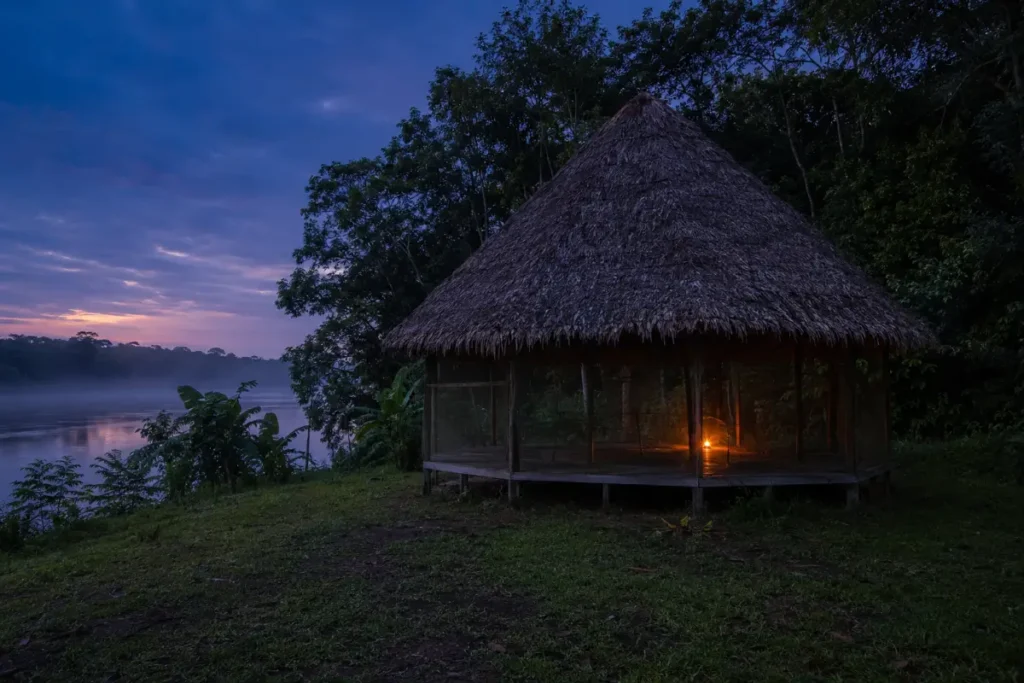
Ayahuasca vs ibogaine safety comes down to 2 different failure modes. Ibogaine’s danger is cardiac and needs an ECG, bloodwork and continuous monitoring. Ayahuasca’s danger is a drug interaction and needs your antidepressants cleared before you drink. Both are screenable. What decides your outcome isn’t the plant. It’s whether the center will turn you away.
Neither failure is really about the molecule, and that is the part the rest of this field gets wrong.
We turn away 13% of the people who apply to our Iquitos center. Another 5 to 8% get a conditional yes and never meet the conditions. So roughly 1 in 5 people who ask to come never sit in our maloca.
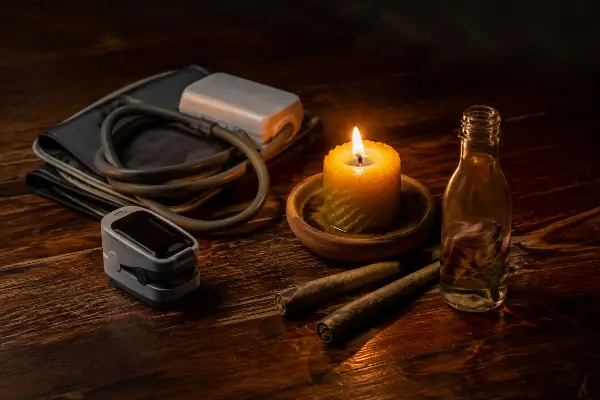
Which is safer, ayahuasca or ibogaine?
On the raw risk profile, ayahuasca. Ibogaine carries a cardiac risk that ayahuasca does not, and it needs hospital-grade monitoring that ayahuasca does not. But “safer” and “better for you” are different questions, and the second one matters more.
Here’s the part worth reading twice. In 2023, a team led by Juliana Rocha at the University of São Paulo published guidelines for both medicines in the journal Psychoactives. It’s the only peer-reviewed paper I know of that sets the screening requirements for ayahuasca and ibogaine side by side. What it describes isn’t 2 different levels of danger. It’s 2 different jobs a center has to do, and almost every serious problem in this field comes from a center that didn’t do its job.
Ibogaine and ayahuasca fail in completely different ways
They share almost no failure mode, which is why comparing them on a single safety scale is misleading.
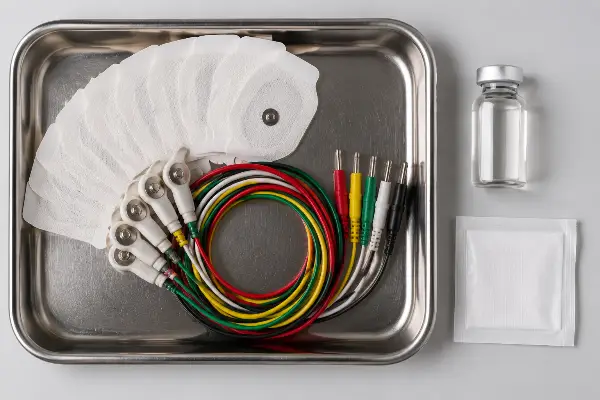
Ibogaine’s risk is cardiac
Ibogaine prolongs the QT interval, which is the part of your heartbeat where the ventricles reset. Stretch it far enough and the rhythm can break down. The Rocha guidelines call for liver and kidney panels, a complete blood count, electrolytes, an ECG, and in some cases a stress echocardiogram or a 24-hour Holter monitor before anyone doses. They recommend continuous monitoring for at least 72 hours afterwards. Not overnight. 3 days.
That’s not a retreat. That’s an inpatient medical procedure, and any place offering ibogaine without that setup is doing something different from what the literature describes.
Ayahuasca’s risk is pharmacological
Ayahuasca’s risk lives in a drug interaction. The caapi vine contains beta-carbolines that act as monoamine oxidase inhibitors. That inhibition is what makes the brew active when you swallow it at all. The NIH’s StatPearls reference lists SSRIs, SNRIs, tricyclics, bupropion, mirtazapine, St. John’s wort and stimulants among the drugs contraindicated with MAOIs, along with tramadol, meperidine, dextromethorphan and methadone. The reason is serotonin syndrome, which that same reference calls potentially life-threatening.
There’s a second layer people miss. The MAOI action is also why the pre-retreat diet exists, and why tyramine matters in the 2 weeks before you fly.
Beyond the interaction, most of what ayahuasca does to you is unpleasant rather than dangerous. The Global Ayahuasca Survey, published by José Carlos Bouso and colleagues in PLOS Global Public Health in 2022, surveyed 8,216 people on physical adverse effects. Roughly 70% reported at least one. 62% reported vomiting or nausea. Of everyone who reported a physical effect, 2.3% needed medical attention.
That 2.3% is the number I’d want if I were choosing. It’s not zero. It’s also not the thing the internet is afraid of.
| Ayahuasca | Ibogaine | |
|---|---|---|
| Primary risk | Drug interaction, serotonin syndrome | Cardiac, QT prolongation |
| Required before dosing | Psychiatric screening, medication washout | ECG, bloodwork, electrolytes, liver and kidney panels |
| Monitoring after | Facilitator present through the night | Continuous, 72 hours minimum |
| Shared exclusions | Psychosis, bipolar, family history of schizophrenia, pregnancy | Same |
| Setting | Ceremonial, group | Clinical, supine, one patient |
| Most common adverse effect | Vomiting, roughly 62% | Cardiac rhythm changes |
What does real screening look like in 2026?
It looks like a process that can reject you, run by someone who loses money by rejecting you.
Ours runs in 5 steps. You fill in a long medical form. Dra. Carmen Ríos Medina, our medical director, reviews every single one inside 72 hours. Then David Park, our senior facilitator, does a 30 to 45 minute video call with every applicant, no exceptions. Flagged applications get discussed by all 3 of us. Then you get a yes, a conditional yes, or a no.
David has rejected people who submitted clean paperwork. A form can’t show you that someone is manic, dissociating, or lying. A conversation can.
The Rocha guidelines and our own list overlap almost exactly on the psychiatric exclusions: personal or family history of psychosis, bipolar disorder or schizophrenia, pregnancy, and unstable psychiatric conditions on active medication. That convergence isn’t a coincidence. Both lists were built from the same failure modes.

What we turn people away for
We have 15 automatic disqualifications. Schizophrenia or schizoaffective disorder. Any history of psychosis. Bipolar I. A parent or sibling with schizophrenia or psychosis, if you’ve never worked with a psychedelic before. Current lithium, which is absolute and has no exceptions. Current pharmaceutical MAOIs. SSRIs or SNRIs without a completed 6-week taper. Uncontrolled cardiac conditions. Uncontrolled hypertension. Pregnancy. Active suicidal ideation with a plan. Active psychotic symptoms. Severe eating disorders with medical instability. Stimulant use inside 30 days. Some seizure disorders, case by case.
Depression, PTSD, anxiety and addiction history are not on that list. They’re the reason most of our guests come. They just get more review, not less.
Do you have to stop your antidepressant?
Yes, and the timeline depends on the drug, not on how you feel.
SSRIs need a minimum 6 weeks off before ceremony. Fluoxetine needs 8, because it clears so slowly. SNRIs need at least 6 and often longer. ADHD medication needs 2 weeks. Tramadol, 2 weeks. St. John’s wort, 2 weeks. 5-HTP, 1 week. Benzodiazepines are case by case, because benzo withdrawal is dangerous on its own and has to be run by a physician.
We won’t ask you to stop a medication without your own doctor involved. Dra. Ríos talks to your prescriber directly when it’s needed and signs off before your spot is confirmed. If your physician thinks the taper is unsafe, you don’t come that cycle.
The mistake I see every few months is someone whose doctor said 2 weeks would be fine. They arrive with brain zaps and emotional whiplash on top of pre-ceremony nerves, and the medicine lands on a nervous system that’s already unstable. It doesn’t hurt them. It wastes their trip.
What happens when something goes wrong at 2 AM?
Someone is already within arm’s reach, and there are 3 tiers above that.
Most nights, what goes wrong is fear. A facilitator kneels beside the mat, makes verbal contact, and stays. A healer comes and sings directly to the person. 10 to 20 minutes usually moves them through it. That’s normal and it happens at every retreat.
The tier above that is medical. Dra. Ríos is physically on the property for every ceremony night, awake, with her kit. She’s been called to assess a guest 6 to 8 times in 9 years for a racing heart, extreme panic or prolonged dissociation. All were handled on site.
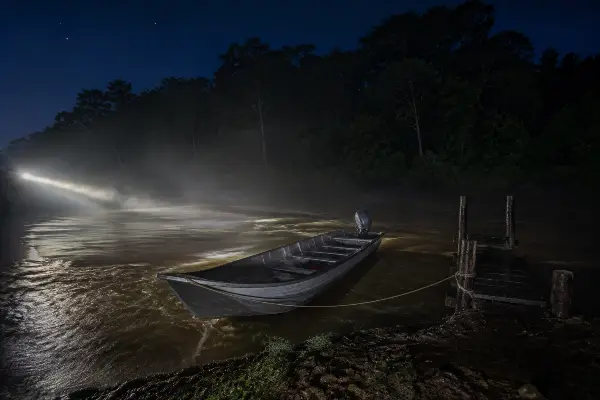
The tier above that is evacuation. A fast launch sits at our dock with an operator sleeping on it during every ceremony block, because there is no road here. Hospital Regional de Loreto is about 45 minutes downriver. We’ve run that plan twice.
In 2018, a guest with an undisclosed heart condition developed chest pressure during ceremony. We took the boat down in the dark. He recovered fully. That night is why we now ask cardiac screening questions and require ECG documentation for anyone over 50, and it’s why I stopped describing this place as a retreat center and started describing it as a medical operation with a maloca attached.
In 2022, a guest developed acute psychosis about 90 minutes in. Dra. Ríos gave intramuscular diazepam, he stabilized in 20 minutes, and we evacuated at dawn. He recovered fully. He’d left his father’s schizophrenia diagnosis off his application because he didn’t think it was relevant. Family psychiatric history became a required disclosure the following month.
Both times, the thing that caused the emergency was information we didn’t have. That’s what screening is for, and that’s why it fails the way it fails.
Why a clean record is not the same as a low risk rate
Across 9 years, 1,900 guests and 650-plus ayahuasca ceremonies, we’ve had 2 evacuations and no deaths.
I want to be careful with that number, because centers use numbers like it dishonestly. One center’s record is not a risk rate. Our sample is small, our screening removes the highest-risk people before they ever arrive, and any place that has been open long enough will eventually have a bad night. A spotless record across many years means the center is young, is selective, or isn’t telling you everything. Ours is the middle one, and I’d rather say that plainly than let you read it as a guarantee. Almost every protocol we run came out of how this place began, and out of 2 nights that went wrong.
What the record does tell you is that the protocol has been tested. Twice it was tested hard.
The safer medicine is not always the better choice
This is where I’ll disagree with most of my own industry.
Ayahuasca has the lower risk profile. It also does nothing measurable for a meaningful share of people. We’ve collected PHQ-9 and PCL-5 scores from every guest since 2021, and among the 290 with complete 3-month follow-up, 70% showed sustained improvement, 14% showed no significant change, and 16% improved and then partially slid back. So about 30% of the people who fly here, prepare for weeks and sit through 4 ceremonies do not have a measurably better score 3 months later.
Ayahuasca also does not touch physical opioid withdrawal. If you’re in acute withdrawal right now, the lower-risk medicine is the wrong tool, and picking it because it looks safer is how people lose 6 months.
There’s real evidence behind ayahuasca for depression. A randomized placebo-controlled trial led by Fernanda Palhano-Fontes, published in Psychological Medicine in 2019, found a 64% response rate against 27% for placebo, in people with treatment-resistant depression. The sample was 29 people. That’s a real finding and a small study, and anyone who quotes it without the sample size is selling you something. We break down what the wider evidence actually supports in our guide to the benefits of ayahuasca, including the parts that don’t hold up.
So the question isn’t which medicine is safer. It’s which risk you need to take to get where you’re going, and whether the place taking it with you has earned that.
The 5 questions to ask any center, including this one
Don’t start with reviews. A 5-star review tells you somebody had a good night. It tells you nothing about what happens when a guest stops breathing at 2 AM.
Ask these instead:
- Who provides medical cover during ceremony, what are their credentials, and how far is the nearest hospital?
- What percentage of applicants do you reject, and what are your automatic disqualifications?
- What is your medication taper policy, and who supervises it?
- What is the staff-to-guest ratio inside the ceremony space?
- Has anyone ever been evacuated, and what changed afterwards?
Our answers, in order. Dra. Carmen Ríos Medina, MD, trained at the Universidad Nacional de la Amazonía Peruana with 18 years in tropical and emergency medicine, on the property every ceremony night, 45 minutes from Hospital Regional de Loreto by fast launch. 13% rejected outright, with the 15 disqualifications listed above. Tapers by drug class, supervised jointly by Dra. Ríos and your own prescriber. 3 healers and 2 facilitators for a maximum of 10 guests, so 1 staff member for every 2 people in the room. 2 evacuations, both described above, both of which changed the protocol.
There’s no licensing body for ayahuasca centers. Peru recognised the tradition as cultural heritage in 2008, and ayahuasca’s legal status there is why this work can happen openly, but recognition is not regulation. No inspector is coming. That absence is exactly why published screening data should carry the weight a license would, and why you should ask.
If you want to see the mechanics of a night before you decide, our hour-by-hour breakdown of an ayahuasca night walks through what happens and when. Our 10-day ayahuasca retreat page has the screening form, and every applicant gets a real conversation before anyone takes a deposit. If you’d rather ask a question first, that works too.
Ayahuasca vs ibogaine safety comes down to one thing in the end. Both medicines are manageable with the right screening and dangerous without it. Pick the medicine that fits the problem, then pick the place that will tell you no.
This article is for educational purposes and is not medical advice. Ayahuasca and ibogaine both carry serious risks outside properly screened and supervised settings. Talk to a qualified physician before pursuing either, especially if you take prescription medication or have any cardiac history.
FAQs
Is ayahuasca safer than ibogaine?
On the raw risk profile, yes. Ibogaine prolongs the QT interval and carries a cardiac risk that ayahuasca does not, which is why the 2023 Rocha guidelines in Psychoactives call for an ECG, bloodwork and at least 72 hours of continuous monitoring before and after an ibogaine dose. Ayahuasca’s main danger is a drug interaction, which a medication washout removes. But the lower-risk medicine is not automatically the right one for your problem.
What is the main safety difference between ayahuasca and ibogaine?
Ibogaine’s risk is cardiac and ayahuasca’s is pharmacological. Ibogaine needs hospital-grade cardiac monitoring. Ayahuasca needs your antidepressants fully cleared, because the caapi vine acts as a monoamine oxidase inhibitor and NIH StatPearls lists SSRIs, SNRIs, St. John’s wort and tramadol among the drugs contraindicated with MAOIs due to serotonin syndrome risk.
Do I have to stop my antidepressant before an ayahuasca ceremony?
Yes. We require a minimum 6-week taper off SSRIs and SNRIs, and 8 weeks for fluoxetine because it clears slowly. ADHD medication, tramadol and St. John’s wort need 2 weeks. Benzodiazepines are handled case by case because benzo withdrawal is dangerous by itself. Every taper is supervised jointly by our medical director and your own prescriber.
Who should not drink ayahuasca?
We have 15 automatic disqualifications, including schizophrenia or schizoaffective disorder, any history of psychosis, Bipolar I, current lithium use, current pharmaceutical MAOIs, uncontrolled cardiac conditions, uncontrolled hypertension, pregnancy, active suicidal ideation with a plan, and stimulant use inside 30 days. The 2023 Psychoactives guidelines list the same core psychiatric exclusions for both ayahuasca and ibogaine.
How common are side effects from ayahuasca?
Common, and mostly not dangerous. The Global Ayahuasca Survey published in PLOS Global Public Health in 2022 asked 8,216 people about physical adverse effects. Around 70% reported at least one and 62% reported vomiting or nausea. Of those reporting a physical effect, 2.3% needed medical attention.
What percentage of applicants does a retreat center reject?
Most centers do not publish this, which tells you something. We reject 13% outright, and a further 5 to 8% receive a conditional acceptance and never meet the conditions, usually because they will not complete a medication taper. So roughly 1 in 5 people who apply here never attend.
What happens if there is a medical emergency during ceremony?
Our medical director is on the property and awake for every ceremony night, and a fast launch sits at the dock with an operator on it, because there is no road access. Hospital Regional de Loreto is around 45 minutes downriver. In 9 years, 1,900 guests and 650-plus ayahuasca ceremonies we have run that evacuation twice, in 2018 and 2022, and both guests recovered fully.